America Leaves Iraq on Wednesday. Iran Stayed.
After 23 years, the last US troops leave Iraq by September 30 — in the middle of a US-Iran war. OPEC's second-largest producer now exports crude at Tehran's discretion. Here's the math, and what it means for oil.

The Iraqi government has declared Wednesday and Thursday public holidays. The official theme, according to the prime minister's office: "Days of Sovereignty." Billboards have gone up in Baghdad showing a hand turning a page, with the slogan "reclaiming the decision and building the home."
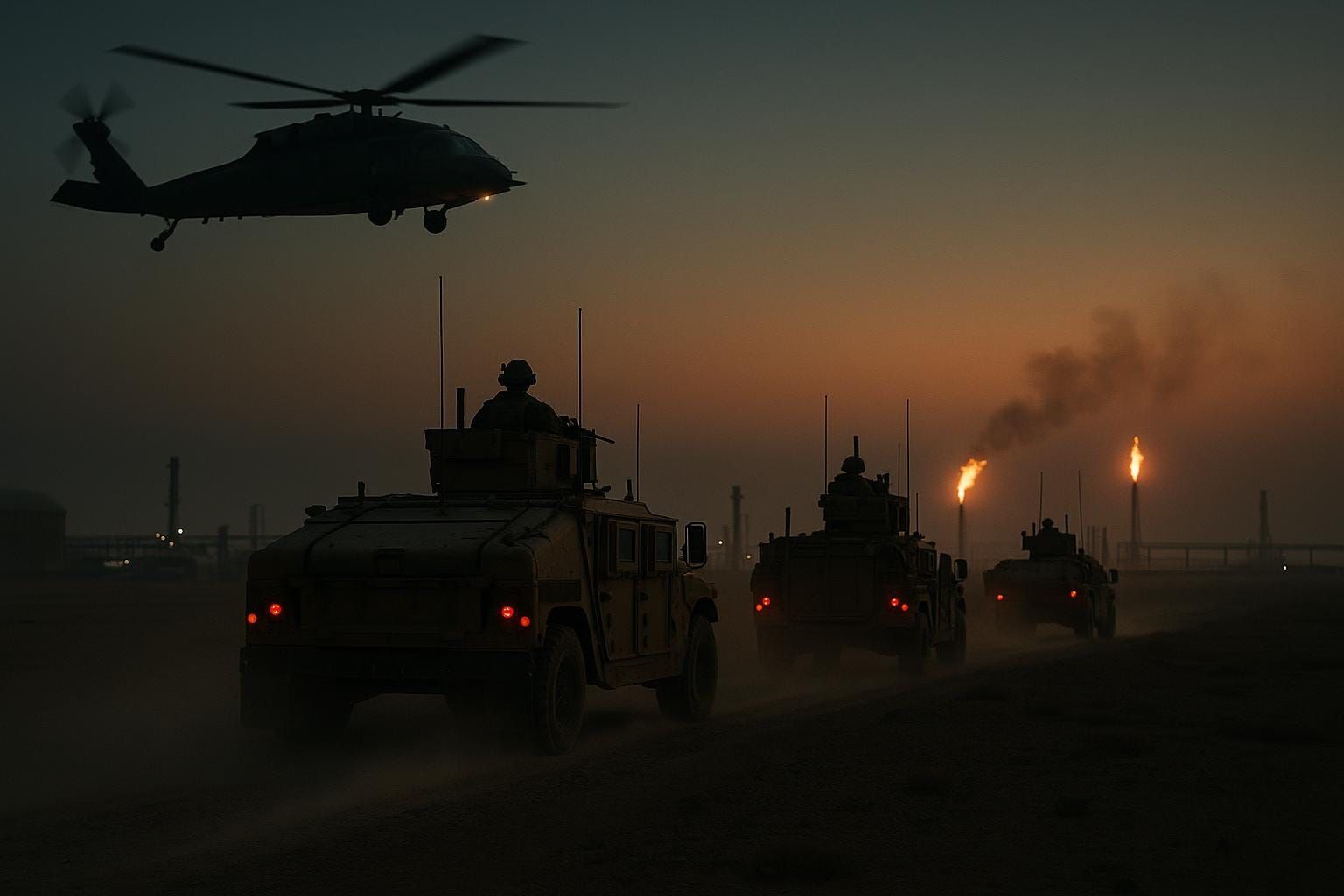
What they are celebrating is the end of one of the longest American military commitments in modern history. By September 30, the last US troops in Iraq — a contingent of hundreds, consolidated at bases in and around Erbil in the Kurdish north — will be gone, 23 years after the 2003 invasion that toppled Saddam Hussein.
The arc of the numbers tells the story on its own. More than 170,000 American troops in-country at the 2007 peak, operating from over 500 bases. Roughly 4,500 American dead across two decades of war. About 2,500 troops remaining when Washington and Baghdad agreed a two-phase exit in 2024 under President Biden. Phase one emptied Ain al-Asad air base in Anbar province, completed this January. Phase two — the Kurdistan bases — ends this week.
A Withdrawal in the Middle of a War
What separates this exit from the 2011 withdrawal is the context: it is happening while the United States is at war with Iraq's neighbor.
Since February, Washington has waged an air and naval campaign against Iran — without ground troops, in deliberate contrast to 2003. Iraq has been the ground caught in between. Seven of the eighteen American service members killed in the war so far died in Iraq, the last an Army sergeant killed in July during the controlled detonation of a drone at a base near Erbil. Defense Secretary Pete Hegseth says Iran-aligned militias in Iraq have carried out more than 600 attacks on US personnel since the war began.
The date, notably, was Baghdad's choice. An Iraqi official told The National that Prime Minister Ali al-Zaidi — in office only since May — personally pushed for the September 30 deadline during his July visit to the White House. President Trump went along: "We don't think we need the military there anymore."
Not everyone in Iraq is celebrating. The Kurdistan Regional Government publicly argued the country's security "has not yet reached a level of stability that would justify such a withdrawal," in the words of the Kurdish prime minister's press secretary. Sunni leaders warn that ISIS sleeper cells are more active than officials admit; Reuters reports Iraqi security forces recently disrupted a suspected ISIS cell preparing suicide attacks timed to coincide with the pullout — designed to prove the group still matters the moment the Americans leave.
And then there are the militias. Baghdad originally tied the American departure to a promise that Iran-backed armed groups would put their weapons under state control. Several factions claim they have. The two most hardline — Kataib Hezbollah and Harakat Hezbollah al-Nujaba — refuse to disarm, and the government has quietly pushed its disarmament target out to June 2027.
Why This Is a Markets Story
For investors, this is not a story about a flag ceremony. Iraq is OPEC's second-largest producer, sitting on roughly 145 billion barrels of proven reserves — the fifth-largest on Earth — with 48 million people and a state almost wholly dependent on oil revenue to pay salaries and fund subsidized food rations.
On September 10–11, drones launched from Iraqi territory struck Saudi Arabia's East–West crude pipeline — the kingdom's only serious alternative export route to a Strait of Hormuz that Iran has kept under effective blockade for months. Saudi Arabia shut the pipeline. Baghdad confirmed the drones came from its own soil. Riyadh, pointedly, chose not to retaliate — it asked Iraq to deal with the problem instead.
That is the environment into which the last American counterweight is now departing. The question the market has to answer this week: what happens to the barrels of OPEC's number two when its export lifeline runs entirely at Tehran's discretion?
Get the next briefing free in your inbox: Join AlphaBriefing
The rest of this briefing is free — it just requires a free AlphaBriefing account: the barrel-by-barrel math of Iraq's shuttle-tanker lifeline through Hormuz, the nearly $10 scarcity signal sitting inside the Brent futures curve this week, and the three scenarios that decide where oil trades from here.
Create your free account → — 30 seconds, no card.