Why the U.S. Navy Is Shopping for Warships in South Korea
The U.S. Navy just asked South Korean yards whether they can build its destroyers and oilers — the first crack in an 80-year ban on foreign-built warships. The stocks are pricing the order book; Congress is drafting the veto.

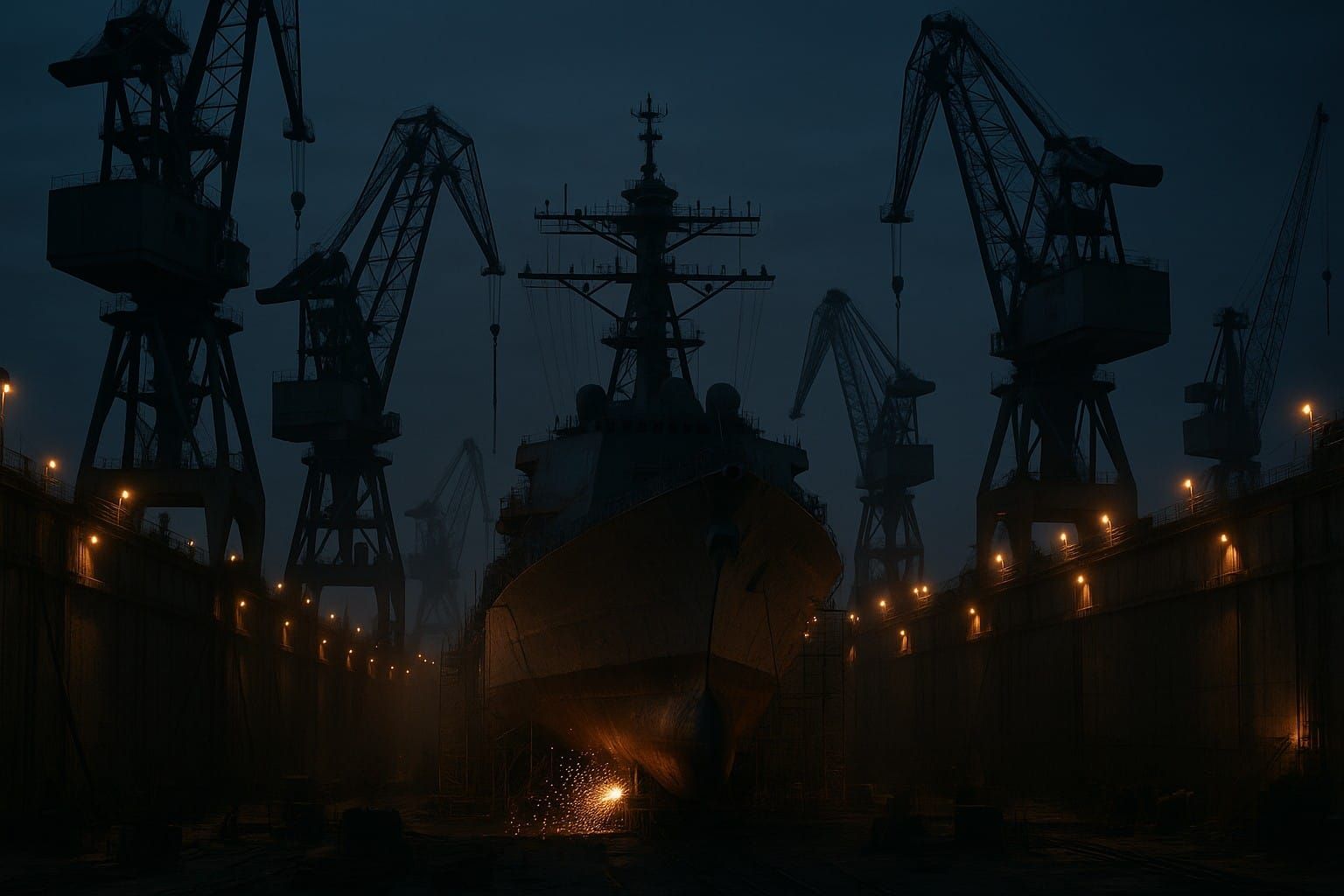
In the second week of July, the U.S. Navy did something it has not done since before most Americans were born: it formally asked foreign shipyards whether they could build its warships.
Two Requests for Information went out to South Korea's big three shipbuilders — one for destroyer-sized surface combatants, one for fleet replenishment oilers. Hanwha Ocean and HD Hyundai Heavy Industries answered both. Samsung Heavy Industries answered the tanker request. All three sent Washington detailed accounts of their design capabilities, production capacity, and how fast they could deliver.
To understand how unusual this is: the last foreign-built combat ships in U.S. Navy service were British-built cruisers that left the fleet in 1922. Since the 1960s, federal law — 10 U.S.C. § 8679 — has flatly prohibited building Navy vessels in foreign shipyards, with a single escape hatch: a presidential national-security waiver that no president has ever used for a major combatant.
The market noticed. Korean shipbuilder stocks have rallied hard on U.S. naval hopes — defying a broad Seoul market selloff in mid-July after President Trump signaled Washington could turn to foreign yards, and after JPMorgan pledged fresh funding to rebuild the Philadelphia shipbuilding hub where Hanwha operates its American beachhead.
But here is what the rally is glossing over: three weeks before the Navy sent those RFIs, the House Armed Services Committee voted to ban exactly what the Navy is asking for.
The Math That Forced the Question
The Navy is not shopping in Seoul out of curiosity. It is shopping because the domestic industrial base has failed at its one job.
An unclassified U.S. Office of Naval Intelligence briefing slide puts China's shipbuilding capacity at roughly 23 million gross tons a year. The United States: less than 100,000 tons. That is a 230-to-1 gap — held by the country the Pentagon calls its pacing threat, which now operates the world's largest navy by hull count while American yards run years behind schedule on nearly every major program.
South Korea is the only allied industrial base that operates at Chinese scale and builds ships the U.S. Navy would recognize. Hanwha Ocean and HD Hyundai both build the Sejong the Great class — 8,500-ton Aegis destroyers that are, by design lineage, close cousins of the U.S. Arleigh Burke class. HD Hyundai's Ulsan complex has six special-purpose docks and a ship lift, and can work on up to seven warships simultaneously.
The political architecture is already being assembled around the industrial logic. At the G7 summit in June, Trump reportedly asked South Korean President Lee Jae Myung directly whether Korea could "quickly build 10 U.S. warships." The two governments are building out MASGA — Make American Shipbuilding Great Again — a shipbuilding cooperation initiative nested inside South Korea's $150 billion U.S. investment commitment. Hanwha, which bought Philadelphia's Philly Shipyard for $100 million in late 2024, announced a $5 billion expansion plan in July: two new docks, three new quays, and a target of scaling annual output from fewer than two vessels to as many as twenty.
The pieces look like they are falling into place. The RFIs, the summit ask, the $5 billion yard buildout, the rallying stocks — all of it points one direction.
Except the part of the U.S. government that actually writes the law is pointing the other way. The House and Senate have now produced two directly conflicting answers to the question "can America's warships be built abroad?" — and which answer survives conference determines whether this is the beginning of a multi-decade order pipeline for Korean yards or a rally built on a bill that dies in committee.
The rest of this briefing is for paid members: the House-vs-Senate NDAA collision and which chamber's language kills or unlocks the trade, the three-scenario map with the specific Korean and U.S. names positioned for each outcome, the "make parts, assemble in America" workaround nobody is pricing, and the catalyst calendar through NDAA conference.
AlphaBriefing Paid gets you every investment thesis, scenario framework, and catalyst brief we publish — the analysis private intel clients pay four figures for, at a fraction of that.