Why the Pentagon Just Made Itself a Rare-Earth Shareholder
Everyone's watching the mine. The real China chokehold is on magnet processing — and Washington's equity-and-price-floor deal with MP Materials just created a sovereign put that re-rates the entire Western rare-earth supply chain.

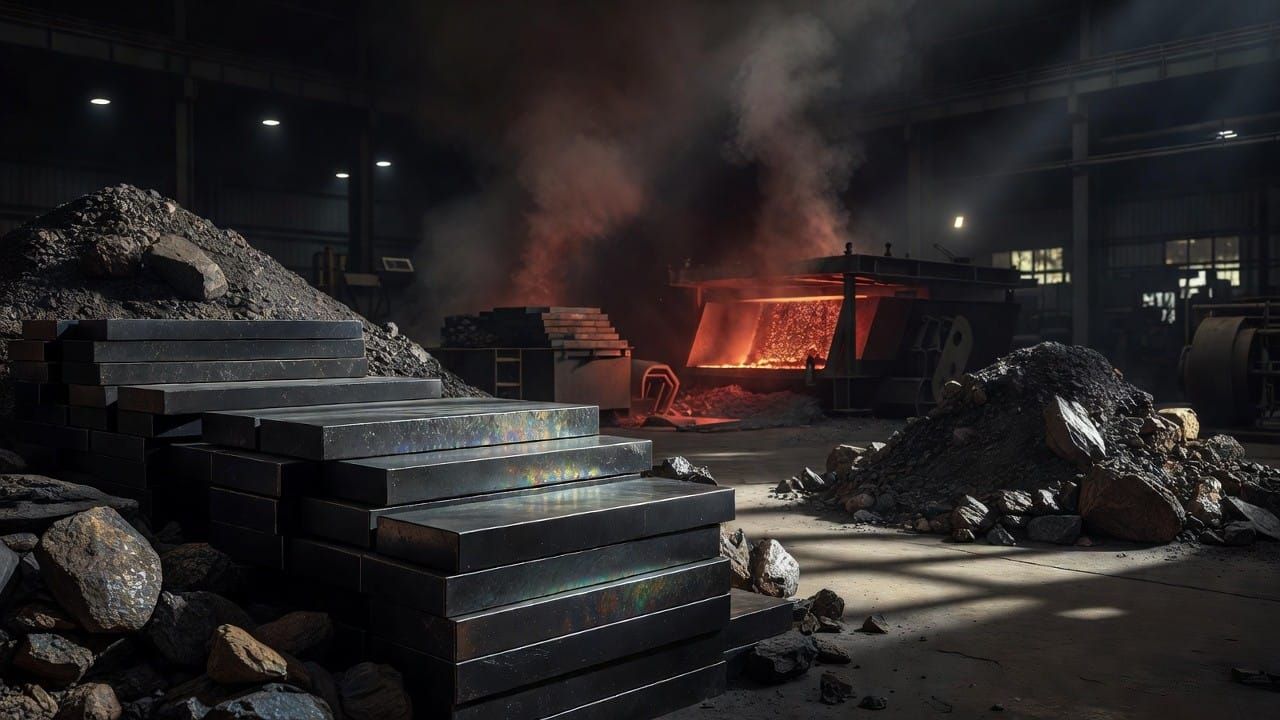
On June 22, 2026, Beijing did something that clarified the entire game. It added MP Materials and USA Rare Earth — the two most important names in America's fledgling rare-earth industry — to its export-control list, formally cutting them off from Chinese dual-use shipments. The message was unmistakable: the country that controls the world's magnets was drawing a line directly through the companies trying to break its grip.
Wall Street mostly filed this under "trade-war headline." That is the wrong drawer. What's actually happening is the birth of a Western strategic-minerals industry, underwritten by an unprecedented tool — the U.S. government putting a guaranteed floor under a commodity price and taking an equity stake to do it. Most investors are still watching the wrong part of the supply chain.
Everyone Is Looking at the Mine. The Chokepoint Is the Magnet.
Say "rare earths" and people picture a mine — a hole in the ground China somehow controls. That mental model is a decade out of date and it's why the trade keeps getting misread.
China's dominance in mining is real but not decisive: it digs roughly 70% of the world's rare earths, and there are viable deposits in the U.S., Australia, and Africa. The stranglehold is downstream, in the steps that turn dirt into a working component. China controls an estimated 90–91% of global rare-earth separation and refining, 93–94% of finished NdFeB permanent-magnet production, and close to 98% of the heavy rare earths — dysprosium and terbium — that let a magnet hold its strength at high temperature.
That last category is the real pressure point. A neodymium-iron-boron magnet is built on neodymium and praseodymium, but it needs small doses of dysprosium and terbium to survive the heat inside a jet actuator, an EV motor, or a missile fin. There is almost no commercial-scale non-Chinese supply of separated Dy and Tb on the planet. Prices for them outside China have already detached from prices inside it.
And these magnets are not a niche input. They are load-bearing for the industrial economy and the defense base alike: EV traction motors, offshore wind turbines, robotics, data-center cooling, and weapons systems. A single F-35 contains an estimated 400-plus kilograms of rare-earth material. Virginia-class submarines, missiles, radar, and electronic-warfare gear all run on the same magnets. When China restricts them, it isn't squeezing a commodity — it's putting a hand on the throat of Western manufacturing and firepower simultaneously.
The Deal That Rewrote the Rules
For twenty years, Washington's answer to this was grants, studies, and stern speeches, none of which built a supply chain, because the economics never worked. Any Western producer that tried to scale could be undercut overnight by a wave of cheap Chinese oxide — a lesson learned in blood when China crushed prices and bankrupted rivals in the 2010s.
In July 2025, the Pentagon threw out that playbook. Its deal with MP Materials, the operator of the only working rare-earth mine in the United States, did three things no U.S. industrial policy had combined before:
- It took equity. The Department of Defense bought $400 million of convertible preferred stock plus warrants, making the U.S. government MP's largest shareholder on a fully converted basis — roughly a 15% stake.
- It set a price floor. For ten years, the DoD guarantees a floor of $110 per kilogram for MP's NdPr output — about double the prevailing Chinese market price at signing. If the market falls below it, the government pays the difference. If prices run above it once the new plant is live, the government shares the upside.
- It guaranteed demand. A ten-year offtake agreement commits to buy 100% of the magnet output from MP's forthcoming "10X" facility, backed by a $1 billion financing commitment from JPMorgan and Goldman Sachs.
Strip away the labels and what the Pentagon actually wrote is a sovereign put on rare-earth prices. It removed the one weapon — predatory pricing — that let China kill every Western competitor before it reached scale. That, not the mine itself, is the thing that changes the investment math.
This is where the analysis gets actionable. AlphaBriefing members get the full investment framework — scenarios, positioning, and the bottom line.
Subscribe to AlphaBriefing — Free, Member, and Paid tiers available.