How a Rainforest Island Ran Out of Water
San Juan is on 48-hour water shutoffs after the driest July in 120 years — on an island with a literal rainforest. The failure isn't the sky: Puerto Rico's utility loses up to 60% of its treated water to leaks, and it's a preview of the repricing coming for America's D-grade water systems.

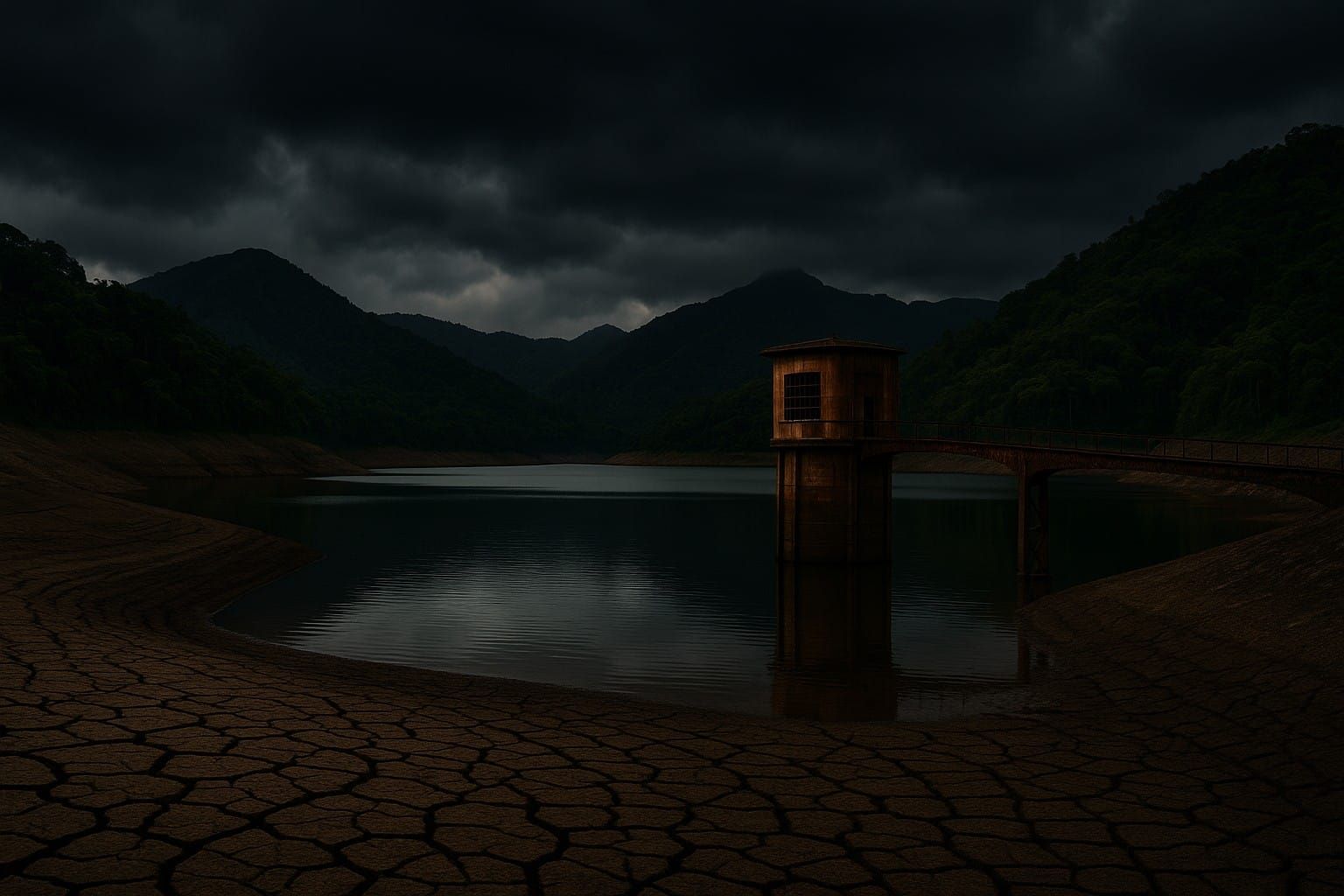
San Juan sits on an island that catches more rain than almost anywhere else under the American flag. El Yunque, the only tropical rainforest in the U.S. national forest system, is a 40-minute drive from the capital. And since August 7, hundreds of thousands of people in and around that capital have had running water only every other day.
The Puerto Rico Aqueduct and Sewer Authority — PRASA, the public utility that supplies drinking water to 97 percent of the island's 3.2 million U.S. citizens — is now enforcing rotating 48-hour shutoffs across San Juan and six surrounding municipalities, covering more than 180,000 customer accounts. Officials have warned the cycles could stretch to 72 hours if reservoir levels keep falling. The National Guard is trucking potable water to neighborhoods. Businesses that can afford it are paying $300 to $500 a day for private tanker deliveries to stay open.
The proximate cause is real: July was San Juan's driest month in more than 120 years of record-keeping, roughly 68 percent of the island is in drought, and rainfall has run more than nine inches below normal since June 1. The Carraízo reservoir, one of the capital's main sources, is at critically low levels.
But the drought is the trigger, not the cause. The cause is a number buried in the utility's own planning documents — and it is the number that should worry people far beyond Puerto Rico.
The 60 Percent Problem
According to the fiscal plan certified by Puerto Rico's federal oversight board, PRASA loses up to 65 percent of the clean, treated drinking water it produces before that water ever reaches a paying customer. Independent water-management experts on the island put the figure at roughly 60 percent. Either way, the scale is staggering: for every gallon that comes out of a tap in San Juan, more than a gallon disappears into the ground through leaking pipes, ruptured mains, and unmetered losses.
For comparison, a typical mainland U.S. water system loses somewhere in the neighborhood of one-sixth of its treated water — a figure that is itself considered a national embarrassment by civil engineers. Puerto Rico's loss rate is not an outlier on the American distribution. It is what the far end of the same curve looks like.
The storage side is no better. Decades of sedimentation have cost Puerto Rico's major water-supply reservoirs an estimated 30 to 60 percent of their designed capacity — meaning that even when the rain does come, the island physically cannot bank as much of it as its engineers once planned. The American Society of Civil Engineers grades the island's drinking water infrastructure a D and puts the investment need at $3.9 billion.
Run the arithmetic and the crisis stops looking like weather. A system that loses more than half its product and has lost up to half its storage does not need a historic drought to fail. It needs an ordinary one.
Briefings like this land in members' inboxes before the market prices them in. Join free →
A Failure With a Timeline
What makes Puerto Rico's case instructive is how visible the run-up was.
In August 2025 — a full year before the rationing began — two pumps failed at the Finca Rosso I station serving San Juan's eastern corridor. Funding for the repair was not approved until November 2025, and the work stretched into mid-2026. Thousands of residents in Canóvanas, Cupey, and eastern San Juan went close to a year with intermittent service before the drought arrived; some neighborhoods have now logged more than 100 consecutive days of unreliable water. In June 2026, a major rupture on the Superaqueduct — one of the island's most important transmission lines — knocked out service to tens of thousands more and helped drain Carraízo into the danger zone.
By the time Governor Jenniffer González-Colón declared an island-wide emergency and rationing began on August 7, the mayor of San Juan had already sued the utility over chronic shortages. As of mid-August, the White House said it was "closely monitoring" the situation and had received no requests for FEMA assistance related to the drought.
Each link in that chain — deferred pump repair, slow capital approval, a transmission main past its service life, reservoirs silting up in plain sight — was individually survivable. The drought simply called the loan on all of them at once.
Solvent on Paper, Leaking Underground
Here is the part that should interest anyone who owns municipal bonds, and it is genuinely uncomfortable.
Through Puerto Rico's decade-long debt catastrophe — the largest municipal restructuring in American history — PRASA was the success story. While the commonwealth, its power utility, and most of its major issuers went through bankruptcy-like proceedings under the PROMESA law, the water authority never restructured its bond debt. It cut a consensual deal with federal agencies in 2019 that trimmed about $380 million from its payments on roughly $1 billion in U.S. government loans and unlocked $400 million in new federal funding. Its senior-lien bonds, refinanced in 2020, run out to 2047. On paper, PRASA was the utility that made it.
The last two months are a demonstration of what that solvency was partly made of: deferred maintenance. The balance sheet stayed intact while the physical system quietly went the other way. A utility can meet every debt-service payment right up until the moment its product stops coming out of the pipes — and the credit analysis that stops at coverage ratios will never see it coming. The water version of an underfunded pension is a funded one sitting on top of a 60 percent leak rate.
The largest fix now in motion tells the same story from another angle. FEMA has awarded $578 million — part of a $790 million project with local cost-share — to replace nearly 1.4 million mechanical water meters across the island with smart ultrasonic meters and advanced metering infrastructure. It is the biggest single investment in the system in years, and it is worth being precise about what it buys: measurement. The new network will tell PRASA, in near real time, exactly where its water is disappearing. It will not replace a single mile of the pipe it is disappearing through.
The Mainland Is on the Same Curve
It is tempting to file Puerto Rico under "island problems." The data does not cooperate.
The American Society of Civil Engineers grades the mainland's drinking water infrastructure a C-minus, with an investment need that federal and industry estimates put between $2.1 and $2.4 trillion over the next 25 years. A water main breaks somewhere in the United States roughly every two minutes. Utilities from California to the Great Lakes are already pushing through double-digit rate increases as climate-driven emergencies — wildfire, flood, drought — land on systems that were built for a calmer century and maintained for a cheaper one.
That sequence should sound familiar, because American markets have run it once already. Property insurance spent decades underpricing climate risk, then repriced it all at once — and the repricing, not the weather, is what broke Florida's market and California's FAIR Plan. Water utilities are next in line for the same logic, with two differences that make the politics uglier: they are monopolies, and their product is non-negotiable. When the bill for 40 years of deferred pipe replacement arrives, it lands on captive ratepayers or on taxpayers. There is no third option, and Puerto Rico is currently demonstrating what happens when both refuse to pay it.
There is also a cautionary tale here for the privatization reflex. Puerto Rico has already tried handing its water system to private operators — from 1995 to 2004, under contracts with some of the largest water companies in the world. Service deteriorated, the finances got worse, and the island took the system back. The electric grid's more recent privatization has produced a running political battle of its own. Ownership models keep changing; the pipes keep aging.
For investors, the actionable part is straightforward and does not require a view on Puerto Rican politics. The capital that must flow — meters, acoustic leak detection, pipe rehabilitation, treatment, storage dredging — flows toward the same handful of companies that dominate water technology and distribution in every scenario, and the FEMA-funded metering build-out is already underway. And for anyone holding water and sewer paper in a muni portfolio, San Juan is a prompt to ask a question coverage ratios will not answer: not whether the utility can pay its bonds, but how much water it loses on the way to the customers who fund them.
The Bottom Line
The rain will come back to Puerto Rico; the leaks will still be there when it does. Rationing may end in weeks or months, but a system that loses more than half its water and half its storage has no margin left — and the next dry season starts from the same place. That is the real export from San Juan this summer: proof of how quickly "deferred maintenance" becomes a civil emergency, and how little warning the financial statements give. Every mainland utility with a D-grade network and an intact credit rating is one dry season away from the same schedule.
If this analysis was useful, this is what AlphaBriefing does every day — geopolitics and markets, connected to what it means for your money. Free members get the daily brief in their inbox; paid members get the investment frameworks, scenario pricing, and catalyst calendars behind the paywall.
Sign up free → — upgrade whenever it earns it.
Get this level of intelligence every day. Subscribe to AlphaBriefing — free, member, and paid tiers available.
Sources & Further Reading
- PBS NewsHour — Drought and aging infrastructure plunge Puerto Rico into a water crisis
- Newsweek — Trump Silent as Puerto Rico Begins 48-Hour Water Rationing Amid Severe Drought
- Underground Infrastructure — Puerto Rico begins water rationing amid aging infrastructure crisis
- Financial Oversight and Management Board — PRASA Fiscal Plan: Roadmap to Preserving Water and Implementing Accurate Metering
- Smart Water Magazine — 1.4 million smart water meters rolled out across Puerto Rico
- Congressional Research Service — Puerto Rico's Public Debts: Accumulation and Restructuring
- Impacto Media — Puerto Rico without water: The drought exposed a crisis years in the making
- Circle of Blue — Climate Emergencies Are Breaking Water Utilities. Customers Are Paying
Disclaimer
AlphaBriefing is an independent intelligence publication. The content in this article is produced for informational and educational purposes only. Nothing published by AlphaBriefing constitutes financial, investment, legal, tax, or regulatory advice, nor should it be construed as a solicitation or recommendation to buy, sell, or hold any security, asset, or financial instrument.
All views expressed are those of the author at the time of writing and are subject to change without notice. Markets are volatile and unpredictable; past performance is not indicative of future results. Any investment involves risk, including the possible loss of principal.
AlphaBriefing and its principals, employees, or contributors may hold positions in securities or assets mentioned in this article. This should be considered a potential conflict of interest. No material relationship with any company referenced exists unless explicitly disclosed. Readers should conduct their own due diligence and consult qualified financial, legal, and tax advisors before making any investment decisions.
Information in this article is drawn from public sources believed to be reliable at the time of publication. AlphaBriefing makes no warranty, express or implied, as to the accuracy, completeness, or timeliness of any information herein. AlphaBriefing accepts no liability for any loss or damage arising from reliance on this content.
© AlphaBriefing. All rights reserved. Unauthorised reproduction or distribution is prohibited.