Why Every Delivery App Suddenly Wants Its Own Air Force
Amazon is scaling drone delivery sixfold to nearly 500 cities, Walmart and Wing are adding 150 stores, and DoorDash just won its own FAA air-carrier certificate. The land grab for America's low-altitude airspace has started — and the deadline is a rule the FAA hasn't published yet.

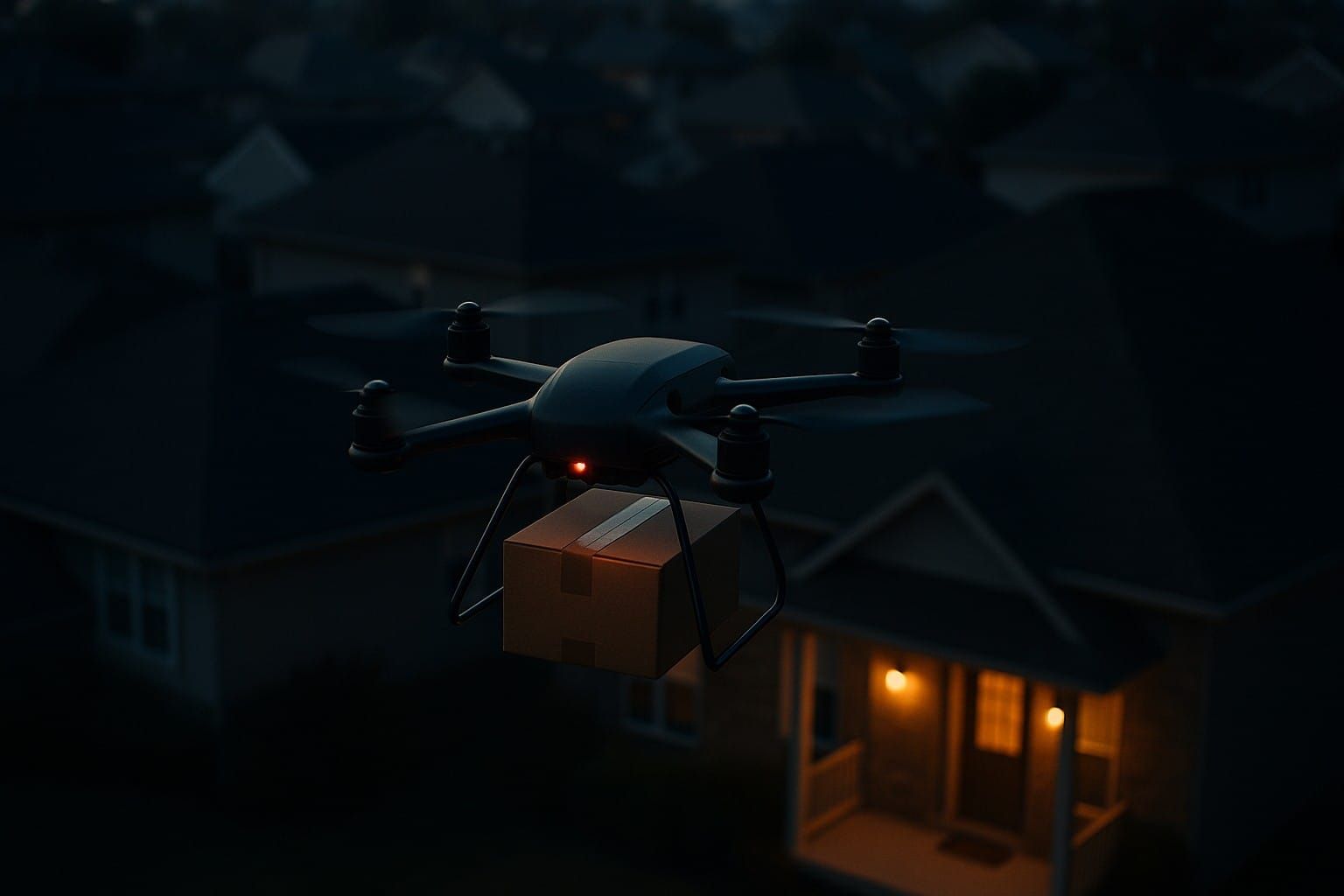
Three announcements landed in a ten-day window this August, and together they mark the end of a twelve-year pilot program.
On August 19, Amazon said Prime Air will expand from 11 metro areas to nearly 500 US cities and towns by the end of 2026 — a roughly sixfold jump in footprint in about four months. The same week, Walmart and Alphabet's Wing said drone delivery is coming to 150 Walmart stores over the next year, reaching more than 40 million potential customers, with over 270 stores planned for 2027. And DoorDash became just the eighth company in US history to hold an FAA Part 135 air carrier certificate, clearing it to fly its own drones — built in-house by DoorDash Labs — beyond the visual line of sight of an operator.
Jeff Bezos first promised drone delivery on 60 Minutes in December 2013. For most of the years since, the honest description of the industry was a demo: a few suburbs, a few thousand flights, a lot of B-roll. That phase is over. What started this month is a land grab — and the deadline driving it is a federal rule that hasn't even been published yet.
The numbers stopped being cute
The scale shift is easiest to see in the operating data the companies are now willing to disclose.
Amazon currently flies from 11 sites across seven states — Arizona, Florida, Kansas, Louisiana, Michigan, Nebraska, and Texas — with each site covering roughly 175 square miles, a circle about 7.5 miles in radius around a fulfillment center. The company says it has made hundreds of thousands of drone deliveries this year, with thousands more daily, and Prime Air vice president David Carbon has told staff the unit is targeting one million deliveries in 2026. New launches are queued for the Chicago, Atlanta, Cleveland, Syracuse, and Boise metro areas, with Chicago service flying from fulfillment centers in the south suburbs of Markham and Matteson. The drones carry packages up to five pounds — a limit that sounds restrictive until you learn it covers more than 60% of Amazon's most commonly ordered items.
Walmart and Wing say their delivery volume tripled in the past six months. Wing's aircraft fly at up to 60 mph on round trips of up to 12 miles, and Wing crossed one million cumulative commercial deliveries earlier this year across its global network. The 150-store expansion adds Los Angeles, St. Louis, Cincinnati, and Miami to existing operations in Dallas–Fort Worth and Atlanta, with Houston, Orlando, Tampa, and Charlotte behind them. The strategic asset here isn't the drone — it's that Walmart operates roughly 4,600 US stores, each one a potential launch site already stocked with groceries and sitting within a few miles of most of the American population.
DoorDash is the newest and most interesting entrant, because it isn't a retailer. It has tested drone delivery since 2022 through partners — Wing in Texas, Flytrex elsewhere — but the Part 135 certificate means it now owns the full stack: aircraft, operations, and the marketplace demand to feed them. Its stated target is the 3-to-5-mile order, which the company says takes about 25% longer to fulfill by road than shorter trips. A drone doesn't care about left turns, parking, or apartment gates.
Briefings like this land in members' inboxes before the market prices them in. Join free →
The real deadline: Part 108
Why is everyone sprinting at once? Because the regulatory moat that currently protects these operators has a published expiration process.
Today, flying a delivery drone beyond an operator's visual line of sight — the only way the economics can ever work — requires either a Part 135 air carrier certificate or a stack of individual FAA waivers. Only eight companies have ever cleared the Part 135 bar. That scarcity is the entire competitive structure of the industry right now: the certificate, not the aircraft, is the hard part.
That structure is scheduled to dissolve. In August 2025, the FAA published its proposed Part 108 rule — a standardized framework for beyond-visual-line-of-sight operations that replaces bespoke waivers with a repeatable authorization process, including risk categories based on population density and requirements for detect-and-avoid systems. The comment period closed, a supplemental round on right-of-way rules wrapped in February, and on July 10, 2026, the final rule arrived at the White House's Office of Information and Regulatory Affairs for review — the last stop before publication. Most observers expect the final rule in late 2026 or early 2027.
When Part 108 lands, the certificate stops being scarce. Which means the window to convert regulatory privilege into durable advantage — site networks, airspace integration, safety records, and above all consumer habit — is the next 12 to 18 months. Amazon's 500 cities, Walmart's 150 stores, and DoorDash's air carrier certificate are all the same trade: build the network while the drawbridge is still up.
The economics are still the open question
None of these companies discloses cost per drone delivery, and that silence is informative. Industry estimates have historically put early-stage drone delivery well above the cost of a van drop or a gig courier, and the entire bet is that density fixes it: one operator, dozens of autonomous aircraft, hundreds of deliveries a day from a single site, no driver in the loop.
The five-pound payload cap frames what this is and isn't. It isn't a replacement for the brown van; it's an attack on the highest-urgency, lowest-weight orders — the phone charger, the fever medicine, the missing dinner ingredient — where customers demonstrably pay for speed and where a 30-minute air drop beats anything on wheels. Those are also precisely the orders that currently subsidize gig-courier networks. If drones skim the short, light, high-frequency deliveries, the economics of the remaining road network get worse, not better — which is a plausible reason DoorDash decided it would rather own the cannibal than be eaten by it.
The risks are real and worth stating plainly: Part 108 could slip or emerge more restrictive than proposed; suburban noise complaints have already shut down individual sites; weather grounds fleets; and a single serious accident anywhere in the industry would test public tolerance for all of it. Scale is new here — the safety record at a million deliveries a year is not yet written.
The investor map
For public-market readers, the exposure runs through four names, none of which trades on drones today — which is rather the point.
- Amazon (AMZN): Prime Air is a rounding error in the P&L and a direct investment in the only moat that matters — delivery speed as a Prime retention weapon. One million deliveries in 2026 would still be a fraction of a percent of Amazon's US package volume. Watch whether drone-eligible selection expands past 60%.
- Alphabet (GOOGL): Wing is the rare "Other Bet" with real commercial traction, an asset-light model — it operates as a delivery network for retailers like Walmart rather than a retailer itself — and a milestone of a million deliveries. It will not move the stock in 2026. It is optionality priced at zero.
- Walmart (WMT): The store-as-airbase model is the most capital-efficient path in the industry. Tripling volume in six months is the single strongest demand signal any operator has published.
- DoorDash (DASH): The highest-beta version of the thesis. Vertical integration means capex and certification risk DoorDash has never carried before — and the largest margin prize if mid-range air delivery works.
Behind them sit the private operators — Zipline, which also flies for Walmart, and Flytrex among them — plus a supplier layer of detect-and-avoid, airspace management, and avionics firms that a finalized Part 108 would effectively hand a mandated market.
The bottom line
For a decade, the constraint on drone delivery was technology. For the last three years, it was regulation. Sometime around the turn of 2027, it becomes geography: launch sites within a 7.5-mile circle of dense suburbs, certificates to fly from them, and customers already habituated to looking up when the doorbell doesn't ring. That's why August 2026 looked the way it did. The demo is over; the enclosure of America's low-altitude airspace has started, and the companies involved are behaving exactly like firms that believe the free land runs out next year.
If this analysis was useful, this is what AlphaBriefing does every day — geopolitics and markets, connected to what it means for your money. Free members get the daily brief in their inbox; paid members get the investment frameworks, scenario pricing, and catalyst calendars behind the paywall.
Get this level of intelligence every day. Subscribe to AlphaBriefing — free, member, and paid tiers available.
Sources & Further Reading
- About Amazon — Prime Air drone delivery is expanding to nearly 500 US cities and towns this year
- TechCrunch — Amazon's Prime Air is taking off in nearly 500 US cities
- CNBC — Amazon to expand drone service to nearly 500 cities after targeting 1 million deliveries this year
- Retail Dive — Walmart is expanding its drone delivery coverage with Wing
- Yahoo Finance / Sourcing Journal — DoorDash Gets FAA Green Light for Commercial Drone Deliveries
- Fortune — Amazon, Uber, DoorDash, and Walmart expand drone delivery in the US
- FreightWaves — Amazon drone delivery expansion targets 500 cities by year's end
Disclaimer
AlphaBriefing is an independent intelligence publication. The content in this article is produced for informational and educational purposes only. Nothing published by AlphaBriefing constitutes financial, investment, legal, tax, or regulatory advice, nor should it be construed as a solicitation or recommendation to buy, sell, or hold any security, asset, or financial instrument.
All views expressed are those of the author at the time of writing and are subject to change without notice. Markets are volatile and unpredictable; past performance is not indicative of future results. Any investment involves risk, including the possible loss of principal.
AlphaBriefing and its principals, employees, or contributors may hold positions in securities or assets mentioned in this article. This should be considered a potential conflict of interest. No material relationship with any company referenced exists unless explicitly disclosed. Readers should conduct their own due diligence and consult qualified financial, legal, and tax advisors before making any investment decisions.
Information in this article is drawn from public sources believed to be reliable at the time of publication. AlphaBriefing makes no warranty, express or implied, as to the accuracy, completeness, or timeliness of any information herein. AlphaBriefing accepts no liability for any loss or damage arising from reliance on this content.
© AlphaBriefing. All rights reserved. Unauthorised reproduction or distribution is prohibited.