Amazon Has 85 Days Left on Its Space Internet Promise. It Hasn't Launched a Satellite Since July.
Amazon says its Starlink rival starts commercial service this quarter. Its own mission log shows no launches since July 2, a waived FCC deadline behind it, and a spectrum penalty running to 2028 — the launch math, the Globalstar spread, and how to position.

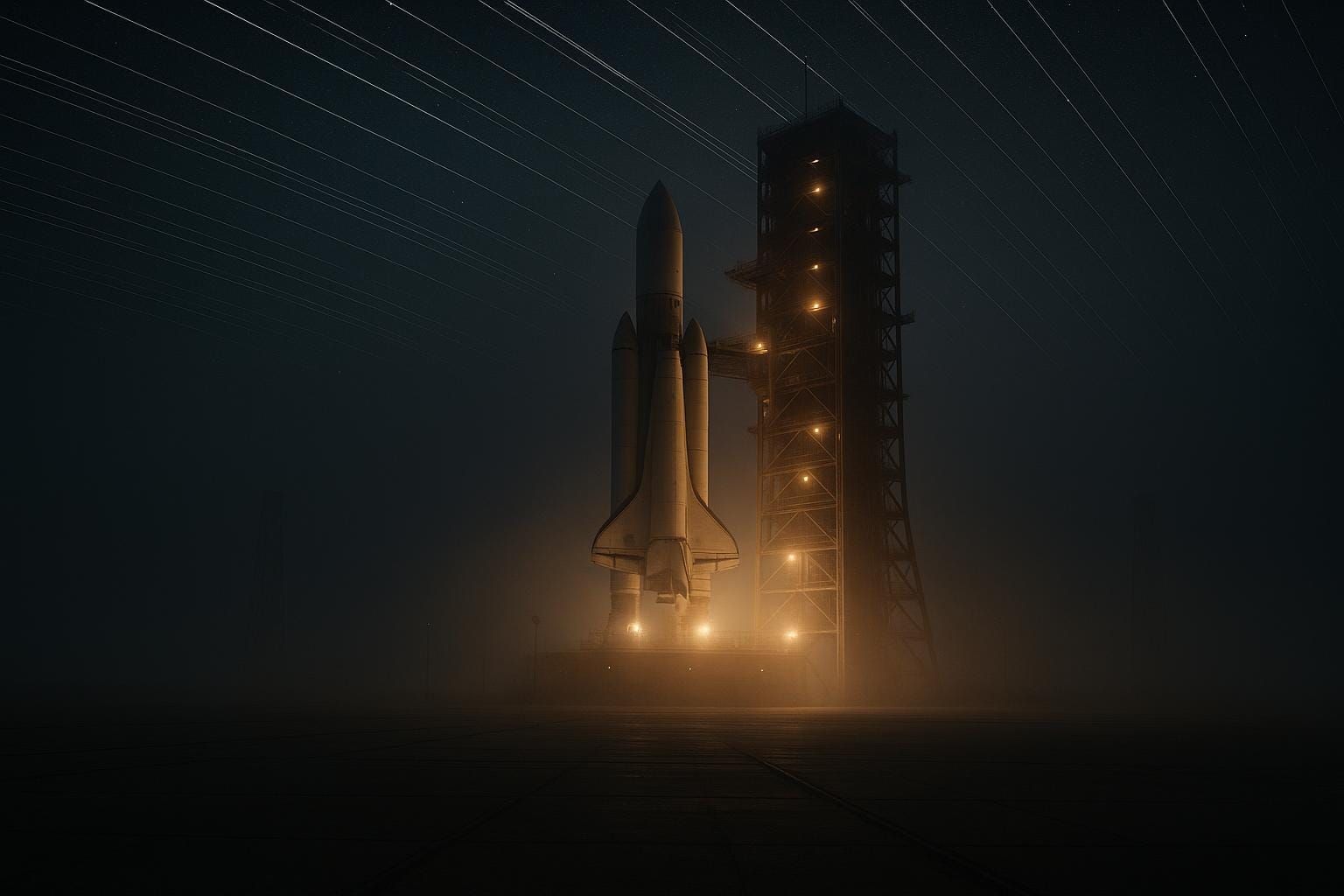
On September 10, at the International Space Summit in Paris, Amazon Leo vice president Chris Weber repeated the company line: Amazon's satellite internet network will begin limited commercial service by the end of this year. SpaceNews reported the pledge the same day, and Amazon's own site still carries it — "an initial service rollout later this year."
The calendar says October 7. That leaves 85 days.
Amazon's own mission log says the last Leo satellites reached orbit on July 2.
The scoreboard
Amazon Leo — the network formerly known as Project Kuiper, rebranded in November 2025 — has deployed 396 satellites across 14 missions since full-scale deployment began in April 2025, per Amazon's mission updates page. The company calls it the third-largest constellation in orbit, which is true, and also a measure of how far the drop is to second place.
The authorized first-generation constellation is 3,232 satellites. Amazon's FCC license originally required half of it — 1,616 spacecraft — in orbit by July 30, 2026. When that deadline arrived, Amazon had roughly a tenth of the full constellation flying. The FCC had seen it coming: in a June 5 order, the agency waived the milestone rather than strip Amazon's authorization. More on the price of that waiver below, because it is the most underappreciated part of this story.
Meanwhile, the competitor: SpaceX operates more than 11,000 Starlink satellites, by its own October 6 update, and began deploying its larger V3 satellites at the end of September. Industry tracking cited by Advanced Television earlier this year counted 4,207 Starlink satellites deployed over one 469-day stretch — about nine per day. At that pace, SpaceX puts up Amazon's entire 18-month output in roughly six weeks.
What broke
Amazon's position, consistently, is that the bottleneck is not satellite manufacturing — production lines in Kirkland, Washington, and a processing facility at Cape Canaveral are reportedly turning out flight-ready spacecraft that are now waiting on rides. The bottleneck is rockets. Amazon deliberately spread its 80-plus contracted launches across nearly every heavy-lift provider that is not SpaceX, plus SpaceX itself. In 2026, almost every leg of that strategy wobbled at once:
- Atlas V (ULA): The workhorse. Eight flights, 224 satellites, 100% success rate — and finished. The July 2 mission was the final Leo flight on Atlas, by design. The campaign now moves to ULA's new Vulcan rocket, which has yet to fly a single Leo mission.
- Ariane 6 (Arianespace): Three missions, 100 satellites, all in under five months — reliable, but a fraction of the needed cadence. On September 9, Amazon added six more Ariane 6 launches, taking its Arianespace commitment from 18 to 24 missions running through 2031. It is the largest commercial contract in Arianespace's history.
- New Glenn (Blue Origin): The heavy hauler that was supposed to carry the largest Leo batches. On May 28, a hot-fire test anomaly destroyed the vehicle and wrecked Launch Complex 36, Blue Origin's only operational orbital pad. The company says it will return to flight before year-end; NASA Administrator Jared Isaacman told CNBC in June that a 2028 pad-recovery timeline was "within the realm" of possibility.
- Falcon 9 (SpaceX): Yes, Amazon buys rides from its chief rival. Three missions, 72 satellites — all flown in 2025, none since.
Add it up: zero Leo launches in over three months, a promised service debut inside 12 weeks, and a 2029 full-deployment deadline that is still legally binding.
The June FCC waiver kept Amazon in the game. But the order came with a clause that quietly hands SpaceX something it had been demanding in filings all spring — and it starts a clock that runs to March 2028.
Get the next briefing free in your inbox: Join AlphaBriefing.
The rest of this briefing is for paid members: the spectrum-demotion clause buried in the FCC's June order and the March 2028 clock it started, the launch math Amazon must sustain to keep its license, the Globalstar arbitrage the market is currently pricing at an 8% gap, the five signals to watch over the next 85 days, and the bottom-line positioning framework.
AlphaBriefing Paid gets you every investment thesis, scenario framework, and catalyst brief we publish — the analysis private intel clients pay four figures for, at a fraction of that.