Why Big Pharma Finally Went Psychedelic
Eli Lilly just agreed to pay up to $3.8 billion for a psychedelic drugmaker whose lead asset is synthetic toad venom — days after the FDA put the first psilocybin therapies on a fast track. The 30-year freeze in the depression drug market is breaking, and the repricing has started.

Last week, Eli Lilly — the most valuable drugmaker in history, a company worth more than a trillion dollars on the back of its obesity franchise — agreed to pay up to $3.8 billion for a company whose lead product is a synthetic version of a compound found in the venom of the Sonoran Desert toad.
The market's reaction was the story. AtaiBeckley shareholders got a 33% pop, which is what you'd expect. What you would not expect: Lilly's own stock rose on the announcement. Acquirers almost always trade down when they buy clinical-stage biotech — the market's default read is "expensive science project." This time, investors looked at the world's biggest pharma company paying nine figures upfront for a psychedelic and concluded it was getting a bargain.
That reaction marks the end of a 55-year argument. Since the Controlled Substances Act put psilocybin, DMT, and their chemical cousins in Schedule I in 1970, psychedelic medicine has lived in a stigma discount — scientifically interesting, commercially untouchable. The discount is now gone. What replaces it is the ordinary, brutal math of pharmaceutical development. That transition is worth understanding, because the repricing it triggers extends well beyond one deal.
What Lilly Actually Bought
The terms: $6.75 per share in cash at closing — roughly $2.8 billion — plus contingent value rights worth up to another $2.50 per share tied to three development and regulatory milestones. The deal is expected to close in the third quarter of 2026. It is one of a string of acquisitions Lilly has announced this year, all funded by the GLP-1 cash machine.
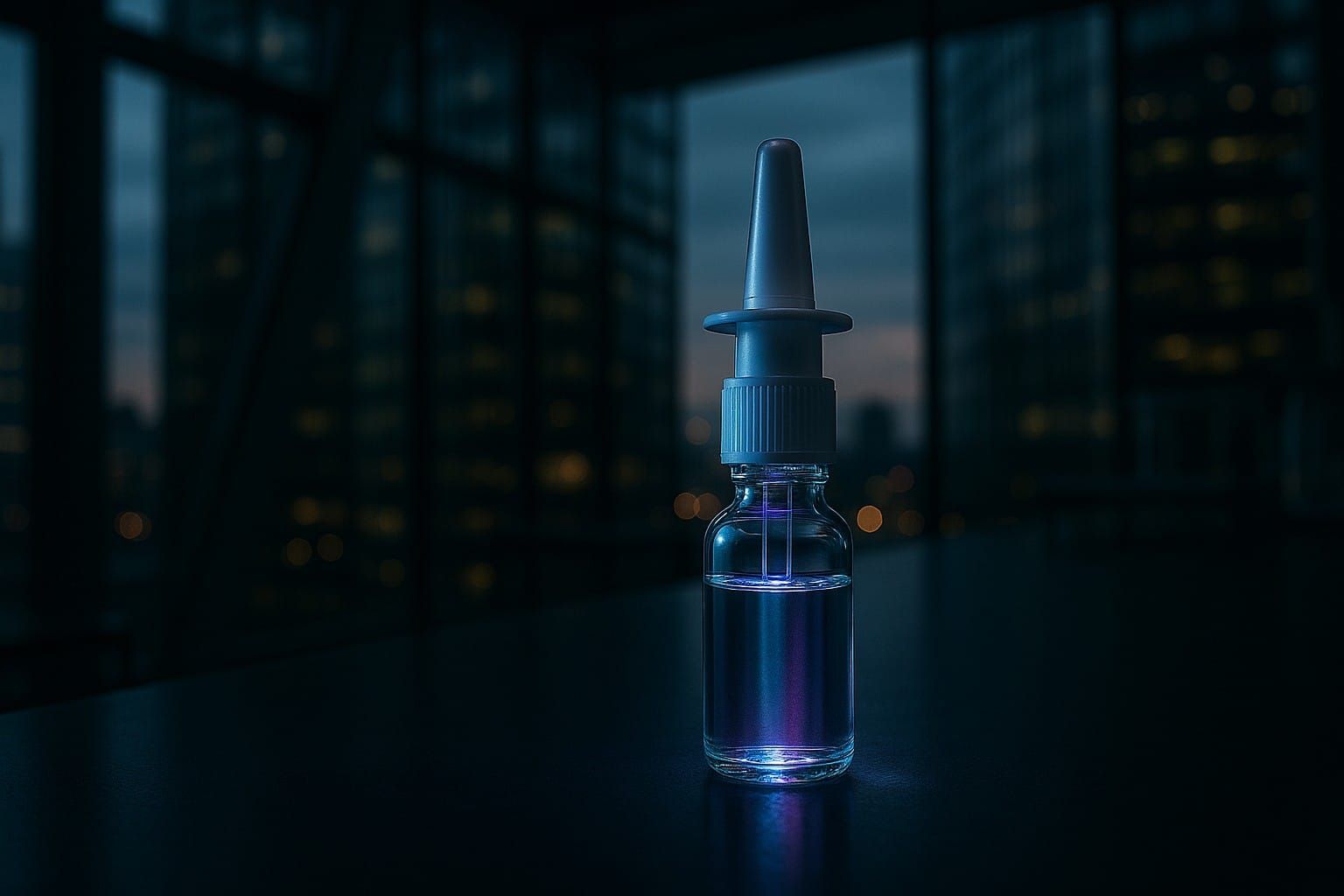
The asset that justifies the price is BPL-003: an intranasal formulation of mebufotenin, better known as 5-MeO-DMT. It carries FDA Breakthrough Therapy designation for treatment-resistant depression and is in Phase 3. The Phase 2a data that put it on Lilly's radar came from a small trial — twelve patients with treatment-resistant depression, still on their standard antidepressants — in which a single dose produced a 66.7% response rate within two days. In the 10 mg cohort, 83% of responders still met the response threshold twelve weeks later. One dose. Three months of effect.
Two more programs come with the deal: VLS-01, a DMT film that dissolves in the cheek, in Phase 2b for the same indication; and EMP-01, a purified form of MDMA aimed at social anxiety disorder.
The commercial logic of BPL-003 specifically is about time. Psilocybin therapy requires a six-to-eight-hour supervised session — a full clinical day per patient. The 5-MeO-DMT experience is measured in minutes, not hours, which means a clinic can treat several patients per room per day instead of one. In a treatment model where the scarce input is supervised clinic time, that throughput difference is the margin.
Why Now: Three Forces Converged
The business model got proven — by accident, by J&J. Spravato, Johnson & Johnson's esketamine nasal spray for treatment-resistant depression, was approved in 2019 to widespread skepticism: a dissociative drug, administered only in certified clinics, under a restrictive FDA safety program, with two hours of mandatory post-dose monitoring. Every element of that model was supposed to be commercially fatal. Instead, Spravato did $584 million in a single quarter this year and is tracking toward $3 billion-plus annually. It proved that American psychiatry will build clinic infrastructure around a supervised, episodic drug — and that payers will cover it. Every psychedelic developer has been drafting behind that proof ever since.
Washington flipped. In April, the White House signed an executive order directing the FDA to accelerate psychedelic therapy development. Days later, the agency issued National Priority Vouchers — its new compressed-review instrument — to three psychedelic programs at once: Compass Pathways' psilocybin for treatment-resistant depression, the Usona Institute's psilocybin for major depression, and Transcend Therapeutics' MDMA-like compound for PTSD. On July 13, the FDA published final guidance on how psychedelic clinical trials should be run. In fifteen months, the regulatory posture went from "prove it twice and we may still say no" to "how fast can you file."
The depression market is enormous, stagnant, and embarrassing. Roughly three million Americans have treatment-resistant depression — depression that has already failed at least two adequate courses of treatment. The SSRIs that dominate the market are 40-year-old science, take weeks to work, and fail roughly a third of the patients who try them. It is the largest market in medicine where the standard of care has not meaningfully improved in a generation. A single-dose therapy with a twelve-week effect is not an incremental entrant into that market; it is a different product category.
Briefings like this land in members' inboxes before the market prices them in. Join free →
The Repricing Beyond the Deal
The analyst response tells you where consensus is heading. Canaccord Genuity nearly doubled its peak-sales forecast for BPL-003 to $3.7 billion by 2036, modeled on a treatment course priced around $30,000 a year. Jefferies went further: if Phase 3 shows superiority over Spravato, peak sales could reach $5 billion or more — and on those numbers, the deal "heavily favors" Lilly.
The sector reaction was more interesting than the headline pop, because it split.
Compass Pathways — the most clinically advanced psilocybin program, with two successful Phase 3 trials and an FDA filing expected in the fourth quarter — fell 7% on the news. That looks perverse until you run the logic: Lilly just became a direct competitor in treatment-resistant depression, with a faster-throughput drug and unlimited commercial resources, and the number of plausible acquirers for Compass just shrank by one. Validation of the category is not the same as validation of every company in it.
GH Research, which is developing its own 5-MeO-DMT program, rose 8% — the read-across of a trillion-dollar company blessing your exact molecule. Cybin climbed double digits. The market is now sorting psychedelic pure-plays into two piles: assets a major would buy, and companies that will have to survive commercialization alone against Lilly and J&J. That sorting has just begun, and the gap between the piles will widen.
There's a second-order market here too. Supervised, episodic psychiatric treatment doesn't fit the retail-pharmacy model that built the antidepressant business — it fits the infusion-center model. Spravato already spawned a network of interventional psychiatry clinics. If psilocybin approval lands next year and BPL-003 follows, that clinic layer — the picks and shovels of in-clinic psychiatry — becomes real healthcare infrastructure, with the real-estate, staffing, and reimbursement businesses that implies.
What Could Break the Thesis
The honest risks, in descending order of severity.
Phase 3 is still Phase 3. BPL-003's headline data came from twelve patients. Depression trials are notorious for placebo responses that flatten in larger samples, and blinding a psychedelic trial is genuinely hard — patients tend to notice whether they got the toad venom. A miss would not kill the category, but it would vaporize the CVRs and mark the deal down to an expensive option.
The FDA has said no before. In 2024, the agency rejected Lykos Therapeutics' MDMA-assisted therapy for PTSD despite two positive Phase 3 trials, citing trial-integrity problems, and demanded another study. The current political tailwind is strong, but the Lykos precedent stands: enthusiasm in the White House does not compel approval, and data quality still decides outcomes.
Reimbursement is the silent gatekeeper. A $30,000 annual course only produces $3.7 billion in sales if insurers pay. Spravato's trajectory suggests they will — for patients with documented treatment failures. Broader coverage fights, prior-authorization friction, and state-by-state Medicaid decisions will set the realistic slope of every revenue curve in this category.
Political weather changes. A regulatory posture created by executive order can be revised by one. The science is durable; the fast track may not be.
The Bottom Line
Categories in pharma don't become real when the science works. They become real when a balance sheet that cannot afford to be wrong commits to them. GLP-1s had their moment like this. So did gene therapy. Psychedelic medicine just had its own: the largest drugmaker on earth looked at synthetic toad venom, ran the numbers against a three-million-patient market with no good answer, and paid up — and its own shareholders applauded.
The first FDA approval of a classic psychedelic — Compass's psilocybin, on the fast track, filing this quarter — is now a matter of timing rather than possibility. The stigma discount is gone. From here, this sector gets priced the way everything else in pharma is priced: on trial data, throughput economics, and payer behavior. Which is exactly what winning looks like.
If this analysis was useful, this is what AlphaBriefing does every day — geopolitics and markets, connected to what it means for your money. Free members get the daily brief in their inbox; paid members get the investment frameworks, scenario pricing, and catalyst calendars behind the paywall.
Sign up free → — upgrade whenever it earns it.
Get this level of intelligence every day. Subscribe to AlphaBriefing — free, member, and paid tiers available.
Sources & Further Reading
- Eli Lilly — Lilly to acquire AtaiBeckley to advance therapies for treatment-resistant depression
- GEN — StockWatch: Lilly's Up-to-$3.8B Deal for AtaiBeckley a Good Trip for Psychedelic Drugs
- BNN Bloomberg — Lilly enters psychedelic drug race with up to US$3.8 billion AtaiBeckley deal
- Yahoo Finance — Eli Lilly to buy psychedelic drugmaker AtaiBeckley for up to $3.8 billion
- PharmaVoice — J&J's comeback kid Spravato heads for blockbuster status
- Houston Public Media — Psychedelic treatments are on the verge of FDA approval
Disclaimer
AlphaBriefing is an independent intelligence publication. The content in this article is produced for informational and educational purposes only. Nothing published by AlphaBriefing constitutes financial, investment, legal, tax, or regulatory advice, nor should it be construed as a solicitation or recommendation to buy, sell, or hold any security, asset, or financial instrument.
All views expressed are those of the author at the time of writing and are subject to change without notice. Markets are volatile and unpredictable; past performance is not indicative of future results. Any investment involves risk, including the possible loss of principal.
AlphaBriefing and its principals, employees, or contributors may hold positions in securities or assets mentioned in this article. This should be considered a potential conflict of interest. No material relationship with any company referenced exists unless explicitly disclosed. Readers should conduct their own due diligence and consult qualified financial, legal, and tax advisors before making any investment decisions.
Information in this article is drawn from public sources believed to be reliable at the time of publication. AlphaBriefing makes no warranty, express or implied, as to the accuracy, completeness, or timeliness of any information herein. AlphaBriefing accepts no liability for any loss or damage arising from reliance on this content.
© AlphaBriefing. All rights reserved. Unauthorised reproduction or distribution is prohibited.