Why America's Frackers Are Now Drilling for Electricity
Fervo just borrowed $421 million against holes in the ground and Quaise raised $134 million to drill with microwaves. The AI power trade already repriced nuclear — enhanced geothermal is the baseload asset class Wall Street hasn't found yet.

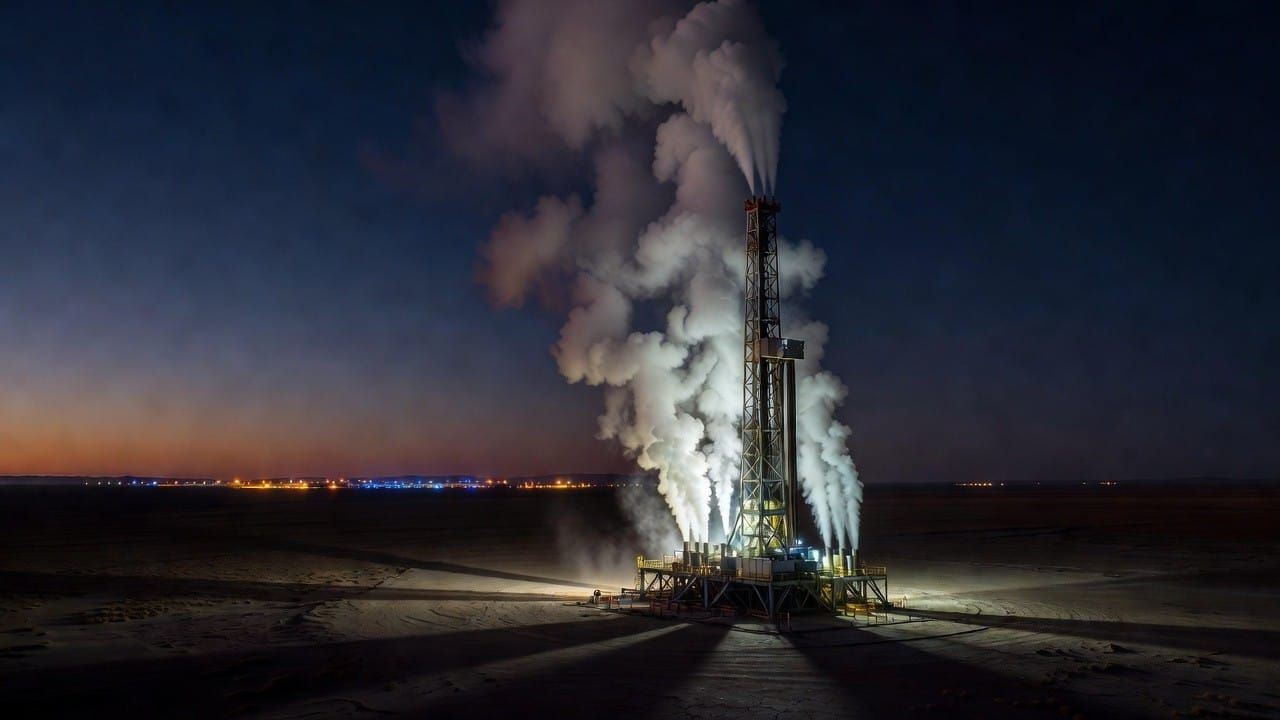
On July 7, a Houston company called Quaise Energy closed $134 million in fresh funding to do something that sounds like science fiction: vaporize granite with millimeter waves — the same energy used in fusion research — and drill toward rock hot enough to melt lead. The round was led by Prelude Ventures, with two of Japan's largest energy companies, JERA and Idemitsu, writing strategic checks. The money funds Project Obsidian in central Oregon, billed as the world's first commercial "superhot" geothermal power plant.
Four months earlier, a quieter deal mattered even more. Fervo Energy — the Houston startup building the largest next-generation geothermal project on earth in Beaver County, Utah — secured $421 million in non-recourse project financing for the first phase of its Cape Station plant. Not venture capital. Not a government grant. A construction-to-term loan, the same boring instrument lenders use for toll roads and gas plants.
That word — boring — is the story. Venture capital funds experiments. Project finance funds infrastructure. When lenders are willing to be repaid solely from the cash flows of holes in the ground in rural Utah, a technology has stopped being a bet and started being an asset class.
The AI power crunch has already repriced nearly everything else that generates a reliable electron. Uranium, nuclear developers, gas turbine order books, even grid transformers — the market found them all. Enhanced geothermal is the one form of 24/7 clean power that hasn't had its moment. That is starting to change, and the reason is not a physics breakthrough. It's that geothermal quietly absorbed the American shale industry's entire playbook.
The shale transfer
Traditional geothermal needed a geological lottery ticket: naturally occurring hot water close to the surface, which is why nearly all of America's roughly 4 gigawatts of existing capacity sits in California and Nevada. Geothermal has been stuck at about half a percent of US electricity for decades.
Enhanced geothermal systems (EGS) remove the lottery. Instead of hunting for hot water, you drill down to hot dry rock — nearly everywhere on earth, if you go deep enough — drill horizontally through it, fracture it, and pump your own water through the artificial reservoir. Hot water comes up, spins a turbine, gets injected back down. A closed loop, running around the clock, on a footprint a fraction of a solar farm's.
If "drill down, turn horizontally, fracture the rock" sounds familiar, it should. It is precisely the technique that turned the United States into the world's largest oil and gas producer. Fervo was founded by petroleum engineers. Its rigs, crews, drill bits, and service contractors come out of the Permian Basin. And the learning curve came with them: Fervo says drilling times at its Utah site have fallen roughly 70% from its first wells, the same kind of cost collapse that made shale economic in the 2010s. The Department of Energy's Enhanced Geothermal Shot targets $45 per megawatt-hour by 2035 — competitive with new gas — and its analysis puts the addressable prize at 90 gigawatts by 2050, roughly twenty times today's installed base.
Briefings like this land in members' inboxes before the market prices them in. Join free →
The bankability threshold
Three separate signals over the past eight months mark the crossing.
First, the debt. Fervo's $421 million package in March — construction-to-term loan, tax-credit bridge, letter of credit — is the financing structure of a power plant, not a startup. It followed a $462 million Series E in December, led by B Capital with Google participating, that pushed Fervo's total raised to roughly $1.5 billion. Cape Station's first 100 megawatts are scheduled to deliver power late this year, scaling to 500 megawatts by 2028, with permits allowing up to 2 gigawatts.
Second, the customers. Google signed the industry's first corporate EGS power purchase agreement and has expanded to a 115-megawatt arrangement supplying its Nevada data centers through NV Energy. Meta has signed 150-megawatt deals with two separate geothermal startups. The hyperscalers spent 2024 and 2025 locking up nuclear capacity; the follow-on trade — firm, clean, deliverable this decade — is geothermal. A data center doesn't care what's underneath it, only that the power never flickers. New EGS plants are designed to run at capacity factors above 90% — on par with nuclear and roughly triple utility-scale solar's.
Third, the strategics. JERA is Japan's largest power generator; Idemitsu is one of its largest integrated energy companies. When Japanese utilities — famously conservative, chronically energy-insecure — buy into an American drilling startup's Series B, they are not chasing venture returns. They are buying an option on a technology that works in their geography too. Quaise's millimeter-wave rig is approaching one kilometer of depth at its central Texas test site; its target of 300–500°C rock, if reached economically, would make geothermal viable almost anywhere on the planet.
Washington's quiet fast lane
Here is the part the energy transition crowd and the drill-baby-drill crowd both underappreciate: geothermal is the only power source with genuine bipartisan cover in 2026.
Energy Secretary Chris Wright built his career in fracking as CEO of Liberty Energy — which was an early Fervo investor, with Wright sitting on Fervo's board before joining the cabinet. Last year's tax overhaul, which gutted wind and solar credits, left geothermal's investment and production tax credits largely intact into the early 2030s. The technology employs oil-field workers, uses oil-field equipment, and produces the firm power the administration says the AI race requires. It is, politically speaking, clean energy that doesn't look like clean energy.
The permitting machinery is moving the same direction. The bipartisan FREEDOM Act, introduced in early July by Senators Tom Cotton and Catherine Cortez Masto, would impose enforceable timelines on federal energy permits with specific provisions for geothermal development. FERC has separately said it will stop routinely conducting cumulative environmental-effects analyses in project reviews, citing a 2025 Supreme Court decision. And Project Obsidian is being built on federal geothermal leases in the Deschutes National Forest — the kind of siting that would have died in litigation a decade ago.
The catch
None of this means the trade is riskless — or even fully formed.
The scale is still tiny. Cape Station's 500 megawatts is one large data center campus. The 90-gigawatt DOE scenario is a 2050 number resting on cost curves that have to keep falling. Quaise's millimeter-wave drilling has penetrated about a kilometer of rock; commercial viability requires several times that, and "first electrons by 2030" is a target, not a contract. Induced seismicity — the earthquake risk that killed a major EGS project in South Korea in 2017 — remains the industry's tail risk, manageable so far at Fervo's sites but capable of freezing permits overnight if a project gets it wrong. Water consumption and transmission access are real constraints in exactly the hot, dry, remote places EGS works best.
And the public-market surface area is thin. Fervo and Quaise are private. The closest pure-play is Ormat Technologies, a conventional geothermal operator now signing data-center deals of its own; beyond that, exposure runs through the oil-services majors — Halliburton, SLB, Baker Hughes — that supply the rigs and have taken their own geothermal positions, and through the utilities buying the output. That thinness is itself information: when an asset class crosses from venture to infrastructure, the repricing happens before most investors can access it directly. Watch for the first EGS developer IPO, the first utility-scale acquisition by an oil major, or the first hyperscaler taking an equity stake rather than a PPA. Any of the three is the starting gun.
The market spent two years bidding up every megawatt of existing clean baseload — nuclear plants, uranium, hydro. Enhanced geothermal is the first genuinely new supply of it. Cape Station's first power, due within months, is when the theory meets a meter.
If this analysis was useful, this is what AlphaBriefing does every day — geopolitics and markets, connected to what it means for your money. Free members get the daily brief in their inbox; paid members get the investment frameworks, scenario pricing, and catalyst calendars behind the paywall.
Sign up free → — upgrade whenever it earns it.
Sources & Further Reading
- Quaise Energy — $134 Million First Close of Series B to Build World's First Superhot Geothermal Power Plant
- Fervo Energy — $421 Million in Non-Recourse Project Financing for Cape Station
- Fervo Energy — $462 Million Series E to Accelerate Geothermal Development
- US Department of Energy — Enhanced Geothermal Shot
- Canary Media — Fervo Lands Major Investment as Cape Station Advances
- Mintz — Washington Update: Sustainable Energy & Infrastructure (July 2026)
Disclaimer
AlphaBriefing is an independent intelligence publication. The content in this article is produced for informational and educational purposes only. Nothing published by AlphaBriefing constitutes financial, investment, legal, tax, or regulatory advice, nor should it be construed as a solicitation or recommendation to buy, sell, or hold any security, asset, or financial instrument.
All views expressed are those of the author at the time of writing and are subject to change without notice. Markets are volatile and unpredictable; past performance is not indicative of future results. Any investment involves risk, including the possible loss of principal.
AlphaBriefing and its principals, employees, or contributors may hold positions in securities or assets mentioned in this article. This should be considered a potential conflict of interest. No material relationship with any company referenced exists unless explicitly disclosed. Readers should conduct their own due diligence and consult qualified financial, legal, and tax advisors before making any investment decisions.
Information in this article is drawn from public sources believed to be reliable at the time of publication. AlphaBriefing makes no warranty, express or implied, as to the accuracy, completeness, or timeliness of any information herein. AlphaBriefing accepts no liability for any loss or damage arising from reliance on this content.
© AlphaBriefing. All rights reserved. Unauthorised reproduction or distribution is prohibited.