Who Builds a Mega-Constellation That Nobody Owns?
Eight NATO nations just agreed to wire their sovereign military satellites into one virtual mega-constellation. Nobody is buying new hardware — which is exactly why the money is in the seams.

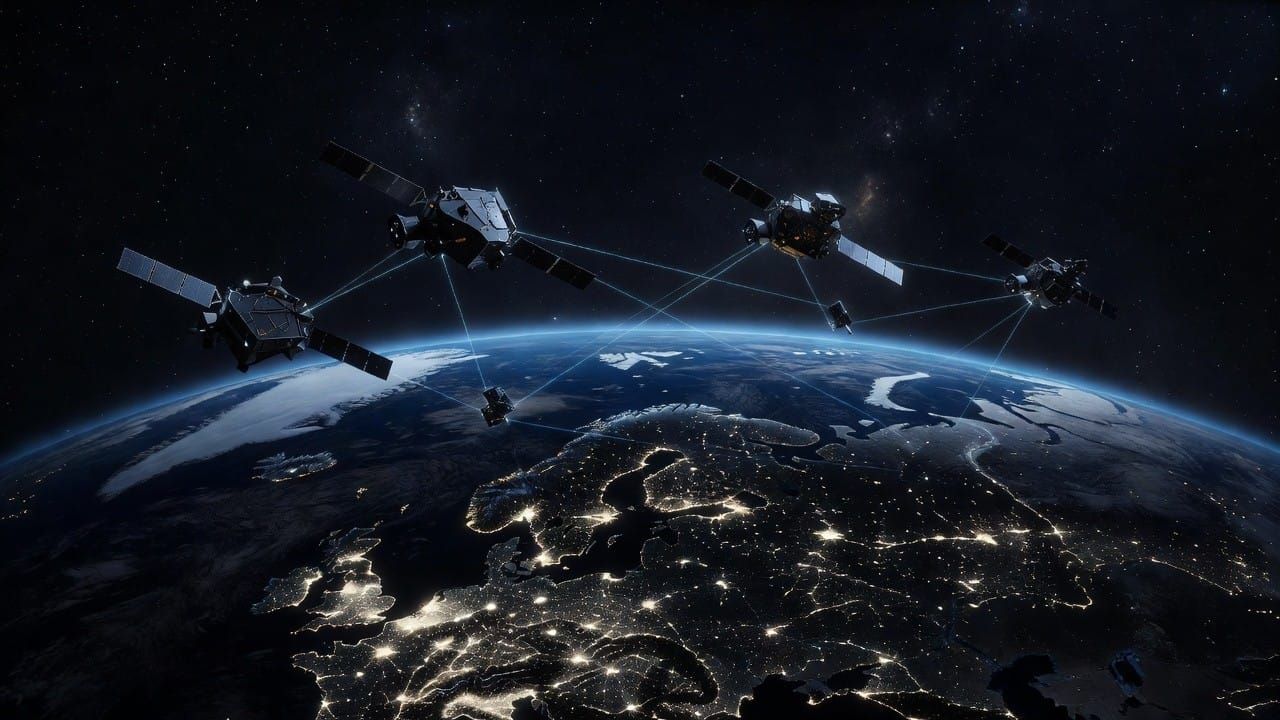
On July 7, at NATO's Summit Defence Industry Forum in Ankara, eight allies — Canada, Denmark, Finland, Germany, the Netherlands, Norway, Sweden, and Türkiye — announced something the space industry has spent a decade insisting was politically impossible. The initiative is called HALO: Hybrid Alliance Layered Operations in Space. Its premise is simple and quietly radical: instead of each nation flying its own undersized military satellite fleet, the eight will wire their sovereign spacecraft together into a single networked "mega-constellation" for high-speed communications, intelligence, and missile tracking.
Every nation keeps ownership and control of its own satellites. But the systems become interoperable — one virtual constellation assembled from eight national fleets. NATO Deputy Secretary General Radmila Šekerinska framed the goal precisely: overcoming "the cost, the time, and coverage limitations of single-nation satellite fleets."
No new constellation. No prime contractor. No flag on the program. That's what makes it interesting — and investable in ways the headlines miss.
The sovereignty tax
Europe's military space problem has never been a technology problem. It's an org-chart problem.
Defense satellites are where European integration goes to die. Nations will happily share weather data and science missions, but reconnaissance and military communications touch the rawest nerve of sovereignty — so every country builds its own small, expensive, incomplete fleet. Germany operates roughly eight to ten defense satellites. Türkiye has around ten. Norway three. Canada's dedicated military satellite fleet is essentially one spacecraft, Sapphire. Sweden orbited its first sovereign military reconnaissance satellite only last year.
Individually, these fleets are subscale: gaps in coverage, no persistent revisit, no redundancy. A satellite that passes over the Baltic twice a day is an intelligence asset. Eight nations' satellites passing over the Baltic forty times a day is a surveillance architecture. The hardware already exists. What's missing is the connective tissue.
The alternative paths are all unattractive. Buying capacity from Starlink means renting your kill chain from a single foreign company — a dependence Europe has been actively trying to escape since the Ukraine war made the risk explicit. The EU's answer, the €10.6 billion IRIS² constellation, isn't expected to deliver service before 2030 and is a civil-led program besides. And building national mega-constellations one country at a time is the most expensive option of all — only Germany, with its €35 billion military space budget through 2030, is even attempting it.
HALO is the fourth path: federation. Take the fleets that already exist, make them speak to each other, and get scale without a single new procurement fight.
What the eight actually bring
The founding membership is more capable than it looks:
- Germany — the anchor tenant. Eight to ten defense satellites today, with announced plans for a communications and reconnaissance architecture of up to 1,200 satellites by 2030, backed by that €35 billion budget line.
- Türkiye — roughly ten satellites across Earth observation and communications, plus newly announced plans for two more high-resolution imaging satellites and a military LEO comms investment.
- Finland — launched its third dedicated military SAR satellite the same week HALO was announced.
- The Netherlands — an experimental fleet growing by four contracted radar-imaging satellites.
- Denmark and Sweden — a joint defense satellite flown in 2025, plus Sweden's new sovereign reconnaissance bird.
- Norway — military radar satellites, defense payloads on state-owned Arctic broadband spacecraft, and something more valuable than any of them (more on that below).
- Canada — Sapphire, deep public-private partnerships, and a new role as the 15th member of NATO's STARLIFT launch-access initiative, announced the same day.
Stitch that together and you have communications, optical imaging, synthetic aperture radar, and Arctic coverage — the ingredients of a genuine layered architecture, already in orbit, already paid for.
Which raises the question every investor should be asking: if federation means nobody has to buy a new constellation, who actually gets paid?
The rest of this briefing is for paid members: the four listed companies that sell the "stitching" HALO cannot work without, the private Finnish supplier that has quietly become the sovereign-radar standard across three HALO fleets (and what its €10 billion June round says about the endgame), the German budget line that turns an unfunded communiqué into contract flow, and the catalyst calendar through 2027.
AlphaBriefing Paid gets you every investment thesis, scenario framework, and catalyst brief we publish — the analysis private intel clients pay four figures for, at a fraction of that.