Why America's AI Boom Is Running Out of Electricians
Big Tech can buy GPUs, sign power deals, and break ground. What it can't do is conjure the welders, electricians, and pipefitters needed to actually build the AI economy — and the shortage is now the binding constraint on every hyperscaler's roadmap.

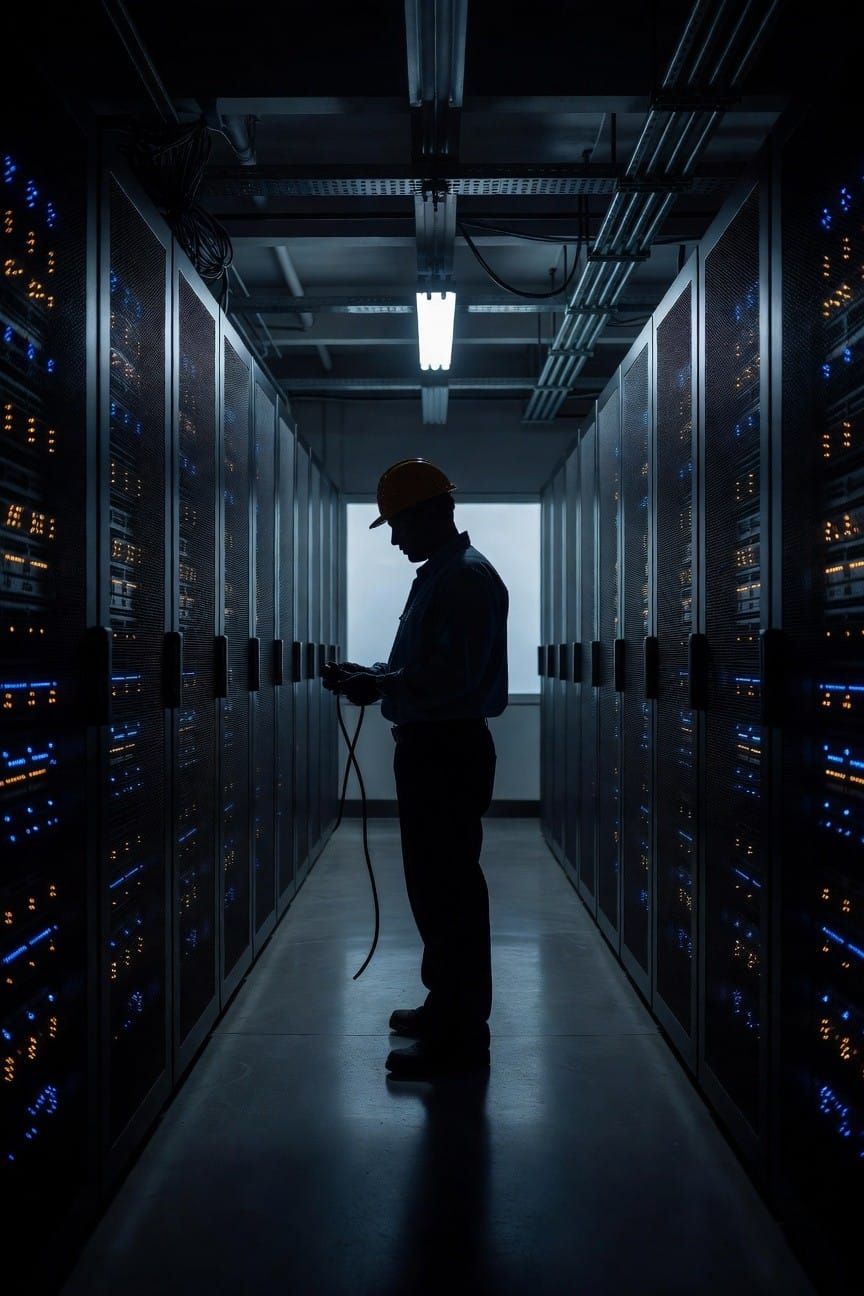
The story Wall Street keeps telling about the AI buildout is one of capital and silicon. Trillions of dollars in capex. Nvidia's order book. Megawatts contracted, gigawatts pending. The financial press has spent two years treating compute and power as the two scarce inputs that will decide who wins the next decade.
There is a third input. Nobody trades it. Nobody models it. And it is, by the admission of the people writing the checks, the single biggest obstacle to the whole thesis.
The United States does not have enough electricians to wire the data centers the hyperscalers have already announced.
It does not have enough welders to fabricate the pressure vessels, structural steel, switchgear enclosures, or cooling loops these facilities require. It does not have enough HVAC technicians, pipefitters, or mission-critical mechanical contractors to finish out the build. And the gap is not narrowing — it is widening, fast, because the workforce is retiring faster than it is being replaced.
This is the constraint Wall Street is mispricing.
The numbers
The American Welding Society projects a deficit of more than 330,000 welding professionals by the late 2020s, against a current U.S. welding workforce of roughly 771,000. Over 157,000 of those workers are at or approaching retirement age. The replacement rate is not close to keeping up.
The electrician picture is worse. The U.S. needs an estimated 300,000 net new electricians over the next decade, plus replacements for roughly 200,000 expected retirements — a combined gap approaching half a million workers. Nearly 30% of unionized electricians are aged 50 to 70. BLS projects 9–11% job growth through the early 2030s, but the pipeline of new entrants isn't matching it.
Pull the lens back to the whole trades stack — electricians, welders, plumbers, HVAC techs, mechanics, carpenters, construction workers — and the gap is nearly 1.4 million unfilled jobs by 2030 across roles that currently total about 5.6 million positions. The Information Technology and Innovation Foundation estimates the resulting drag could run as high as $325 billion in annual GDP by 2030 if it remains unaddressed.
The Associated Builders and Contractors estimate the construction industry alone needs 349,000 net new workers in 2026 to keep up with current demand. Specifically for data center construction, one labor-market study projects a shortfall of up to 499,000 workers this year.
Why this is the binding constraint
Hyperscalers have been telling anyone who will listen.
Microsoft's Brad Smith has called the electrician shortage Microsoft's single biggest obstacle to U.S. data center expansion — not capital, not permits, not even power. The company has resorted to flying electricians in from 75-plus miles away and temporarily relocating crews to keep facilities on schedule. The International Brotherhood of Electrical Workers has called the situation a "life or death" issue for Microsoft, Amazon, and Meta.
The reason is structural. Electrical work accounts for 45 to 70% of total data center construction cost. A modern hyperscale facility is, in engineering terms, a giant electrical box wrapped in a building. You can finance it, you can permit it, you can contract the power — but if you can't get qualified high-voltage electricians and mission-critical mechanical contractors on site, the GPUs sit on a pallet.
The consequences are already visible. Several Oracle data centers earmarked for OpenAI workloads have slipped from 2027 into 2028. Texas builders report data center projects pulling electricians off residential jobs by offering double-digit hourly premiums, delaying single-family home builds by up to two months. Welders and electricians on mission-critical sites are now earning into six figures, often on overtime, with the best specialists clearing $150,000+ on high-voltage or cleanroom work.
This is not a 2030 problem. It is a 2026 problem, in real time, on every active site.
Why Wall Street keeps missing it
The market has correctly identified compute and power as scarce. It has rewarded Nvidia, the hyperscalers, the merchant power producers, the uranium miners, the grid equipment makers, the transformer suppliers. What it has consistently underpriced is the layer of human capital that physically converts capex into operating compute capacity.
Part of that is taxonomy. There is no "AI labor" ETF. The companies that benefit most are unsexy electrical and mechanical contractors, fabrication players, and specialty trade schools — names that don't trade on AI narrative even when they print AI numbers. Quanta Services and EMCOR are not in anyone's "AI basket." They should be.
The other part is timing. Markets price the next quarter. The trades shortage prices the next five years. The labor pipeline — from high school recruitment to four-year apprenticeship to mission-critical certification — is fundamentally longer than the data center cycle the AI capex wave is trying to ride. Even if every Big Tech CEO got a wand tomorrow and waved 100,000 new electrician apprentices into existence, journeyman-grade headcount on hyperscale sites would not meaningfully shift until late 2028 at the earliest.
That mismatch — short capex cycle, long labor cycle — is the trade.
This is where the analysis gets actionable. AlphaBriefing members get the full investment framework — scenarios, positioning, and the bottom line.
Subscribe to AlphaBriefing — Free, Member, and Paid tiers available.