Why America Is Buying Yen
The US Treasury intervened to strengthen the yen for the first time since 1998, the BOJ just hiked to a 31-year high, and Japan's entire bond curve trades at mid-1990s levels. The world's largest creditor is repricing — here's what it means for Treasuries, the carry trade, and your positioning.

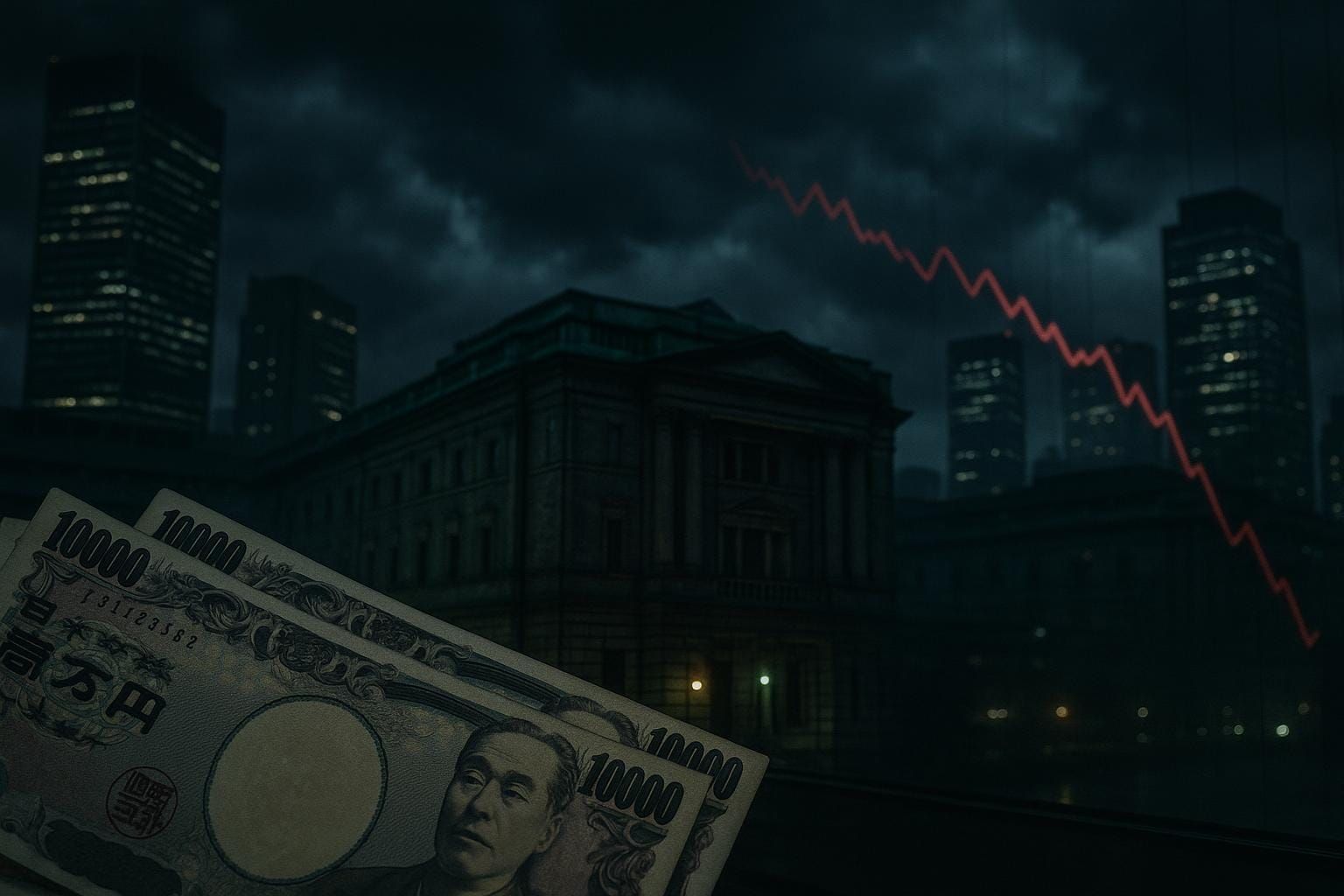
On the last Friday of July, the Federal Reserve Bank of New York quietly sold euros out of the U.S. Treasury's reserves and bought Japanese yen. It was the first time Washington had intervened to strengthen the yen since 1998, when the Asian financial crisis was burning through the region. Treasury Secretary Scott Bessent confirmed the operation days later, called the yen substantially undervalued, and pledged the U.S. would "not hesitate" to do it again. President Trump publicly framed the intervention as a win for both countries.
Two months later, the friendship is being stress-tested. The Bank of Japan has since raised its policy rate to the highest level in 31 years — and the yen fell anyway. Japan's entire government bond curve now trades at levels last seen in the mid-1990s. On Monday, the 2-year Japanese government bond yield closed at 1.98%, its highest since March 1995. The 10-year closed at 3.08%, a level last seen in August 1996. The 25-year set a record in Ministry of Finance data going back two decades.
This is what a slow-motion sovereign repricing looks like. The world's largest creditor nation — and the largest foreign holder of U.S. Treasuries — is watching four decades of financial assumptions expire simultaneously. What happens next matters far beyond Tokyo.
The Summer the Dam Broke
The yen spent July sliding toward ¥164 to the dollar, a level financial media described as four-decade-low territory. The proximate causes stacked up fast: Prime Minister Takaichi's government had pushed a record budget with tax cuts that spooked the bond market, the Fed had turned hawkish while the BOJ dithered, and the rate differential between U.S. and Japanese debt made shorting the yen one of the most comfortable trades in global macro.
Tokyo had intervened alone before, in 2022 and 2024, with diminishing effect. What changed on July 31 was Washington joining in. The New York Fed executed coordinated yen-buying on the Treasury's behalf — selling euros, notably, not dollars — while the BOJ held rates at 1.00% the same day. Bessent followed with a "whatever it takes" pledge and later suggested upsizing the Fed's FIMA repo facility as a structural backstop. The Treasury has never disclosed the size of the operation, despite pressure from Senator Warren for details.
The intervention worked, briefly. Then September arrived. The 10-year JGB yield crossed 3% on September 1 for the first time since 1996, driven by what Reuters described as investor concerns about inflation, fiscal health, and mounting political pressure on the BOJ. The 30-year touched 4.18%. The yen slid back toward ¥160.
The Hike That Didn't Work
On September 18, the Bank of Japan did what markets had spent months demanding: it raised its short-term policy rate a quarter point to 1.25%, the highest since 1995, on a 7–2 vote. Governor Kazuo Ueda declined to rule out consecutive hikes or a half-point move. By the standards of an institution that spent the better part of a decade pinning its 10-year yield near zero, this was hawkish.
The yen's response: it weakened. Dollar-yen went from around ¥156 before the decision to nearly ¥159 within a week. Only a reported BOJ "rate check" — the traditional prelude to intervention, in which the central bank calls dealers to ask for quotes — knocked it back to the upper ¥156 range late last week. It trades near ¥157.6 today.
Why didn't the hike work? Because the other side of the trade kept moving. The Fed raised its own target range to 3.75%–4.00% on September 16 — its first hike since 2023, passed unanimously, with projections pointing to another by December. The U.S. 10-year Treasury now yields around 5.26%, the 30-year 5.59%. Even after Japan's historic repricing, an investor is still paid roughly two percentage points more to hold American debt than Japanese debt at the 10-year point. The gravitational pull on capital hasn't reversed; it has barely weakened.
Meanwhile Japan's fiscal arithmetic gets harder with every basis point. Government debt stands at roughly two and a half times GDP, by far the highest ratio of any major economy, and the finance ministry now has to refinance it into the most expensive JGB market in three decades. The BOJ, still the dominant holder of its own government's bonds after years of quantitative easing, is trying to normalize policy without becoming the crisis it is managing.
That leaves three actors — the BOJ, the finance ministry, and the U.S. Treasury — jointly defending a currency that keeps falling, against a bond market that keeps repricing. Someone's resolve gets tested first. The question for investors is who, and what the tradeable consequences are.
Get the next briefing free in your inbox: Join AlphaBriefing
The rest of this briefing is for paid members: the repatriation math on Japan's $1.1 trillion in U.S. Treasuries, the carry-trade unwind scenario and its August 2024 precedent, the specific Japanese financial names that benefit from a steeper curve, the hedged-versus-unhedged Japan equity decision, and the five-date catalyst calendar through December.
AlphaBriefing Paid gets you every investment thesis, scenario framework, and catalyst brief we publish — the analysis private intel clients pay four figures for, at a fraction of that.