The Hottest Job in the AI Economy Doesn't Require a Degree
Meta got 35,000 applications in a week for 1,000 spots at a trades academy. The AI buildout's real bottleneck isn't chips — it's electricians, and America is short 349,000 construction workers this year alone.

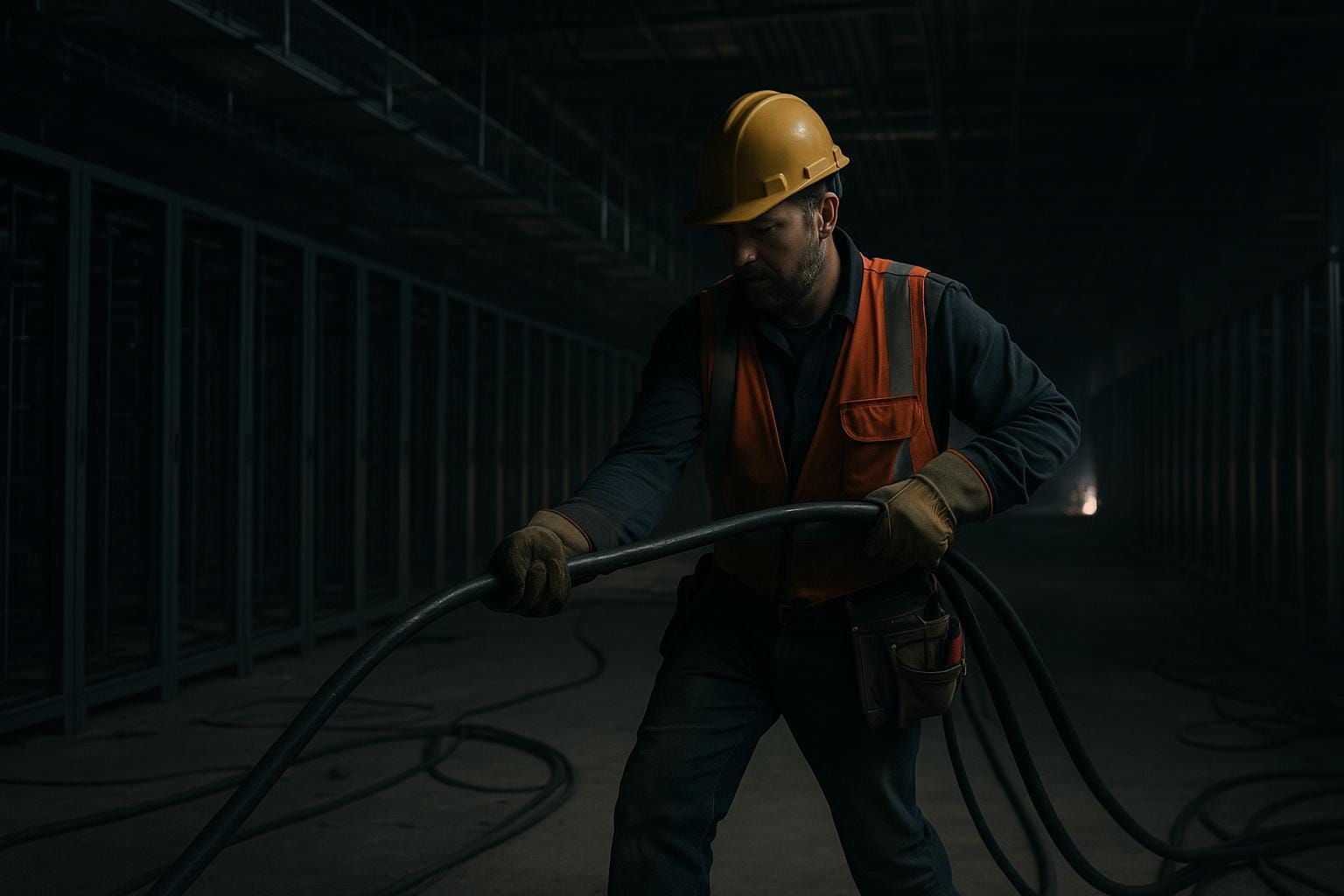
In June, Meta opened applications for a five-week trades academy — free tuition, free lodging, a daily stipend, and a guaranteed job on a data center construction site at the end. Within seven days, 35,000 people had applied for 1,000 spots.
Read that again. An industry that spent a decade telling America's young people to learn to code is now spending $115 million to teach them to pull wire, weld pipe, and pour concrete — and the response rate would make an Ivy League admissions office blush. Meta's "America's Workforce Academy," launching in Indiana, Louisiana, Ohio, and Texas, exists because the artificial intelligence buildout has collided with a problem no amount of capital can immediately solve: the United States does not have enough skilled tradespeople to build what Big Tech has already promised its shareholders.
The AI story of 2026 has been told mostly in chips, power, and capex announcements. The labor story underneath it is just as consequential — and it is quietly rewriting the economics of blue-collar America.
The math doesn't work
Start with the demand side. The four largest hyperscalers — Amazon, Microsoft, Alphabet, and Meta — are on track to spend somewhere in the neighborhood of $700 billion on capital expenditure in 2026, the overwhelming majority of it on AI data centers, according to company guidance compiled by CNBC and Statista; tallies range from roughly $630 billion to over $750 billion depending on what counts and how leases are booked. Whatever the exact figure, it is nearly double what the same four companies spent in 2025, and every dollar of it ultimately lands on a construction site somewhere.
A data center is, structurally, a fairly simple building. What makes it expensive — and labor-hungry — is what goes inside: switchgear, transformers, generators, miles of conduit and cable, cooling loops, fire suppression. Electrical systems are among the largest single cost components of a modern data center build, which means the binding constraint on how fast these facilities go up is not concrete or steel. It is electricians, pipefitters, and the supervisors who can run mission-critical work.
Now the supply side. Associated Builders and Contractors, the construction trade group, estimates the industry needs to attract 349,000 net new workers in 2026 just to meet demand — and 456,000 more in 2027 as spending growth resumes. More than half of that gap is simple replacement: the baby-boomer tradespeople who built the last generation of American infrastructure are retiring faster than they can be replaced, just as megaprojects — AI data centers, semiconductor fabs — stack demand on top.
The federal numbers tell the same story from a different angle. The Bureau of Labor Statistics counts about 821,000 electricians in the country and projects roughly 72,700 openings every year over the coming decade, with employment growing 9 percent from 2025 to 2035 — much faster than the average occupation. Those projections were built before anyone modeled what a $700 billion annual capex cycle does to demand for the trade.
Briefings like this land in members' inboxes before the market prices them in. Join free →
What scarcity pays
The BLS puts the median electrician wage at $63,190 as of May 2025. That number is already a relic in the places where the AI buildout is actually happening.
Industry recruiters and trade press covering hyperscale construction markets report journeyman electricians on data center projects earning $55 to $75 an hour before overtime — an annualized $114,000 to $156,000 at standard hours. Layer on the overtime that mission-critical schedules demand and the untaxed per diems paid to traveling workers, and total annual earnings of $130,000 to $170,000 are common, with specialized workers on the most competitive sites — Northern Virginia, Texas — reportedly clearing $200,000. These figures come from staffing firms and industry surveys rather than government data, and they describe the hot end of the market, not the median. But the direction is unambiguous: data center work now carries a substantial wage premium over traditional construction, and contractors are poaching each other's crews to meet schedules.
For a 22-year-old weighing options, the arbitrage is stark. One path: four years, six figures in tuition debt, and an entry-level white-collar job market that AI is actively compressing. The other: earn while you train, graduate debt-free into a decade-long backlog of guaranteed work, and — at the hot end of the market — out-earn most of your college-educated peers before you turn 30.
The supply response is real — and slow
Young Americans have noticed. The National Student Clearinghouse reports that enrollment at vocationally focused public two-year colleges grew 11.7 percent this spring — about 91,000 additional students — the third consecutive year of strong growth, putting enrollment at these trade-focused institutions nearly 20 percent above spring 2020 levels at roughly 871,000 students. Trade-oriented programs like mechanic and repair technologies are among the fastest-growing majors in the two-year system.
But here is the catch that keeps construction executives up at night: you cannot surge-produce a journeyman electrician. A full apprenticeship typically runs four to five years — classroom hours plus thousands of hours of supervised field work. The students enrolling in trade programs today become fully qualified journeymen around 2030 or 2031. The data centers are being built now. That mismatch is precisely why Meta is paying for its own academy, why contractors are offering signing bonuses once reserved for software engineers, and why the wage premium is unlikely to compress soon: the demand curve moved years faster than the training pipeline can respond.
Why this matters beyond the job site
Three implications worth sitting with.
First, labor — not chips — may set the real timeline of the AI buildout. Nvidia can fab more GPUs. Utilities can (eventually) add generation. But every gigawatt of announced data center capacity has to be physically wired by a finite pool of qualified people, and that pool grows at apprenticeship speed. When hyperscalers miss buildout schedules in 2027 and 2028, look past the chip supply chain to the craft-labor market.
Second, this is a structural wage-inflation story the Fed can't hike away. Construction wage growth driven by a decade-long demographic hole plus a capex supercycle is not the kind of inflation that responds neatly to monetary policy. It compounds instead into the cost of everything else that needs an electrician — housing, factories, grid upgrades — at exactly the moment reshoring and electrification demand more of all three.
Third, the college-premium narrative that organized American economic life for forty years is being repriced in real time. When Meta pays people to skip college and guarantees them a job in five weeks, while entry-level white-collar hiring softens under AI adoption, the relative return on a four-year degree shifts — and 35,000 applications in a week suggests the market has already noticed. The downstream effects on student lending, higher education, and regional economies where data centers cluster will play out for a decade.
The shovels are in the ground. The question the labor market is now asking — and the one worth watching through 2027 — is simple: who is going to hold them?
Get the next briefing free in your inbox: Join AlphaBriefing
If this analysis was useful, this is what AlphaBriefing does every day — the forces moving markets, connected to what they mean for your money. Free members get the daily brief in their inbox; paid members get the investment frameworks, scenario pricing, and catalyst calendars behind the paywall. Get this level of intelligence every day. Subscribe to AlphaBriefing — free, member, and paid tiers available.
Sources & Further Reading
- Fortune — A 5-week course and a guaranteed job: Meta commits $115 million to solve the skilled-trades shortage stalling its AI build-out
- CBS News — Meta launches program to train workers for data center jobs
- Meta — Introducing America's Workforce Academy
- Bureau of Labor Statistics — Occupational Outlook Handbook: Electricians
- Construction Dive — Construction's new worker demand drops to 350,000 in 2026
- NCCER — Report: Construction Needs 349K New Workers in 2026
- National Student Clearinghouse — Vocational-Focused Public 2-Years Lead Spring Enrollment Rise
- CNBC — Tech AI spending approaches $700 billion in 2026
Disclaimer
AlphaBriefing is an independent intelligence publication. The content in this article is produced for informational and educational purposes only. Nothing published by AlphaBriefing constitutes financial, investment, legal, tax, or regulatory advice, nor should it be construed as a solicitation or recommendation to buy, sell, or hold any security, asset, or financial instrument.
All views expressed are those of the author at the time of writing and are subject to change without notice. Markets are volatile and unpredictable; past performance is not indicative of future results. Any investment involves risk, including the possible loss of principal.
AlphaBriefing and its principals, employees, or contributors may hold positions in securities or assets mentioned in this article. This should be considered a potential conflict of interest. No material relationship with any company referenced exists unless explicitly disclosed. Readers should conduct their own due diligence and consult qualified financial, legal, and tax advisors before making any investment decisions.
Information in this article is drawn from public sources believed to be reliable at the time of publication. AlphaBriefing makes no warranty, express or implied, as to the accuracy, completeness, or timeliness of any information herein. AlphaBriefing accepts no liability for any loss or damage arising from reliance on this content.
© AlphaBriefing. All rights reserved. Unauthorised reproduction or distribution is prohibited.