What If the Fed's Next Move Is a Hike?
Inflation just hit 4.2%, the Fed's own dot plot points up, and the only thing keeping hikes off the table is a labor market too weak to touch. Markets rallying on bad news are celebrating the trap closing.

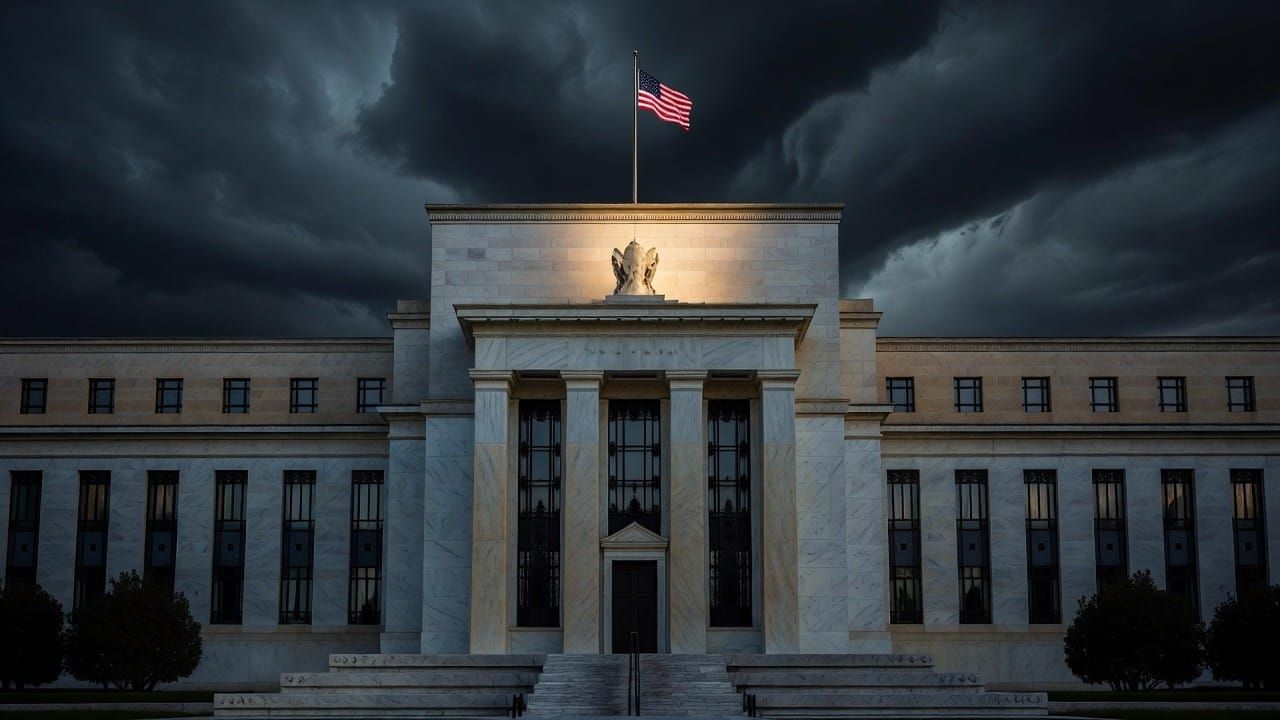
Markets just wrapped their best week since May. The S&P 500 and Nasdaq closed out the strongest first half since 2020, the Dow set fresh record closes, and global equities rallied into the July 4 weekend.
The catalyst for the final leg? A bad jobs report.
That sentence should bother you more than it bothers the market. On July 2, the Bureau of Labor Statistics reported that the US economy added just 57,000 jobs in June — roughly half of what economists expected. Prior months were revised down by a combined 74,000. Stocks rallied anyway, because weak hiring "pours cold water" on the one thing Wall Street has spent the past month quietly dreading: the first Federal Reserve rate hike since 2023.
Read that again. The debate in 2026 is not about when the Fed cuts. It is about whether the Fed has to start raising rates again — with inflation at 4.2%, a brand-new Fed Chair, and a labor market that just stalled. That combination has a name, and nobody at the Fed wants to say it out loud.
Inflation Is Back — and It's Not Subtle
Start with the number the rally is trying to ignore. Headline CPI hit 4.2% year-over-year in May, up from 3.8% in April — the hottest print since April 2023 and more than double the Fed's 2% target. The monthly gain was 0.5%.
The composition matters. This is not a broad demand overheat — it is an energy shock working its way through the economy. Energy prices are up 23.5% year-over-year, with gasoline up a staggering 40.5%, a direct transmission from a year of Middle East escalation and a repriced oil market. Core inflation, which strips out food and energy, sits near 2.9% — elevated, but a different universe from the headline.
That gap between headline and core is the entire policy problem. Energy shocks eventually pass through into everything: freight, airfares, food, plastics, utilities. The longer gasoline sits 40% above last year, the more the "temporary" shock hardens into wage demands and pricing behavior. Every central banker alive studied what happened when the Fed dismissed exactly this dynamic in the 1970s.
The First Hike Debate Since 2023
The Federal Reserve is currently holding its policy rate at 3.50%–3.75%, where it has sat for four consecutive meetings. June's decision was the first under new Chair Kevin Warsh — and it came with a projection package that quietly rewrote the story markets had been telling themselves.
The June dot plot moved the median projected policy rate for end-2026 up to 3.8%, from 3.4% in March. Nine of nineteen Fed officials now pencil in at least one hike this year. Eight see no change. Exactly one sees a cut. The committee also raised its own inflation forecasts — 3.6% headline and 3.3% core for 2026.
Officials are saying it in plain English, too. St. Louis Fed President Alberto Musalem has said a hike "may be needed" if inflation doesn't ease. Governor Lisa Cook — appointed by the previous administration — has signaled the same openness. Bank of America's rates team has floated hikes beginning as early as the fall. For the first time in three years, tightening is a live option on the table, not a tail risk.
This is the context the June jobs report landed in. Markets didn't rally because the economy is fine. They rallied because the economy looked just weak enough to keep Warsh's Fed from pulling the trigger.
The Other Half of the Trap
Now look at what the labor market is actually doing, because this is where the Fed's dilemma stops being academic.
The June unemployment rate fell to 4.2% — and that is the most misleading statistic of the summer. It fell because roughly 720,000 Americans left the labor force in a single month, dragging participation down to 61.5%, the lowest since March 2021. Hiring has slowed to a "low hire, low fire" stall: companies aren't firing workers, but they've largely stopped adding them. Leisure and hospitality — the sector most exposed to gas prices and discretionary spending — shed jobs outright.
So here is the box the Fed is in:
- If it hikes to fight 4.2% headline inflation, it tightens into a labor market that is already stalling — and risks converting a hiring freeze into layoffs.
- If it holds while headline inflation compounds above 4%, it repeats the central banking sin of the 1970s: treating a supply shock as temporary while inflation expectations quietly reset higher.
- Cutting — the thing equity valuations still structurally assume comes eventually — is not even in the conversation.
Rate hikes are a demand weapon. This inflation is substantially a supply problem: an energy shock plus a shrinking workforce. Raising the cost of money does not drill wells or coax 720,000 people back into the labor force. The Fed's tools don't fit the disease — which is precisely what made the 1970s so painful. Arthur Burns held policy too loose into supply shocks and let inflation psychology take root; Paul Volcker then had to break it with a double-digit funds rate and back-to-back recessions. Warsh, in his first year, inherits the opening chapters of that same story arc.
What Gold Already Knows
While equities celebrate the absence of a hike, the metal that doesn't care about earnings season is telling a different story. Gold spiked above $5,000 an ounce at its January peak and still trades north of $4,100 — roughly double where it sat two years ago. It rallied again after the jobs report.
The gold market's logic is brutally simple: if the Fed can't hike because the labor market is too fragile, then real interest rates — the return on cash after inflation — get eaten alive. A 3.6% policy rate against 4.2% headline inflation is a negative real rate. That is the single most bullish macro condition for gold that exists, and it is the current state of American monetary policy. The bond market sees the same thing: hike odds get priced in on hot CPI days and priced out on weak jobs days, whipsawing the front end while the long end quietly demands more compensation.
Equities, meanwhile, are priced for the Goldilocks version: inflation fades on its own, the labor market stalls but never breaks, and the Fed never has to choose. That is a possible outcome. It is not the probable one, and it is certainly not the one you want to be leveraged to at record-high index levels.
What to Watch From Here
Three dates decide how this standoff resolves:
- Mid-July: June CPI. If headline pushes toward 4.5% on energy pass-through, the September hike debate reignites no matter what payrolls did. Watch core services — that's where a supply shock becomes an inflation regime.
- Late July: the FOMC meeting. A hold is near-certain; the language is not. Any acknowledgment that "further policy firming" was discussed would be the most hawkish Fed signal since 2023.
- Early August: July payrolls. A second consecutive sub-100K print with falling participation shifts the conversation from "hike or hold" to "is the expansion ending" — a much worse question at these valuations.
The honest summary of mid-2026 America: inflation more than twice target, a policy rate below headline inflation, a workforce that is shrinking, equity indexes at records, and gold at levels that imply deep distrust of all of the above. Markets spent the holiday week celebrating a jobs report weak enough to handcuff the Fed. That is not good news. That is the trap closing — on Warsh, and on every portfolio priced for rescue.
The last time Wall Street cheered bad economic news this enthusiastically, the assumption underneath was that the Fed would ride in with cuts. This time there is no cavalry coming. There is only a rookie chairman, a 4.2% inflation print, and a dot plot that points up.
Get this level of intelligence every day. Subscribe to AlphaBriefing — free, member, and paid tiers available.
Sources & Further Reading
- Reuters — US job growth misses expectations in June; unemployment rate falls to 4.2%
- BLS — Consumer Price Index Summary (May 2026)
- BLS — Employment Situation Report (June 2026)
- CNBC — Fed holds rates steady at June 2026 meeting, dot plot shifts hawkish
- Reuters — Fed's Musalem says rate hike may be needed if inflation doesn't ease
- Fortune — The Fed's rate-hike outlook under Kevin Warsh: sticky inflation meets slowing job growth
- Indeed Hiring Lab — June 2026 Jobs Report: An Unmoving Tide
- CNBC — Gold and silver rally as jobs data dents rate-hike bets
Disclaimer
AlphaBriefing is an independent intelligence publication. The content in this article is produced for informational and educational purposes only. Nothing published by AlphaBriefing constitutes financial, investment, legal, tax, or regulatory advice, nor should it be construed as a solicitation or recommendation to buy, sell, or hold any security, asset, or financial instrument.
All views expressed are those of the author at the time of writing and are subject to change without notice. Markets are volatile and unpredictable; past performance is not indicative of future results. Any investment involves risk, including the possible loss of principal.
AlphaBriefing and its principals, employees, or contributors may hold positions in securities or assets mentioned in this article. This should be considered a potential conflict of interest. No material relationship with any company referenced exists unless explicitly disclosed. Readers should conduct their own due diligence and consult qualified financial, legal, and tax advisors before making any investment decisions.
Information in this article is drawn from public sources believed to be reliable at the time of publication. AlphaBriefing makes no warranty, express or implied, as to the accuracy, completeness, or timeliness of any information herein. AlphaBriefing accepts no liability for any loss or damage arising from reliance on this content.
© AlphaBriefing. All rights reserved. Unauthorised reproduction or distribution is prohibited.