What Does the Won Know That the KOSPI Doesn't?
South Korea runs a current-account surplus, exports record chips, and hosts one of the world's hottest stock markets. Its currency just hit 2009-crisis lows anyway. The won is the first honest price of the Warsh Fed era.

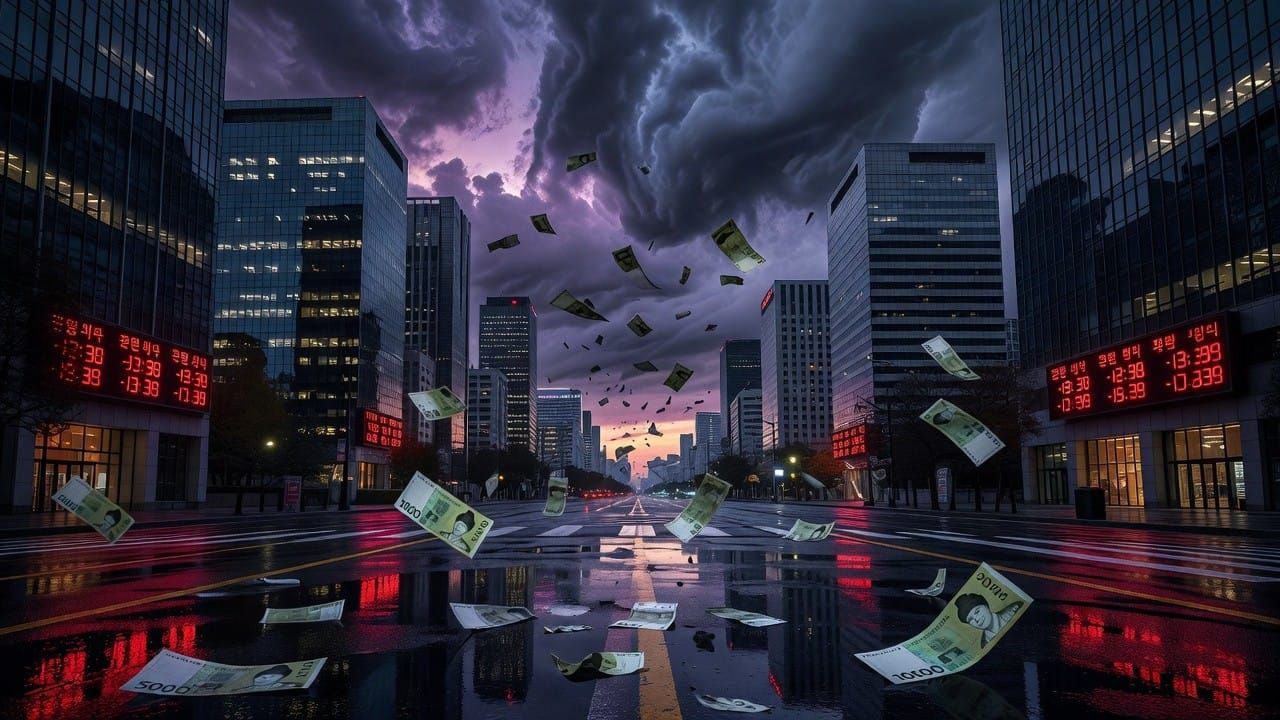
On July 1, the gauge tracking emerging-market currencies erased everything it had gained in 2026. Six months of the "EM renaissance" trade — one of Wall Street's consensus calls for the year — round-tripped in a single spring. And leading the move lower, sliding back toward levels last seen in March 2009, was a currency that has no business being there: the South Korean won.
Think about what was happening in March 2009. Lehman was six months dead. The S&P was carving out its crisis bottom. Global trade had fallen off a cliff, and Korea — a leveraged bet on global trade if there ever was one — watched its currency collapse toward 1,600 per dollar as foreign capital fled anything with beta.
Now look at Korea in 2026. The current account runs a surplus. Semiconductor exports are riding the biggest memory upcycle in history. The defense industry has become a $24 billion export machine backfilling the West's empty arsenals. Samsung crossed $1 trillion in market value in May as the KOSPI smashed through record after record — even after this week's pullback, it remains one of the best-performing major stock markets in the world this year.
And yet the won broke 1,560 per dollar in early June — its weakest since the depths of the global financial crisis — forced Seoul into emergency meetings, and is sliding again this week as global funds dump Korean stocks.
Currencies at crisis lows are supposed to mean crisis economies. Korea doesn't have a crisis economy. So either the stock market is wrong about Korea, or the currency market is wrong — or they're both right, and they're pricing two different things.
That last option is the story. And it's much bigger than Korea.
The leak is coming from inside the house
The textbook says a country that sells more than it buys accumulates claims on foreigners, and its currency firms. Korea sells far more than it buys. The textbook is failing for one reason: the surplus never comes home.
Korea's own savers have become the outflow. Retail investors — the famous seohak ants — have spent years shoveling household wealth into US stocks, and the institutions followed: pension money, insurance money, corporate treasuries. By mid-2026, Korean holdings of US assets had crossed the $1 trillion mark. Every month, the export surplus flows in — and flows straight back out into Nvidia, Treasuries, and Texas real estate. The current account says "buy won." The capital account screams "sell."
This is not hot foreign money fleeing an emerging market — the classic 1997 script. This is a rich country's own citizens deciding, at scale, that their savings compound better in someone else's currency. There is no speculator to punish, no George Soros to blame. The Bank of Korea can probe offshore derivatives desks all it wants — the flow it's fighting is its own population's retirement plan.
Then Warsh lit the match
For the first half of 2026, that structural leak was survivable, because the dollar was drifting and everyone from JPMorgan down was overweight EM currencies for the second half.
Then came June 17. Kevin Warsh chaired his first FOMC meeting, and the market discovered what a post-Powell Fed actually looks like. The statement was gutted to a fraction of its old length. The easing bias vanished. With inflation running near 4.2%, nine of eighteen committee participants penciled in at least one hike by year-end — a dot plot that flipped the entire 2026 rates conversation from "when do they cut" to "how soon do they tighten." At the ECB's Sintra forum this week, Warsh's message stayed simple: inflation is still too high.
The dollar did what the dollar does when the Fed turns hawkish and everyone is positioned the other way. And every currency living off rate-differential goodwill — the won first among them, with the Bank of Korea unable to match a tightening Fed against a soft domestic economy — got repriced in weeks.
Here is why this matters far beyond Seoul: the won is the most liquid, most institutionally traded proxy for Asian FX risk. It is the canary that trades around the clock. If a surplus economy with world-class exporters and a record stock market cannot hold its currency in the Warsh era, ask what happens to the deficit economies that were supposed to lead the second-half EM rally.
The KOSPI's record run and the won's collapse are not a contradiction. They are the same trade, viewed from opposite sides: capital rewarding Korea's dollar-earning corporations while fleeing the currency those corporations pay their workers in. One market prices the companies. The other prices the country.
The question is what breaks the loop — and who makes money in each version of the answer.
This is where the analysis gets actionable. AlphaBriefing members get the full investment framework — scenarios, positioning, and the bottom line.
Subscribe to AlphaBriefing — Free, Member, and Paid tiers available.