Three Industries Are Paying for the Most Expensive Midterms in History
The all-time record for corporate election spending fell in March — seven months before a single midterm vote. The money isn't coming from oil, pharma, or banks: crypto, AI, and sportsbooks are buying the regulatory map.

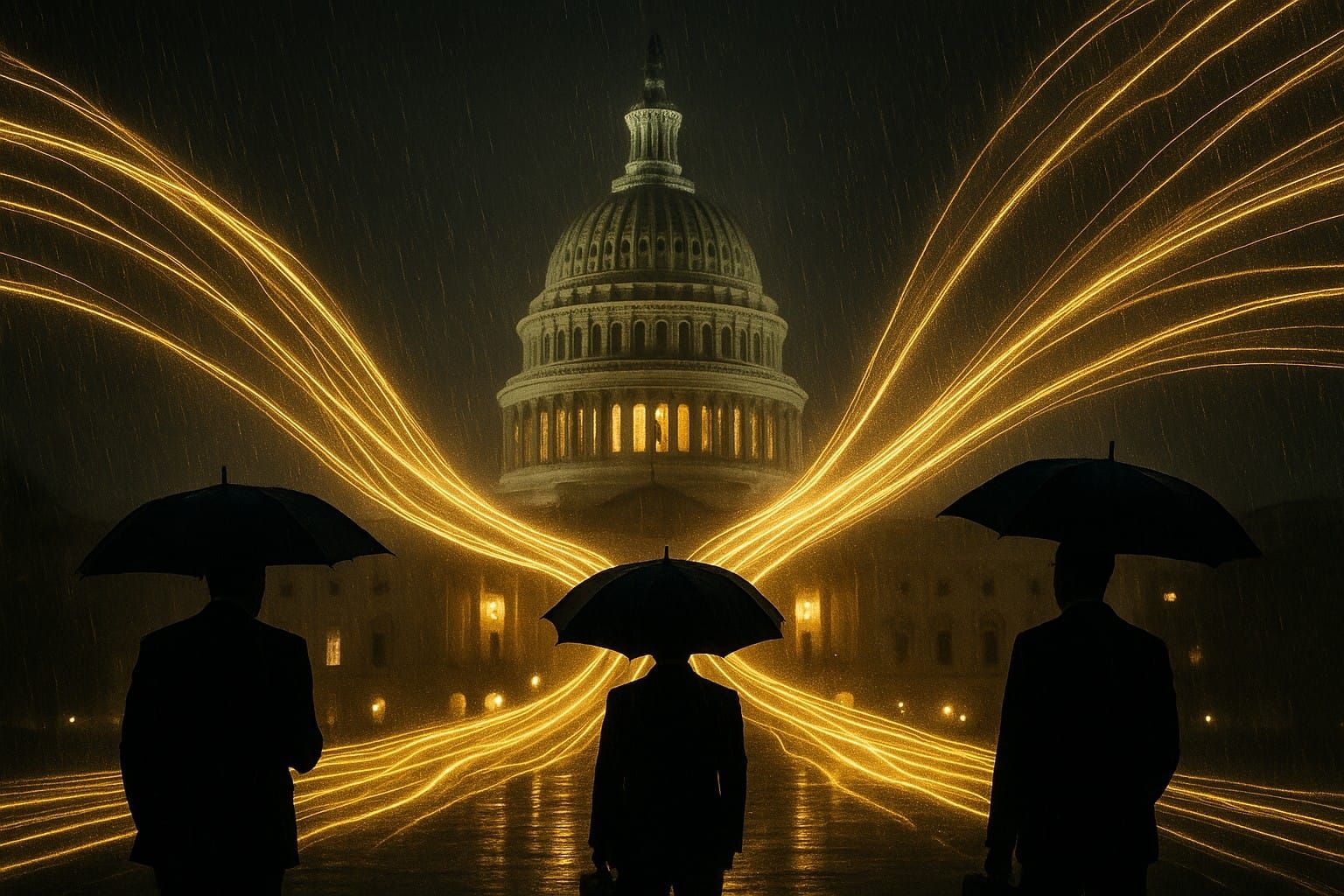
On November 3, Americans will vote in the most expensive midterm election ever held. That much was already settled by spring.
Corporate spending on House and Senate races hit $517 million in the 15 months through the end of the first quarter of 2026, according to data compiled by the watchdog group Public Citizen. That figure doesn't just put this cycle on record pace — it already exceeds the $461 million corporations spent across the entire 2024 presidential cycle, with the fall advertising blitz still to come. When every source of political money is counted, ad-tracking firm AdImpact projects total 2026 midterm ad spending of $11.6 billion, topping the record $11.2 billion set in 2023–24.
"The scale of corporate spending in this election cycle is unlike anything we've seen previously," says Rick Claypool, Public Citizen's research director. "One-third of the corporate money that's been spent since 2010 has been spent in this election cycle — and it's not even over yet."
But the real story isn't the size of the number. It's who's writing the checks.
The money is not coming from the industries that dominated Washington influence for half a century — not oil, not pharma, not the banks. At least $294 million of the corporate total, more than half, comes from three industries that barely existed as political forces a decade ago: crypto, artificial intelligence, and online betting. Crypto alone accounts for roughly $189 million — about 37% of all corporate election spending this cycle, making it the single largest corporate spender in American politics.
The Playbook Was Written in 2024
To understand what's happening in 2026, start with what crypto proved two years ago.
Fairshake, the industry's flagship super PAC — funded almost entirely by Coinbase, Ripple, and Andreessen Horowitz — spent heavily in the 2024 cycle and helped unseat Senator Sherrod Brown of Ohio, then the chair of the Senate Banking Committee and one of the most vocal crypto critics in Congress. Public Citizen later described Fairshake as a corporate "Death Star" that could "annihilate individual candidates."
The innovation wasn't the money. It was the doctrine. Fairshake refused to pick a party. It backed any candidate who supported industry-friendly policy and spent millions against any candidate who didn't — a pure reward-and-punish machine, indifferent to ideology.
The deterrent effect is now visible in real time. As Brown attempts a Senate comeback, his campaign manager says the former Banking Committee chair "recognizes that cryptocurrency is part of America's economy" and is keeping an open mind. That sentence is what $100+ million in demonstrated willingness to spend buys: not just victories, but pre-emptive surrender.
Fairshake entered 2026 with a $193 million war chest and, per regulatory filings, still holds roughly $130 million in dry powder for the final stretch to November.
Briefings like this land in members' inboxes before the market prices them in. Join free →
AI Learned the Trade in Eighteen Months
In 2024, artificial intelligence barely registered as a political force. In 2026, it is running the crypto playbook at startup speed.
Leading the Future, the AI industry's flagship super PAC network, has raised roughly $140 million for the midterms, anchored by substantial donations from OpenAI co-founder and president Greg Brockman and his wife Anna, alongside Andreessen Horowitz. (OpenAI insists it neither finances nor directs the group: "No outside political group speaks for OpenAI or represents our company's views." The Brockmans have separately given $25 million to MAGA Inc., the pro-Trump super PAC.)
On the other side of the AI policy argument, Anthropic has donated at least $40 million through Public First Action, a nonprofit that has raised $100 million and routes about half its funds toward elections through two aligned PACs — plus a smaller super PAC that counts a personal $1 million from CEO Dario Amodei.
The two camps have already collided. In June, political groups backed by OpenAI and Anthropic — or their executives — poured more than $23 million into a single House primary between two Democratic candidates in a safely liberal New York City district. "It was basically two AI groups having it out with each other and the candidates were secondary," said Brendan Glavin, research director at OpenSecrets.
Threading through both industries is one firm: Andreessen Horowitz has given more than $81 million to crypto- and AI-focused PACs this cycle, including at least $23.8 million to Fairshake. Its co-founders have each added roughly $4 million in personal money, most of it to MAGA Inc.
And beyond the corporate vehicles, tech's principals are writing personal checks at unprecedented scale: Elon Musk has committed more than $90 million to federal races this cycle. Sergey Brin has spent over $106 million in California alone, much of it against a proposed state wealth tax. Meta has put $65 million into four super PACs active in state races across California, Texas, and Illinois.
The Sportsbooks Came Third
The quietest of the three new kingmakers may be the most instructive. DraftKings, FanDuel, Fanatics, and bet365 have collectively donated more than $72 million this cycle — enough to make online betting the third-largest corporate donor industry in the country, by Public Citizen's estimate.
Notice where that money goes: not to Washington, but through two affiliate PACs — American Conservative Fund and American Future — into state races, where gambling taxes, licensing, and advertising rules actually get written. Prediction-market platform Polymarket, meanwhile, gave $1 million through its corporate parent to the Congressional Leadership Fund, the House Republican super PAC.
The pattern across all three industries is identical: young, digitally native sectors facing existential regulatory questions have concluded that political spending is not overhead — it's core infrastructure, priced like customer acquisition.
What the Money Is Buying
This is not spending for access or goodwill. Each industry has a specific legislative target, and each target has a date.
Crypto wants the CLARITY Act — the market-structure bill that would end the SEC-CFTC turf war and give tokens a defined regulatory home. The Senate is reportedly planning a vote around September 15. President Trump and industry executives spent last week in a coordinated final push, and markets responded immediately: bitcoin surged more than 20% on the week, reclaiming levels near $80,000, as traders began pricing a legislative outcome that PAC money spent two years constructing. The CFTC chair has already promised to "move swiftly" on crypto rules even if Congress fails — a fallback position that itself reflects how completely the policy conversation has shifted.
AI wants pre-emption — to keep a patchwork of state AI laws from hardening before federal rules exist, and to keep permitting friction away from the data-center buildout. That second goal is getting harder: Gallup finds 71% of Americans would rather not live near a data center, and AI super PAC money is now flowing into state legislative races precisely where those siting fights happen.
Betting wants the state map — favorable tax rates and rules in the statehouses that control the industry's unit economics, plus federal breathing room for the prediction-market frontier.
Where the Playbook Breaks
Money of this scale creates its own opposition. Polls consistently show a majority of Americans believe there is too much money in politics, and candidates are starting to run against the donors themselves: progressive Senate candidates like James Talarico in Texas and Abdul El-Sayed in Michigan have built competitive campaigns almost entirely around the argument that corporations and billionaires have purchased Washington.
Claypool frames the deeper risk bluntly: "You have the situation we have in Congress now, where they are spending an inordinate amount of time discussing niche regulatory policy problems related to crypto while people really just want cheaper groceries."
That is the fault line to watch. The reward-and-punish model works brilliantly against individual politicians — Sherrod Brown's conversion proves it. But it has never been stress-tested against a general electorate that decides the spending itself is the issue. If anti-corporate-money campaigns win in Texas or Michigan, every PAC dollar spent becomes a liability attached to the candidates who took it.
The Bottom Line
For investors, three things follow from the most expensive midterms in history:
- Regulatory risk in crypto, AI, and online betting is now partially underwritten. These sectors have built standing political machines that make hostile legislation measurably harder to pass. That's a real, if unquantifiable, reduction in policy tail risk — and part of what the August crypto rally is pricing.
- The catalysts have dates. The mid-September CLARITY Act vote is the first test of whether $189 million in crypto political spending converts into law. Third-quarter FEC filings in mid-October will reveal how much the war chests grew. November 3 settles the rest.
- Watch the backlash trades. Data-center siting fights, anti-PAC campaigns, and "too much money in politics" polling are the early indicators that the playbook's cost curve is bending. The model works until the spending itself becomes the story — and in at least two Senate primaries, it already has.
The old corporate lobbies bought influence quietly, over decades, through trade associations and golf. The new ones bought it in two election cycles, in public, with disclosure stamps on the receipts. Whatever November returns, that transition is permanent — and the price of admission to American policymaking has been reset.
If this analysis was useful, this is what AlphaBriefing does every day — geopolitics and markets, connected to what it means for your money. Free members get the daily brief in their inbox; paid members get the investment frameworks, scenario pricing, and catalyst calendars behind the paywall.
Sign up free → — upgrade whenever it earns it.
Get this level of intelligence every day. Subscribe to AlphaBriefing — free, member, and paid tiers available.
Sources & Further Reading
- Reuters — The new kingmakers: Crypto, AI and betting firms fuel record spending on the 2026 midterms
- Public Citizen — Corporate Supremacist Super PACs Drive $500 Million Midterm Spending
- Bitcoin Magazine — Crypto Leads $517 Million Corporate Surge Into 2026 Midterms
- CNBC — Bitcoin surges 12% in two days as Trump, crypto execs lead last ditch effort for Clarity Act
- The Hill — CFTC chair vows swift crypto rules if legislation stalls
- Cointelegraph — CFTC chair says agency will move forward on crypto regulation if Congress doesn't act
Disclaimer
AlphaBriefing is an independent intelligence publication. The content in this article is produced for informational and educational purposes only. Nothing published by AlphaBriefing constitutes financial, investment, legal, tax, or regulatory advice, nor should it be construed as a solicitation or recommendation to buy, sell, or hold any security, asset, or financial instrument.
All views expressed are those of the author at the time of writing and are subject to change without notice. Markets are volatile and unpredictable; past performance is not indicative of future results. Any investment involves risk, including the possible loss of principal.
AlphaBriefing and its principals, employees, or contributors may hold positions in securities or assets mentioned in this article. This should be considered a potential conflict of interest. No material relationship with any company referenced exists unless explicitly disclosed. Readers should conduct their own due diligence and consult qualified financial, legal, and tax advisors before making any investment decisions.
Information in this article is drawn from public sources believed to be reliable at the time of publication. AlphaBriefing makes no warranty, express or implied, as to the accuracy, completeness, or timeliness of any information herein. AlphaBriefing accepts no liability for any loss or damage arising from reliance on this content.
© AlphaBriefing. All rights reserved. Unauthorised reproduction or distribution is prohibited.