The World's Widest Energy Arbitrage Is Stuck in Texas
The war deleted 20% of global LNG supply and sent world gas prices to six times the US benchmark — yet American gas keeps getting cheaper. The bottleneck holding the spread apart is the trade, and the EIA has already published the date it breaks.

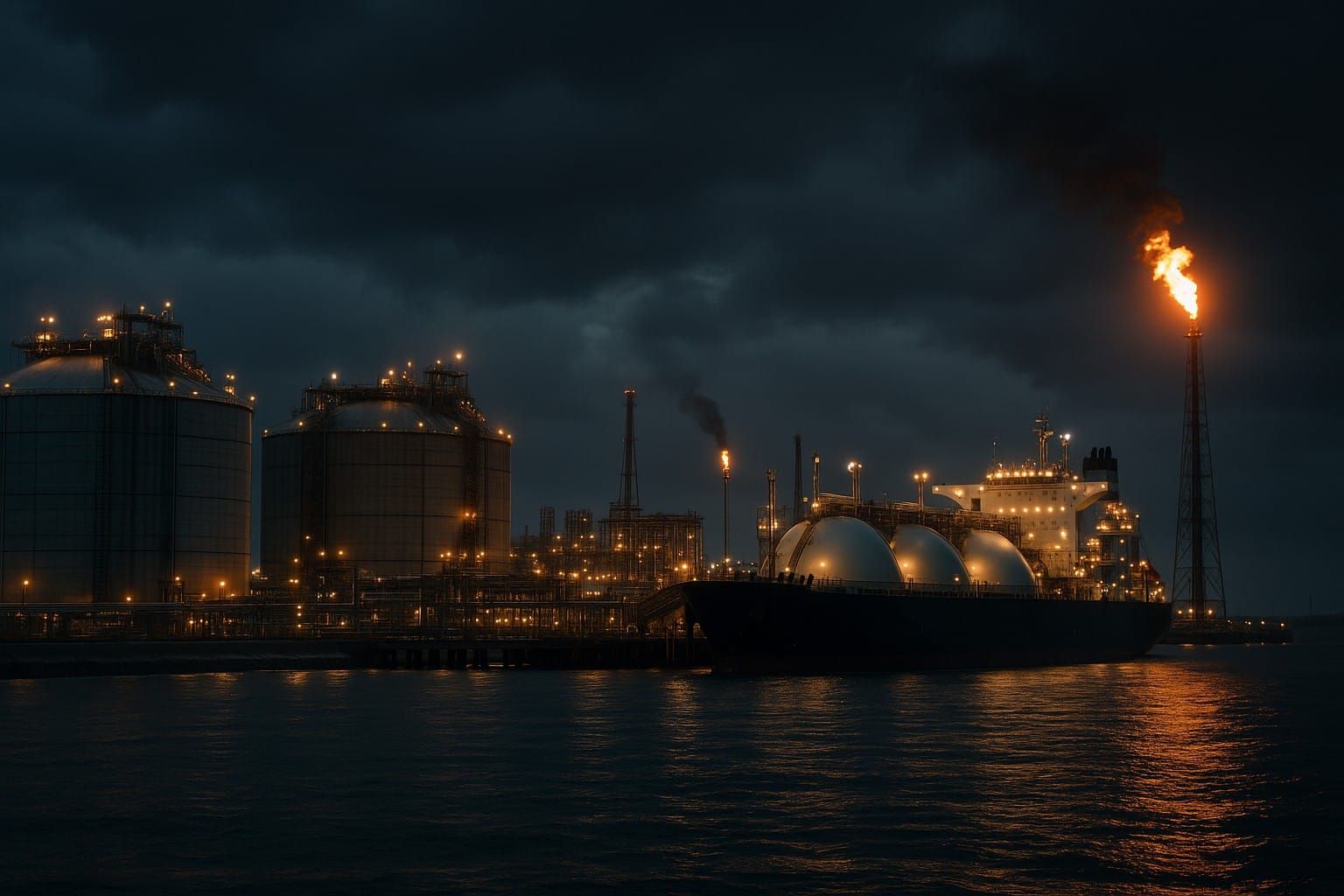
Somewhere in West Texas this week, a gas producer paid someone to take his gas. At the Waha hub in the Permian Basin, spot prices have traded below zero almost every day this year. Nine thousand miles away, a utility buyer in East Asia paid $18.60 per million British thermal units for a September cargo of liquefied natural gas — when it could find one at all.
Same molecule. A price gap of nearly $19. It is, by a comfortable margin, the widest sustained arbitrage anywhere in the energy complex — wider than anything oil, coal, or power markets have on offer. And almost nobody in America can touch it.
That is the strange aftermath of the war that rewired the world's gas market. When the US-Israel conflict with Iran erupted at the end of February, missile strikes on Qatar's Ras Laffan complex and the effective closure of the Strait of Hormuz deleted roughly 20% of global LNG supply overnight. QatarEnergy's force majeure for European buyers has now been extended through at least the end of September. Europe and Asia have spent five months scrambling for every spare cargo on the water, at one point bidding prices up 84% and 108% respectively.
Textbook economics says American gas — the cheapest large-scale supply on earth — should have surged to meet them. The opposite happened.
The War Made American Gas Cheaper
Henry Hub, the US benchmark, settled at $2.91 per MMBtu on July 22 and has slid toward 17-month lows — down since the war began. While the rest of the world treats gas like a strategic scarcity, the American market is drowning in it:
- Production is at records. US dry gas output hit an all-time high of 107.7 billion cubic feet per day in 2025 and is running nearly 4% higher year-to-date in 2026. The Permian alone is averaging 23.7 Bcf/d — gas that comes out of the ground whether anyone wants it or not, because it is a byproduct of $100-oil-fueled crude drilling.
- Storage is swollen. Lower 48 inventories stood at 3,056 Bcf in mid-July — 6.4% above the five-year average — even in the middle of air-conditioning season.
- The export door is bolted shut. US liquefaction terminals can process roughly 18 Bcf/d of feedgas. In July they averaged 17.4 Bcf/d — effectively every functioning train on the Gulf Coast running flat-out, with Freeport down for scheduled maintenance. No matter how high Tokyo or Rotterdam bids, America physically cannot liquefy one more molecule.
Roughly 16% of American gas production is being exported into a starving world at record margins. The other 84% is trapped in a domestic market that cannot consume it fast enough — which is why the most violent bull market in global gas history has coincided with Waha paying people to take supply away.
An arbitrage this wide, guarded by a bottleneck this hard, does something very specific: it hands a war-sized windfall to whoever owns the bottleneck — and it starts a countdown for everyone else. The countdown has a date on it.
The rest of this briefing is for paid members: which companies are actually capturing the $16 spread right now (and why their contract structures matter more than their capacity), the pipeline chokepoint behind the chokepoint, the 2027 supply-demand flip the EIA has already put a number on, and the bottom-line positioning framework for both sides of the trade.
AlphaBriefing Paid gets you every investment thesis, scenario framework, and catalyst brief we publish — the analysis private intel clients pay four figures for, at a fraction of that.