The U.S. Navy Will Be Smaller in 2030 Than It Is Today — Here's Who Profits
America's shipbuilding industrial base is hollowed out, China's yards are launching a navy's worth of hulls each year, and the Pentagon's only fixes funnel money through a handful of contractors and unlikely foreign saviors.

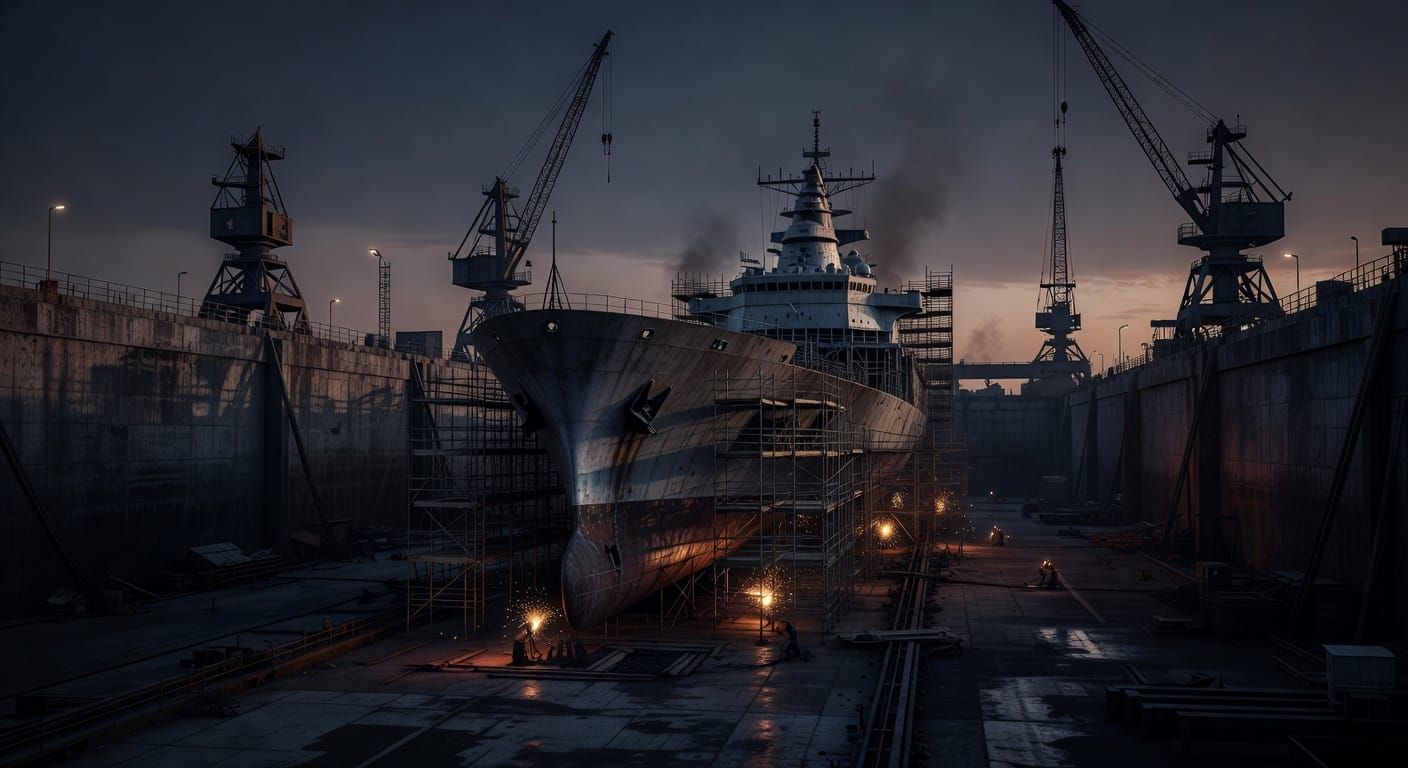
On paper, the United States Navy still leads the world. In hull count, it does not. China's People's Liberation Army Navy is now the largest fleet on Earth — and growing by roughly the size of the entire French navy every two years. Meanwhile, the U.S. battle force is set to shrink through the back half of this decade before any plausible expansion begins.
That is not an opinion. It is the Navy's own arithmetic.
The most recent Congressional Budget Office shipbuilding review and the Navy's own 30-year plan both project a fleet bottoming out near 285 battle force ships in the late 2020s — well below the 355-ship target Congress wrote into law in 2017, and even further below what wargames against China increasingly suggest the United States needs. The deficit is structural. Shipyards are full. The submarine industrial base is missing entire tiers of welders, electricians, and sub-tier vendors. Programs from the Constellation-class frigate to the Columbia-class ballistic missile submarine are running years late and billions over budget.
For investors, the gap is the trade. The Pentagon does not have the luxury of starting over. Every dollar that flows into closing it must move through a tiny set of choke points: two ship designers, one nuclear-capable yard, a handful of subcontractors, and — for the first time in modern memory — a small list of allied foreign yards willing to take American ownership stakes. The names are knowable, the timelines are funded, and the political consensus is unusually durable.
How a Five-Year Navy Became a Twenty-Year Problem
The hollowing-out of U.S. shipbuilding did not happen suddenly. It is the cumulative result of three decades of consolidation, post-Cold War budget cuts, the collapse of U.S. commercial shipbuilding, and a workforce pipeline that simply stopped replenishing itself.
In 1990, the United States operated more than 20 major shipyards capable of building warships. Today it operates seven, and only two — Huntington Ingalls Industries' Newport News and General Dynamics' Electric Boat — can build nuclear submarines. Only one, Newport News, can build a nuclear aircraft carrier. The Constellation-class frigate, pitched in 2020 as a "parent-design" program that would slot a proven Italian hull into a U.S. yard for fast delivery, is now running roughly three years late, with so many U.S.-specific design changes that commonality with the Italian original has collapsed below 15%.
The bigger problem sits one level down. The Navy's submarine industrial base needs to build two Virginia-class attack submarines per year and one Columbia-class ballistic missile boat per year and the AUKUS contribution to Australia by the early 2030s. Today it is delivering Virginia-class boats at roughly 1.2 per year, and Columbia-class delivery on the lead boat is slipping. Suppliers in propulsion, valves, and missile tubes are operating at or above stated capacity. Welders are the new oil — a commodity in shortage, with signing bonuses in Connecticut, Virginia, and Mississippi now resembling tech recruiting offers.
China's Yards Are Doing the Opposite
China's People's Liberation Army Navy has been adding roughly 30 hulls to its battle force per year, by Office of Naval Intelligence estimates. The state-owned China State Shipbuilding Corporation operates yards that, on commercial tonnage alone, out-produce the entire U.S. commercial and military shipbuilding sector combined by a ratio ONI has put north of 200 to one. China is launching Type 055 cruisers, Type 054B frigates, and a third aircraft carrier (the Fujian) while expanding submarine pens at Huludao.
The qualitative gap still favors the United States. The quantitative gap is closing in months, not years. And in a high-end Pacific scenario, the quantitative gap is what determines who can replace combat losses.
This is where the analysis gets actionable. AlphaBriefing members get the full investment framework — scenarios, positioning, and the bottom line.
Subscribe to AlphaBriefing — Free, Member, and Paid tiers available.