America's Infrastructure Decade Ends in 63 Days
The $1.2 trillion infrastructure law — the largest public-works program since Eisenhower — expires September 30 with no successor in place. The funding cliff arrives at the exact moment the money is doing the most work.

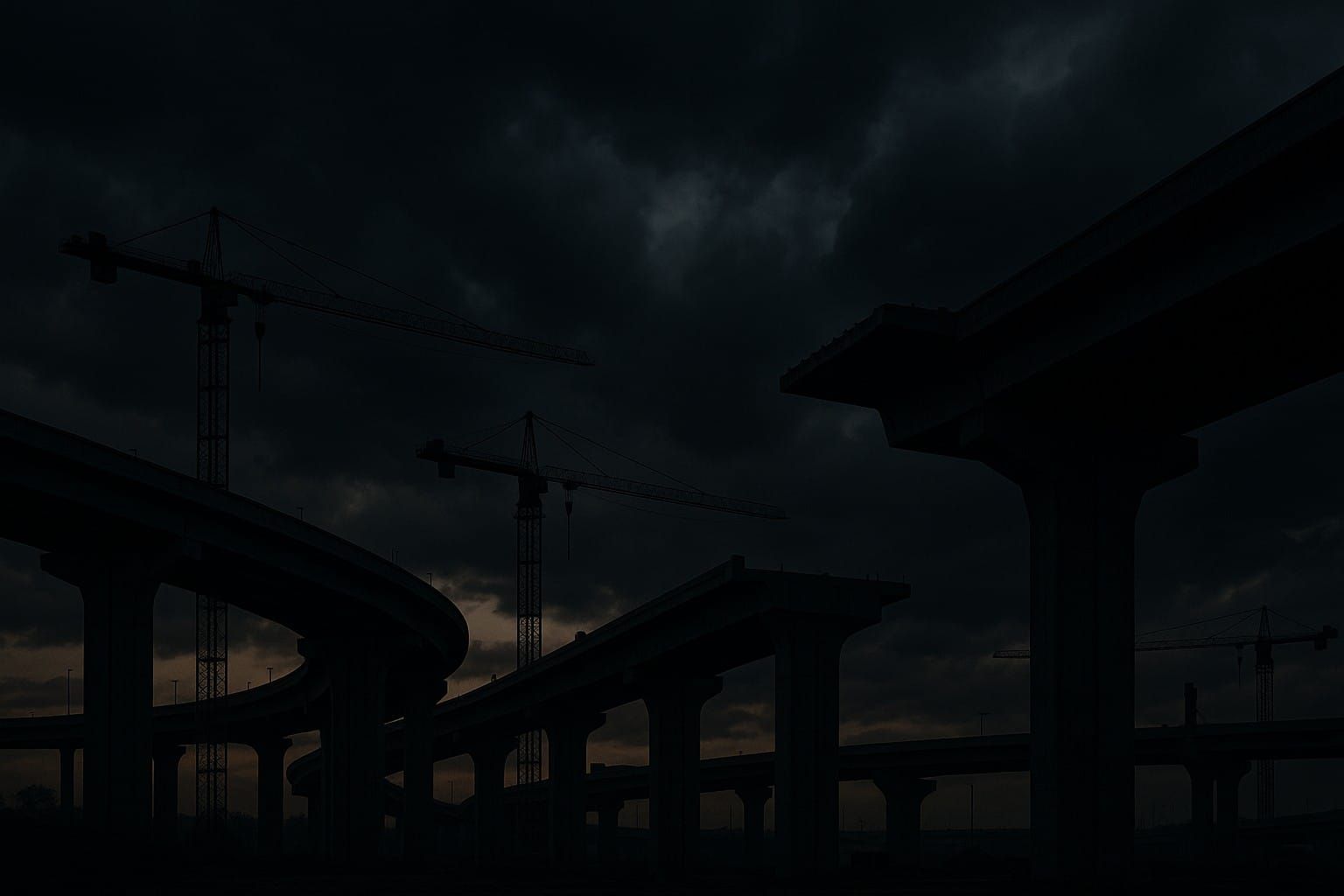
On November 15, 2021, the Infrastructure Investment and Jobs Act was signed into law: $1.2 trillion, including $550 billion in new spending — the largest federal commitment to roads, bridges, transit, water, and broadband since the Eisenhower interstate era. Washington called it the start of the "infrastructure decade."
The decade turns out to have a hard stop. The law's surface transportation programs — the highway, bridge, and transit funding that forms its spine — expire on September 30, 2026. That is 63 days from today. There is no successor law, the two chambers of Congress are not close to agreeing on one, and the trust fund that is supposed to pay for the next bill does not have the money.
Almost nobody outside the industry is paying attention, because "surface transportation reauthorization" may be the least clickable phrase in American politics. But the stakes are concrete in the most literal sense: this is the funding stream behind roughly a quarter of all US highway and bridge capital spending, the order books of the country's largest construction-materials and equipment companies, and the repair backlog on the 42,067 American bridges rated structurally deficient.
What actually happens on October 1
The IIJA did something unusual: it funded five years of infrastructure spending up front, through roughly $156 billion in advance appropriations layered on top of the traditional Highway Trust Fund. That structure is why state transportation departments have enjoyed five years of unprecedented certainty — and why the expiration is sharper than a normal budget lapse.
Money that has already been obligated — committed to specific projects under signed agreements — keeps flowing. The interchange being rebuilt outside Nashville does not stop mid-pour on October 1. As of late 2025, about 71% of the law's highway and bridge funds had been obligated, though only around 48% had actually been disbursed, which means 2026 was always going to be the peak year for money hitting the ground.
What stops is everything after that. Without a new law or an extension, federal highway and transit programs revert toward their pre-2021 baseline, and states lose the ability to commit federal dollars to new projects at IIJA levels. State DOTs plan on multi-year horizons; they schedule contract lettings one to two construction seasons ahead. Faced with uncertainty about what the federal share will be in 2027, the rational move is to slow down new project starts now — which is precisely what happened during the last major lapse. When the 2005 highway bill expired in 2009, Congress needed 33 months and ten short-term extensions to pass a replacement. Every surface transportation bill since 1991 has required at least one extension before its successor became law.
Briefings like this land in members' inboxes before the market prices them in. Join free →
A bill exists. It is stuck.
The strange part is that the House actually did its homework. In May, Transportation and Infrastructure Committee chairman Sam Graves and ranking Democrat Rick Larsen unveiled the BUILD America 250 Act — a five-year, $580 billion reauthorization covering fiscal 2027 through 2031, with $474 billion guaranteed from the Highway Trust Fund and the rest subject to future appropriations. It bills itself as the largest bridge investment in history and includes the first federal framework for autonomous commercial trucking. The committee advanced it 62–2, a margin that barely exists in the modern House on anything.
Then it hit the wall every highway bill hits: the money. The bill cannot go to the floor until the Ways and Means Committee writes the revenue title — the part that explains how to pay for it — and there is no agreed answer. The Senate is further behind: the Environment and Public Works Committee has advanced its portion with unanimous support, but the remaining committees have yet to fill in their pieces, negotiators are still arguing over the overall spending level, and members openly concede the clock is running out. The realistic best case now being discussed in the Senate is not a new law by September 30 — it is a short-term extension passed before Congress leaves for its August recess, punting the real fight into 2027.
The 18.4-cent problem
The reason every highway bill ends in the same standoff is arithmetic that Congress has refused to touch for a generation. The federal gas tax — 18.4 cents per gallon on gasoline, 24.4 cents on diesel — has not changed since October 1993. It is not indexed to inflation, and the vehicle fleet it taxes grows more fuel-efficient (or fully electric) every year.
The result: the Highway Trust Fund takes in roughly $44 billion a year against a spending trajectory north of $100 billion needed to maintain IIJA-level programs. The Congressional Budget Office projects the fund's highway account approaches insolvency around fiscal 2027–2028, with a cumulative ten-year shortfall of roughly $189 billion. Since 2008, Congress has papered over the gap with more than $275 billion in general-fund transfers rather than raise the tax — and the appetite for another large deficit-financed patch has collapsed. This year's reconciliation law added trillions to the deficit; the same Congress has already clawed back more than $2.3 billion in IIJA money, including roughly $879 million from the EV-charger program, and redirected funds from other IIJA grant lines. The creative financing that built the 2021 law — advance appropriations plus deficit tolerance plus a bipartisan coalition spanning transit and highways — is not available in 2026.
The cliff meets the peak
Here is what makes the timing perverse for markets: the funding cliff arrives at the exact moment IIJA money is doing the most work in the real economy.
Reimbursements to states — the point where federal dollars become revenue for contractors, aggregates producers, and equipment dealers — were always projected to crest in 2026. Martin Marietta, one of the two dominant US aggregates producers, posted record revenue in 2025 and has told investors it expects IIJA-related outlays to peak during the 2026 construction season. Vulcan Materials, the largest producer in the country, has spent three years pricing in a multi-year public-works supercycle; nearly $350 billion of federal-aid highway money, including about $40 billion for bridges, flows disproportionately through the states both companies serve. Caterpillar's North American construction segment, the engineering firms, the short-line contractors — the entire complex has treated federal infrastructure demand as the stable floor under an otherwise soft private construction market, at a moment when homebuilders are cutting prices and commercial construction is limping.
A multi-year reauthorization at BUILD America 250 levels would extend that floor into the 2030s. A lapse-and-extensions scenario — the historical norm — replaces a five-year visibility window with quarter-to-quarter uncertainty, and the 2009–2012 precedent says states respond by deferring exactly the kind of large, multi-season projects that move the revenue needle. The gap between those two futures is not priced as a live question right now. After September 30, it will be.
The bridges themselves, meanwhile, are indifferent to the legislative calendar. The industry's own math puts the cost of clearing the full repair backlog at more than $400 billion — against the roughly $16 billion the IIJA's bridge program actually delivered to states in its first three years. Even the infrastructure decade, fully funded, was a down payment. The question on the table in Washington is whether the down payment gets a second installment or a pause of indeterminate length.
The bottom line
The most likely path from here is the familiar one: a short-term extension in August or September, followed by months — possibly years — of extensions while Ways and Means and the Senate argue about revenue nobody wants to raise. That outcome keeps existing projects alive but freezes the pipeline of new ones, and it lands hardest on the companies and states that structured the last five years around federal certainty. The less likely path — an actual five-year, $580 billion law passed on time — would be one of the more consequential pieces of economic legislation of 2026, and almost no one is watching it.
Either way, the infrastructure decade as originally advertised ends in 63 days. What replaces it is now one of the most underpriced open questions in the American economy.
If this analysis was useful, this is what AlphaBriefing does every day — geopolitics and markets, connected to what it means for your money. Free members get the daily brief in their inbox; paid members get the investment frameworks, scenario pricing, and catalyst calendars behind the paywall.
Sign up free → — upgrade whenever it earns it.
Sources & Further Reading
- House Transportation & Infrastructure Committee — Graves & Larsen Announce Deal on the BUILD America 250 Act
- Roll Call — 'Time's a-ticking' on Highway Bill, Senators Acknowledge
- ARTBA — Senate Prepares Bipartisan Funding Patch as House Passes Mostly Partisan Measure
- Bipartisan Policy Center — How IIJA's Funding Structure Complicates Surface Transportation Reauthorization
- Congressional Budget Office — Addressing the Long-Term Solvency of the Highway Trust Fund
- Congressional Research Service — Funding and Financing Highways and Public Transportation Under the IIJA
- Transportation for America — Five Reasons Why IIJA Will Expire Without a Replacement in September 2026
- ARTBA — Slow & Steady Progress Repairing America's Bridges, According to Latest Federal Data
Disclaimer
AlphaBriefing is an independent intelligence publication. The content in this article is produced for informational and educational purposes only. Nothing published by AlphaBriefing constitutes financial, investment, legal, tax, or regulatory advice, nor should it be construed as a solicitation or recommendation to buy, sell, or hold any security, asset, or financial instrument.
All views expressed are those of the author at the time of writing and are subject to change without notice. Markets are volatile and unpredictable; past performance is not indicative of future results. Any investment involves risk, including the possible loss of principal.
AlphaBriefing and its principals, employees, or contributors may hold positions in securities or assets mentioned in this article. This should be considered a potential conflict of interest. No material relationship with any company referenced exists unless explicitly disclosed. Readers should conduct their own due diligence and consult qualified financial, legal, and tax advisors before making any investment decisions.
Information in this article is drawn from public sources believed to be reliable at the time of publication. AlphaBriefing makes no warranty, express or implied, as to the accuracy, completeness, or timeliness of any information herein. AlphaBriefing accepts no liability for any loss or damage arising from reliance on this content.
© AlphaBriefing. All rights reserved. Unauthorised reproduction or distribution is prohibited.