The Strait That Controls Your Gas Prices
The Strait of Hormuz has been closed for three months. Oil is at $91 a barrel, gas is pushing $5 a gallon, and the U.S. just drained its emergency reserves to their lowest level in decades. Here's why reopening a 21-mile waterway won't fix anything fast.

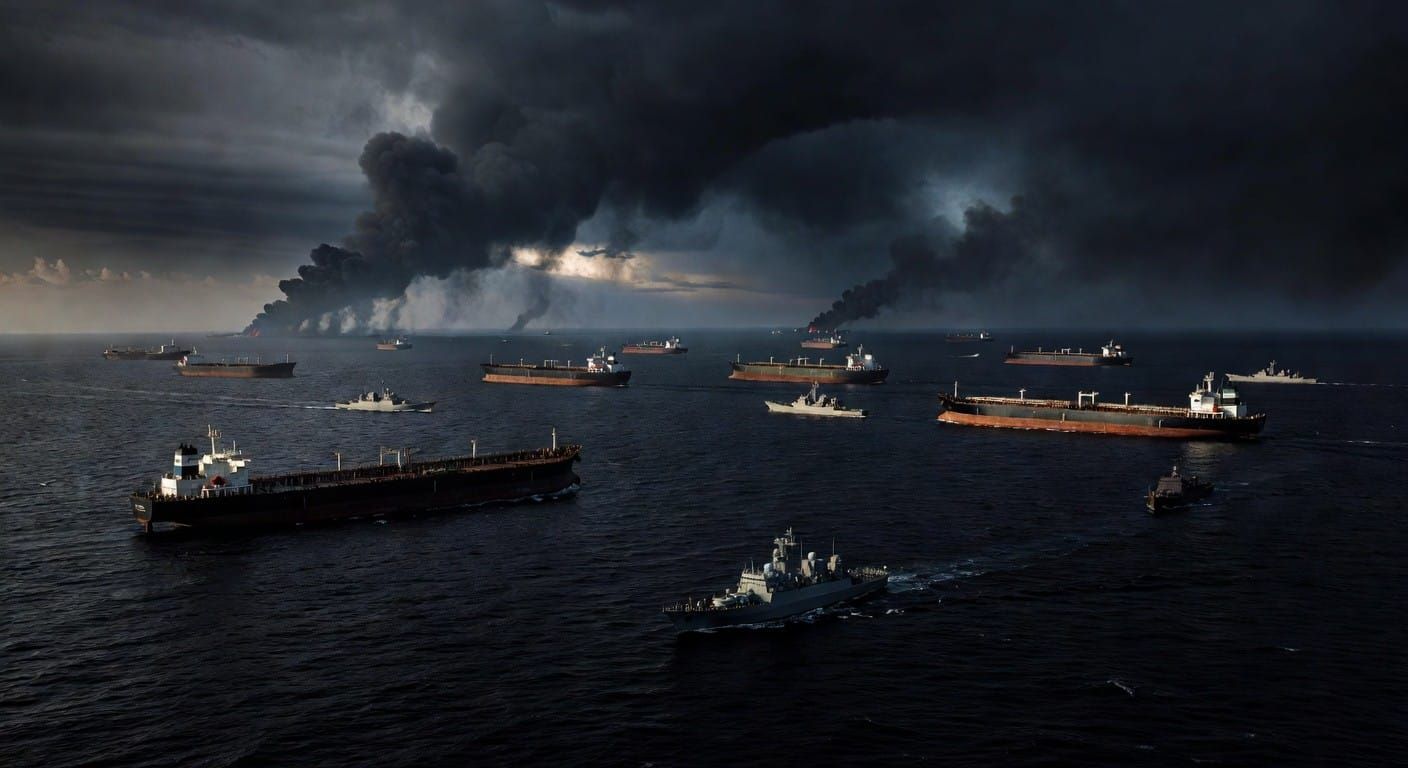
Three months. That's how long the Strait of Hormuz — a 21-mile-wide channel between Iran and Oman — has been effectively closed to commercial shipping.
In that time, roughly 11 million barrels of oil per day have been removed from global markets. Brent crude has nearly doubled from pre-crisis levels, settling at $91 a barrel. American gasoline prices have crossed $4.50 a gallon, and analysts warn they could hit $5 before the Fourth of July.
The strategic petroleum reserve is being drained at a record pace. The UAE just quit OPEC after 59 years. And a tentative ceasefire deal that could reopen the strait is sitting on Trump's desk, unsigned.
This is the biggest disruption to global energy markets since the 1973 oil embargo. And even if a deal gets signed today, the pain is far from over.
What Happened
On February 28, 2026, U.S. and Israeli forces struck military targets inside Iran. Iran's response was immediate and asymmetric: the IRGC declared the Strait of Hormuz closed and began enforcing it with mines, fast-attack boats, and anti-ship missiles.
The consequences were instant. One-fifth of the world's oil trade and 20% of global LNG supply flow through that narrow channel. Within days, shipping companies pulled their vessels. Insurance premiums for Gulf-bound tankers went vertical. Qatar declared force majeure on its LNG contracts.
By April, only 191 commercial vessels transited the strait — a trickle compared to the roughly 2,000 that pass through in a normal month.
The U.S. imposed a counter-blockade on Iranian ports, but this did little to restore the flow of Saudi, Kuwaiti, Iraqi, and Qatari energy exports that the world depends on. Gulf producers watched helplessly as their oil sat in full storage tanks with nowhere to go.
The Price Tag
The numbers tell the story:
Oil: Brent crude spiked as high as $120 per barrel in the weeks after the closure before settling into the $90–100 range as demand destruction kicked in. Pre-crisis, oil was trading around $65. Wood Mackenzie has warned that a prolonged closure could push prices toward $200 by year's end.
Gasoline: The national average hit $4.50 per gallon in May — the highest since the 2022 price shock. GasBuddy projects a summer average of $4.80 per gallon. Memorial Day fill-ups cost American families roughly 50% more than they did a year ago.
Natural Gas: European TTF benchmark prices surged 80% in March, hitting €65 per megawatt-hour. They've since eased to around €46, but EU gas storage stands at just 37% — dangerously low heading into the summer injection season when Europe needs to refill reserves for next winter.
Strategic Petroleum Reserve: The U.S. has been draining its emergency oil stockpile at record rates — 9.9 million barrels in a single week in mid-May. The SPR now holds approximately 365 million barrels, down from 411 million at the end of 2025. That's roughly 51% of capacity, the lowest level in decades.
The Ceasefire That Isn't Signed Yet
As of this week, U.S. and Iranian negotiators have reportedly reached a framework for a 60-day ceasefire extension that includes reopening the Strait of Hormuz. The deal would have Iran clear mines it deployed, allow unrestricted commercial shipping, and forgo any transit tolls. In return, the U.S. would lift its naval blockade and resume nuclear negotiations.
The problem: Trump hasn't signed it.
Reports describe the deal as needing only the president's signature, but Trump has publicly demanded that the strait reopen without "external control or tolls" and that Iran abandon its nuclear weapons program as preconditions — terms that go well beyond what's in the current framework. He also threatened Oman over potential toll arrangements.
Oil traders are deeply skeptical. Even if a deal is signed this weekend, the timeline for actual reopening stretches far beyond a presidential signature.
Why a Deal Won't Fix This Quickly
Here's what most coverage misses: even if the ink dries today, the Strait of Hormuz won't return to normal operations for months. The reasons are physical, not political.
Mine clearance takes time. The Pentagon told Congress it could take up to six months to fully clear Iranian-laid mines from the shipping lanes. Military officials have pushed back on that timeline, calling it a worst-case scenario, but even optimistic estimates from former naval officers suggest two to three weeks — and that's after hostilities actually end.
Historical precedent isn't encouraging. After Desert Storm, clearing roughly 1,000 mines from the Persian Gulf took seven months. The Strait's narrow lanes, strong currents, and potential for additional, undiscovered mines complicate every operation.
1,500+ ships are trapped in the Gulf. A massive traffic jam of oil tankers, LNG carriers, and commercial vessels has built up behind the closure. Rerouting, sequencing, and clearing these ships through the strait — even through cleared lanes — will take additional weeks.
Insurance markets won't cooperate. War-risk premiums for Gulf shipping have exploded. Even after mines are cleared, insurers will demand verification, escort requirements, and security guarantees before they'll underwrite tanker voyages at reasonable rates. That process alone could add weeks.
Global supply chains have already rerouted. Ships that would normally transit Hormuz have been taking the Cape of Good Hope — adding 10–15 days and significant cost to every voyage. Unwinding these diversions and restoring normal routing patterns takes time and coordination across an industry that just spent three months building alternative logistics.
The SPR Problem
The strategic petroleum reserve was designed for exactly this kind of crisis. But the U.S. entered this one with less ammunition than it should have.
After the massive drawdown in 2022 to fight post-pandemic inflation and the Russia-Ukraine price shock, the SPR was never fully replenished. It went from roughly 638 million barrels in 2020 to about 411 million at the start of 2026. Now, three months of emergency releases have pushed it to 365 million — and the drawdown continues.
At current release rates, the reserve could approach what officials have described as a "certified national security floor" of approximately 243 million barrels. Physical constraints also limit how quickly oil can be withdrawn — the maximum sustainable rate is about 4.4 million barrels per day.
The uncomfortable math: the U.S. is burning through its emergency reserves at an unsustainable pace, and even if the crisis ends tomorrow, refilling the SPR will take years and billions of dollars — competing for supply in a market that's already tight.
OPEC Is Fracturing
The crisis has accelerated a structural shift that was already underway inside the oil cartel.
On May 1, the UAE formally exited OPEC after 59 years. The immediate catalyst was frustration with production quotas that kept UAE output well below its 4.85-million-barrel-per-day capacity. But the deeper motivation, as a presidential adviser later explained, was strategic: Abu Dhabi wants to maximize revenue during what it calls the "autumn of the hydrocarbon age" — before peak demand arrives and the world's appetite for oil permanently declines.
The timing was extraordinary. The UAE left the cartel in the middle of the worst energy supply crisis in decades, when coordinated production management matters most.
OPEC+ responded with a symbolic 188,000-barrel-per-day production increase for June — a gesture of continuity that changes almost nothing in practice, since most member states can't actually export their oil through a closed strait.
But the precedent is set. If the UAE can walk away, others with capacity frustrations — Iraq, Kazakhstan — may follow. OPEC's ability to manage supply and stabilize prices is weaker than it's been in a generation.
What Happens Next
If the ceasefire is signed and holds: Expect partial reopening of the strait within weeks, with limited escorted convoys moving first. Full normalization of shipping could take 2–6 months depending on mine clearance. Oil prices would likely retreat toward $75–80 by late 2026, though they'd remain above pre-crisis levels. Gas prices would ease but likely stay above $4 through the summer.
If negotiations collapse: The scenario darkens considerably. Extended closure through the summer could push Brent toward $120+ again, gasoline toward $5–6 per gallon, and European gas prices into crisis territory as winter approaches. The EIA projects global oil demand would fall by 6 million barrels per day in the second half of 2026 — demand destruction on a scale that would signal a shallow global recession.
Either way: The Hormuz crisis has permanently changed the energy security calculus. Europe's dependence on LNG — with the U.S. now set to supply two-thirds of EU LNG imports in 2026 — has been laid bare. The fragility of chokepoint-dependent supply chains is no longer theoretical. And the strategic petroleum reserve needs rebuilding at a time when the budget, the market, and the politics all make it difficult.
The 21-mile strait has reminded the world of a lesson that gets forgotten between crises: energy security isn't about how much oil exists underground. It's about whether it can reach the people who need it.
Get this level of intelligence every day. Subscribe to AlphaBriefing — free, member, and paid tiers available.
Sources & Further Reading
- Reuters — U.S. Government Energy Arm Assumes Strait of Hormuz Will Stay Shut Through Late May
- Reuters — How the U.S. Could Clear Mines in the Strait of Hormuz
- CNBC — Traders Are Skeptical of Iran Timeline for Strait of Hormuz Reopening
- Reuters — Record Oil Draw From U.S. Emergency Reserve Drives Total Volumes to Two-Year Low
- Al-Monitor — Proposed U.S.-Iran Deal Involves Opening Strait During 60-Day Ceasefire Extension
- Tufts University — Re-Opening the Strait of Hormuz Won't Restore the Status Quo
- Wood Mackenzie — Strait of Hormuz Closure Risks Greatest Global Energy Supply Shock in Decades
Disclaimer
AlphaBriefing is an independent intelligence publication. The content in this article is produced for informational and educational purposes only. Nothing published by AlphaBriefing constitutes financial, investment, legal, tax, or regulatory advice, nor should it be construed as a solicitation or recommendation to buy, sell, or hold any security, asset, or financial instrument.
All views expressed are those of the author at the time of writing and are subject to change without notice. Markets are volatile and unpredictable; past performance is not indicative of future results. Any investment involves risk, including the possible loss of principal.
AlphaBriefing and its principals, employees, or contributors may hold positions in securities or assets mentioned in this article. This should be considered a potential conflict of interest. No material relationship with any company referenced exists unless explicitly disclosed. Readers should conduct their own due diligence and consult qualified financial, legal, and tax advisors before making any investment decisions.
Information in this article is drawn from public sources believed to be reliable at the time of publication. AlphaBriefing makes no warranty, express or implied, as to the accuracy, completeness, or timeliness of any information herein. AlphaBriefing accepts no liability for any loss or damage arising from reliance on this content.
© AlphaBriefing. All rights reserved. Unauthorized reproduction or distribution is prohibited.