The Silver Squeeze Nobody Can Mine Their Way Out Of
Silver is in its sixth straight year of supply deficit — yet the demand story everyone's watching is quietly breaking. The durable trade isn't solar or AI. It's that the world can't mine its way out of a shortage in a metal it mostly digs up by accident.

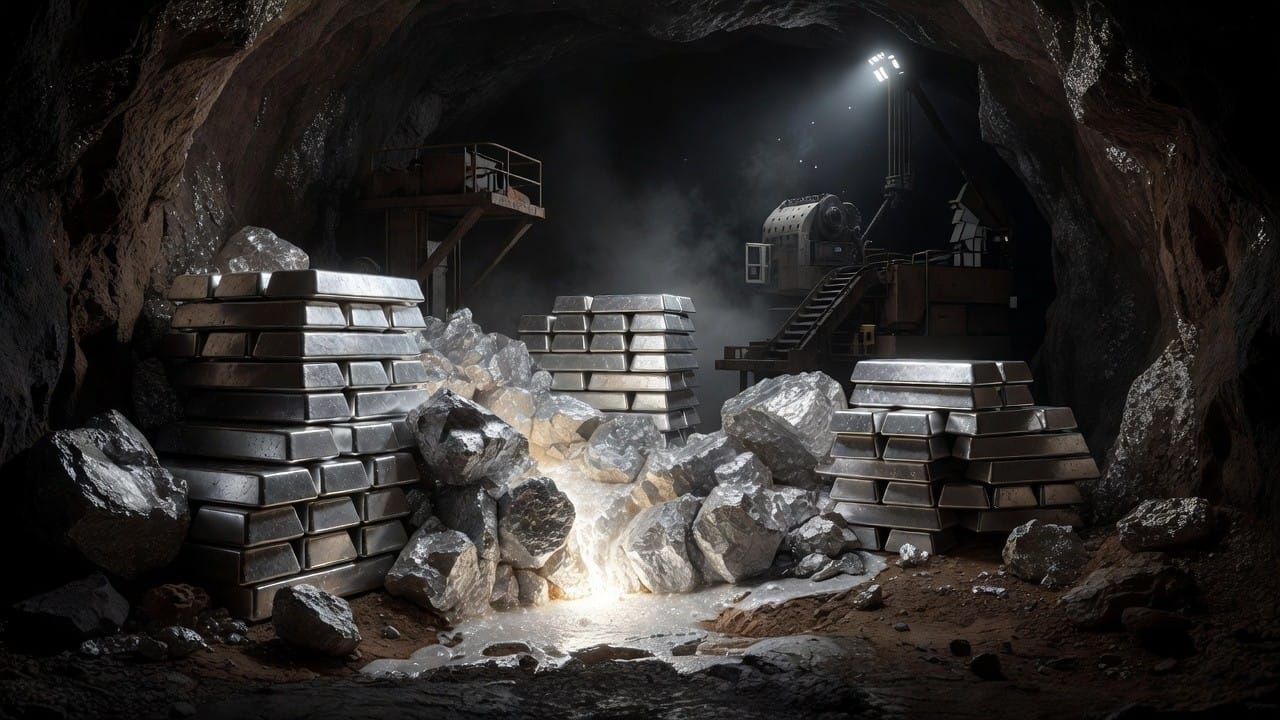
Silver did something in early 2026 that it had not done in forty-five years: it broke its 1980 record, ran to an intraday high near $121 an ounce in late January, and then fell apart. By spring the correction had wiped out a third of the move. The financial press, which had spent the autumn writing breathless pieces about a "silver squeeze," moved on to the next trade.
That is usually the moment worth paying attention to.
Because underneath the price chart, the thing that actually drives silver over a decade did not change at all. The metal is now in its sixth consecutive year of structural supply deficit. The world is consuming more silver than it digs out of the ground, and it has been doing so since 2021. The Silver Institute's own numbers put the 2026 shortfall near 46 million ounces — and other forecasters, counting differently, put the cumulative hole far deeper. The deficit is not a forecast. It is a fact that has already happened, five years running.
Here is what makes silver different from almost every other commodity, and why the usual rules don't apply: you cannot simply mine more of it.
The metal nobody decides to produce
Roughly 70% of the silver that comes out of the ground each year is not mined on purpose. It is a by-product — a bonus that falls out of the rock when companies dig for copper, lead, zinc, and gold. A copper miner sets production based on the copper price. The silver that comes with it is an afterthought, booked as a credit against costs. When the silver price triples, that copper miner does not dig faster. He digs for copper at the pace copper economics dictate, and the silver shows up at whatever rate it shows up.
This is the part the market consistently misunderstands. In a normal commodity, a price spike is self-correcting: high prices pull new supply into the market, and the supply kills the price. Silver's supply leg is broken. The price can run, and the mines barely respond, because the people who control most of the world's silver output are not even thinking about silver when they make their decisions. Primary silver mines — operations that exist to produce silver and nothing else — are a minority of global supply and a shrinking one. New ones take a decade and a friendly jurisdiction to build, and the best deposits were found generations ago.
So you have a metal in chronic deficit whose supply cannot meaningfully expand even when buyers are desperate. That is the entire story. Everything else is noise around it.
The demand story everyone is watching is the wrong one
The popular bull case for silver is solar panels. It is intuitive, it is green, and it is — at this point — mostly wrong.
Photovoltaics did become silver's single largest industrial use during the solar boom. But silver near record prices did exactly what economics says it should: it forced engineers to design the metal out. Solar manufacturers have cut the silver loading per panel aggressively, and silver demand from photovoltaics actually fell roughly 6% in 2025 and is forecast to drop another 19% in 2026. The "solar will eat all the silver" thesis is quietly unwinding in real time. Jewelry demand has slumped to multi-year lows for the same reason — high prices destroy discretionary use.
And yet the deficit persists. Sixth year. That is the tell.
It persists because silver is two completely different assets wearing one ticker. It is an industrial input whose uses are diversifying away from any single buyer — into the power grid, electric vehicles, electronics, and the wiring and connectors of AI data centers — even as solar economizes. And it is a monetary metal, a poor man's gold, that investors buy by the ton when they lose faith in paper money. In 2025, coin and bar demand rose 14%; physical investment in India alone surged a third. When the demand picture loses one leg, another picks up the weight — and the supply side, indifferent to all of it, just keeps falling short.
This is where the analysis gets actionable. AlphaBriefing members get the full investment framework — scenarios, positioning, and the bottom line.
Subscribe to AlphaBriefing — Free, Member, and Paid tiers available.