Two Railroads Want to Merge. The Bigger Trade Is the One That Follows.
The market is fixated on whether the $85 billion Union Pacific–Norfolk Southern merger gets approved. The real money is in what approval forces next: a BNSF-CSX countermerger and the rerating of an entire oligopoly.

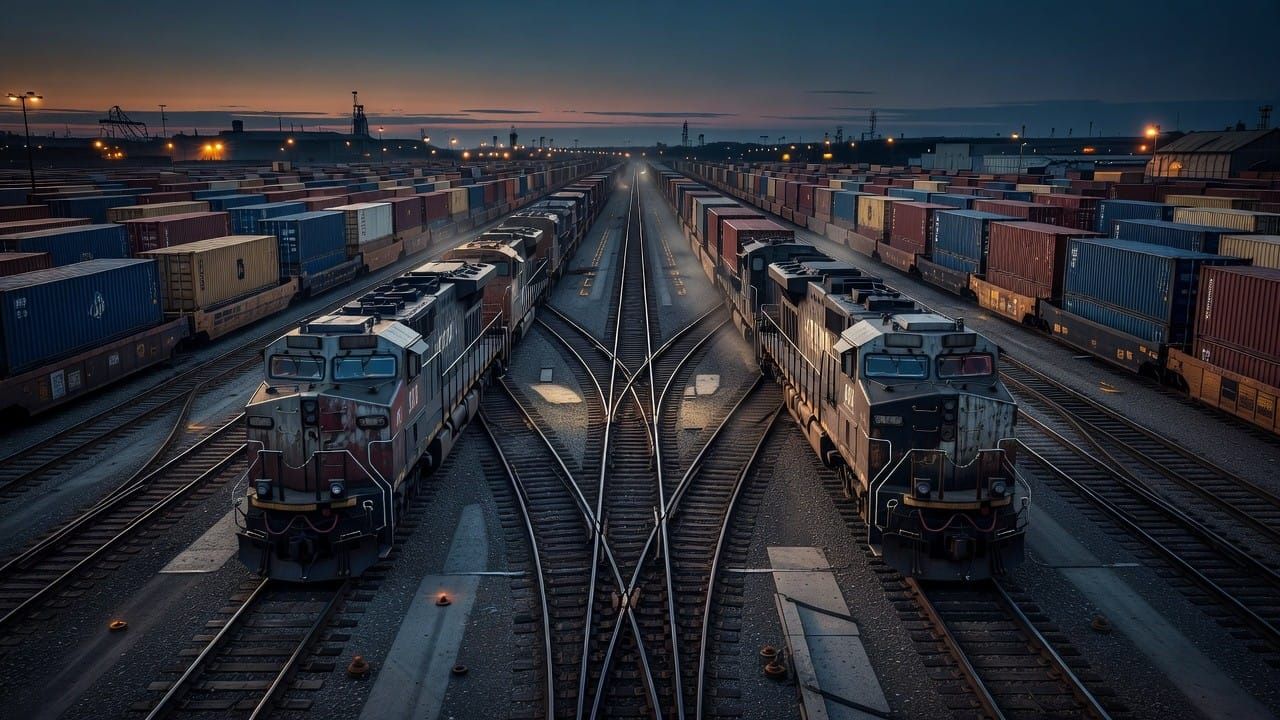
On December 19, 2025, two of America's largest railroads filed the most ambitious merger application the freight industry has seen in a generation. Union Pacific wants to buy Norfolk Southern for roughly $85 billion — $320 a share, a 25% premium — and stitch together the country's first true coast-to-coast railroad. A single network running from the ports of Los Angeles and Long Beach to the Atlantic terminals of Norfolk and Savannah, under one operator, for the first time in the 156 years since the golden spike.
The market has spent six months arguing about the wrong question. Everyone is fixated on whether the deal gets approved. That is the visible trade — and it is the boring one.
The interesting trade is what approval forces. Because the moment the Surface Transportation Board signs off on a transcontinental Union Pacific, it doesn't create one super-railroad. It detonates the equilibrium that has held the entire Class I oligopoly in place since 2001. And the companies with the most to gain aren't the ones whose names are on the application.
What the Deal Actually Is
The numbers are large enough to be abstract, so anchor them. Norfolk Southern holders receive one Union Pacific share plus $88.82 in cash per share. The combined enterprise would be worth north of $250 billion, operate roughly 50,000 route miles, and employ over 100,000 people. Management is pitching $2.75 billion in annual synergies — $1.75 billion from new revenue (single-line routing that today requires an interchange handoff between two railroads) and $1 billion from cost cuts. They project shippers save $3.5 billion a year and that the combined operating ratio improves by more than seven points over a decade.
That is the bull case as told by the acquirer. Here is the part the press release skips: the synergy math only works if the STB approves the deal clean. Union Pacific has told regulators it would walk away entirely if the Board imposes widespread forced line sales or trackage rights — the standard remedies regulators use to preserve competition. In other words, the company is telling Washington: approve it whole, or there is no deal. That is not the posture of a buyer with a margin of safety. It's the posture of a buyer who knows the economics are fragile.
The Regulatory Clock Nobody Is Pricing Correctly
The timeline tells you everything about where the risk sits. The STB rejected the original application in January 2026 as incomplete — it lacked projected market-share data and key merger documents. The companies refiled on April 30. On May 28, the Board accepted the revised application but immediately held the proceeding, including the environmental review, in abeyance, ordering supplemental information by July 27, 2026.
Read that sequence again. This is the most scrutinized rail merger in modern history, reviewed under 2001 rules written specifically to make major mergers harder, by a Board that has already bounced the application once. The companies say they'll close in early 2027. The merger agreement doesn't even expire until January 2028, with automatic extensions built in — which tells you the lawyers expect this to grind.
Every one of the four railroads that would remain independent — BNSF, CSX, CPKC, and CN — has formally graded the application "incomplete." That unanimity is not a coincidence. It's the opening move in the real game.
This is where the analysis gets actionable. AlphaBriefing members get the full investment framework — scenarios, positioning, and the bottom line.
Subscribe to AlphaBriefing — Free, Member, and Paid tiers available.