The Shadow Fleet Is Winning
Nearly one in five oil tankers on Earth now sails outside the legitimate maritime system — with its own insurers, registries, and naval escorts. The sanctions built to stop it are losing, and the bifurcated tanker market it created is one of shipping's most underpriced structural stories.

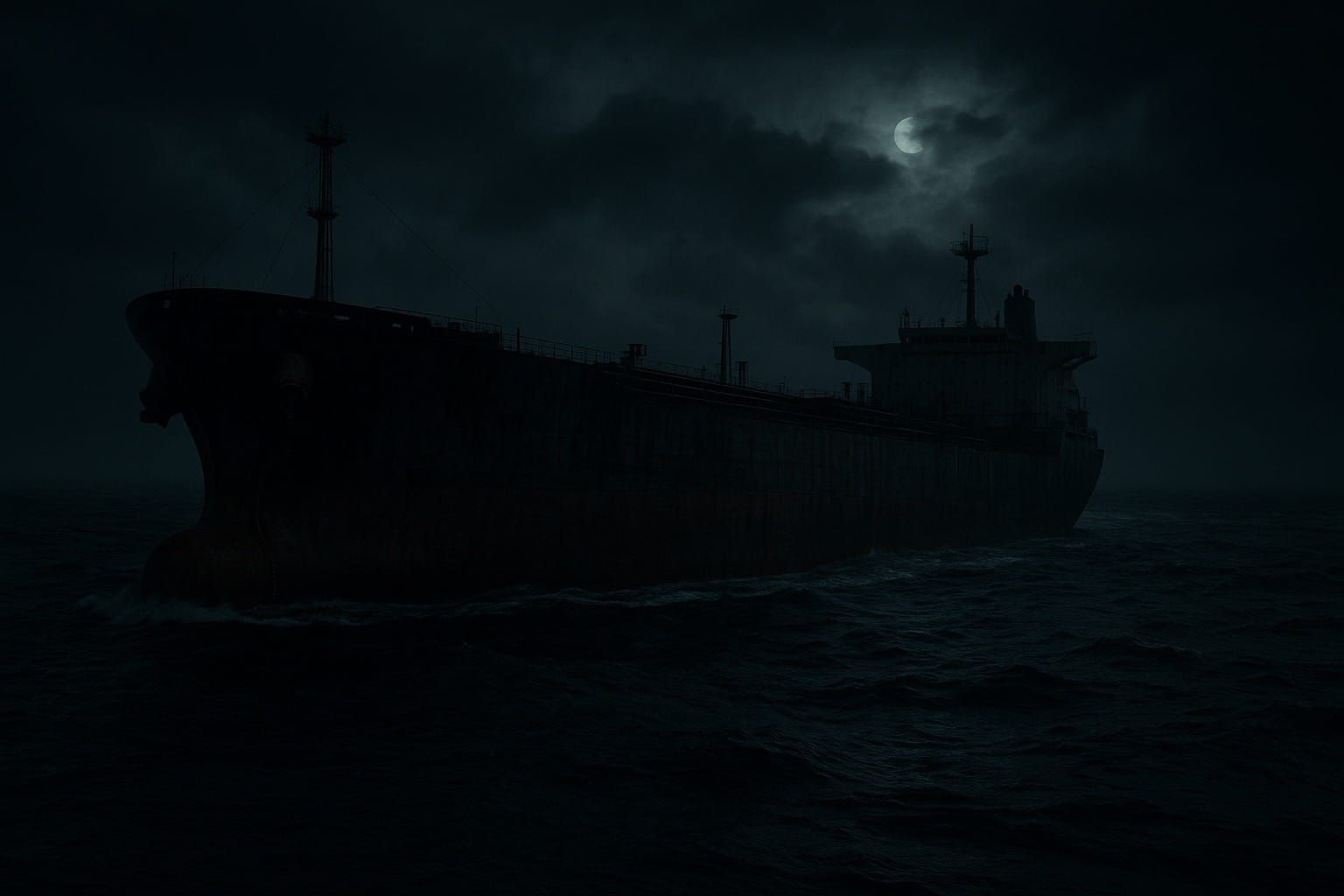
Somewhere in the Danish straits right now, an oil tanker old enough to be scrapped years ago is steaming toward the Atlantic with a million barrels of Russian crude in its belly. Its registered owner is a mailbox company in the Marshall Islands incorporated eleven months ago. Its flag belongs to a landlocked African state — or, increasingly, to no state at all. Its insurance certificate, if the crew produces one when Denmark radios, was issued by a Moscow insurer that is itself under Western sanctions. Its transponder may or may not be telling the truth about where it has been.
Nothing about this voyage is hidden, exactly. Danish authorities logged 292 transits by sanctioned vessels through their straits in 2025 alone. The ships pass in plain sight of NATO patrol aircraft, under the cameras of a German-led task force assembled specifically to watch them. And then they keep going, because almost nobody has the legal authority — or the political appetite — to stop them.
This is the shadow fleet, and three and a half years after the West set out to strangle it, the uncomfortable conclusion is becoming hard to avoid: it is winning.
The numbers stopped being a curiosity a while ago
When Western sanctions and the G7 oil price cap hit Russian crude in December 2022, the "dark fleet" was a niche phenomenon — a couple hundred elderly tankers that had spent years hauling Iranian and Venezuelan barrels around US enforcement. Russia industrialized it. By August 2025, the Paris-based shipbroker BRS counted roughly 1,140 shadow oil tankers — more than 18% of the entire global tanker fleet — and the Atlantic Council's researchers estimate the fleet is still growing by around 30 vessels a month.
The West's response has been to sanction ships by name, one designation at a time. The EU list now covers 671 vessels. The UK's covers 627. Add the American list and the combined total is about 740 unique tankers under formal sanction — port bans, service bans, insurance bans. On paper, it is the largest blacklisting of commercial shipping ever attempted.
For a while, it genuinely worked. Brookings researchers tracking the fleet found that monthly Russian oil volumes moving on US-sanctioned tankers collapsed from an average of 35 million barrels in 2023–24 to about 7 million barrels in 2025 — an 80% reduction. A US designation was close to a death sentence for a ship, because the threat behind it was secondary sanctions: any refinery, port operator, or bank in Asia that touched a listed vessel risked losing access to the dollar system.
Then the threat stopped being credible.
The enforcement engine is idling
The American sanctions list has not added a single vessel since January 2025 — frozen at 216 ships while the EU and UK lists more than doubled. That leaves 524 tankers sanctioned by Europe but not by Washington, free to serve any buyer who fears only the US Treasury. And with no secondary-sanctions cases being brought against the Asian refineries taking delivery, the fear premium is evaporating. Brookings' August 2026 assessment is blunt: volumes on sanctioned tankers are re-accelerating, and the fading "fear factor" is the reason.
Meanwhile the fleet has solved its other chokepoints:
- Flags: Shadow tankers cycle through registries of extreme convenience — Gabon, Tanzania, Djibouti — faster than flag states can deregister them. The more striking development: ships that simply stop pretending. By February 2026, researchers counted over 500 vessels sailing with no valid flag registration at all, a status that quadrupled in the Baltic in late 2025. A ship with no flag has no regulator, and under the law of the sea, almost nobody can board it on the high seas.
- Insurance: Twelve European coastal states began demanding proof of protection-and-indemnity coverage from passing tankers in late 2024. The fleet's answer was not to buy Western insurance — it was to present Russian paper. By late February 2026, roughly one in three tankers crossing the Baltic carried certificates from sanctioned Russian or Russian-linked insurers like Ingosstrakh, whose actual capacity to pay a major claim is unknowable because it discloses almost nothing.
- Deterrence: In January 2026, Russia's Maritime Board formalized what had been an improvisation: naval escorts for shadow tankers deemed "linked to Russia," now observed in the Gulf of Finland and the English Channel. Danish and Swedish maritime pilots report uniformed Russian naval personnel aboard commercial tankers, absent from crew manifests. The message to European boarding parties is not subtle.
Europe still gets the occasional win — Estonia detained a tanker with 40 documented deficiencies, France convicted a shadow-fleet captain in absentia in March 2026, Denmark has pioneered "port-state control at sea." But the aggregate score is not close. Denmark inspected 122 ships in 2025 and detained five.
Here is what makes this an investment story rather than just a policy failure: those 1,100-plus ships have not left the market. They have left your half of the market. Nearly a fifth of the world's tanker fleet now operates in a parallel system — and that bifurcation is quietly rewriting the economics of every legitimate tanker owner on a public exchange, the value of every 15-year-old hull, and the tail risk carried by every coastal state on the route. The question that matters for capital is what happens to a two-tier ocean under each of the three ways this ends.
The rest of this briefing is for paid members: the fleet-bifurcation math that has kept old tankers off the scrapyard and compliant tonnage tight, the listed owners positioned on the right side of the split, the two Washington catalysts that could re-shock effective tanker supply within weeks of enforcement, and the scenario framework — escalation, drift, and unwind — with what each does to rates, secondhand values, and the Urals discount.
AlphaBriefing Paid gets you every investment thesis, scenario framework, and catalyst brief we publish — the analysis private intel clients pay four figures for, at a fraction of that.