The Router That Grounded America
For four hours on Friday, nothing took off in the United States. The cause wasn't a hacker or a storm — it was one bad router on a government network Washington had already decided to replace.

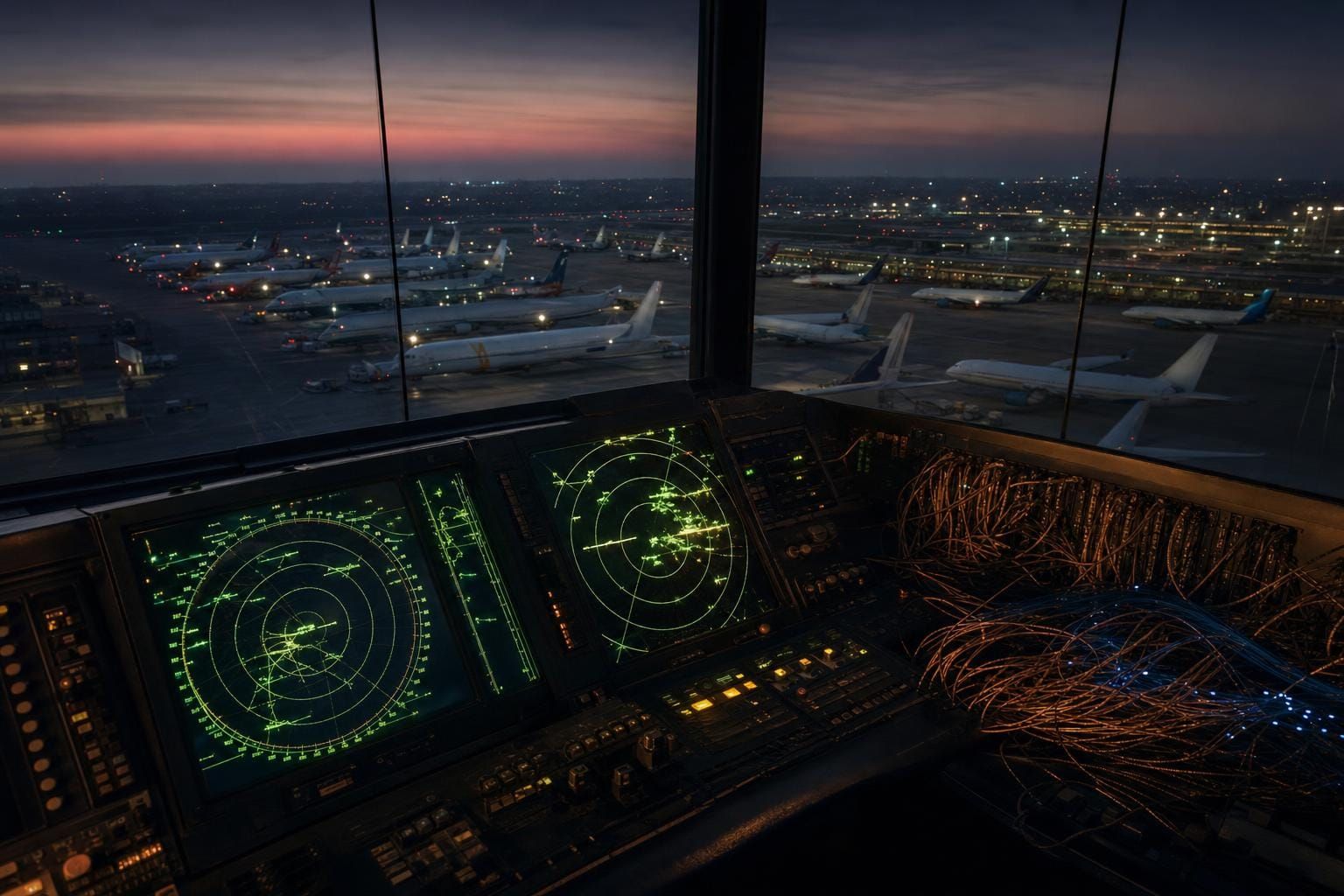
At 3:54 p.m. Eastern on Friday afternoon, the Federal Aviation Administration ordered every commercial departure in the United States to stop. Aircraft already airborne were allowed to continue to their destinations. Everything else stayed on the ground — coast to coast, for more than four hours. It was only the second nationwide ground stop since September 11, 2001, and the longest since that day.
The White House convened an emergency meeting in the Situation Room. The immediate assumption, inside government and out, was a cyberattack. The real answer, delivered by Transportation Secretary Sean Duffy at a Saturday press conference, was more mundane — and in some ways more unsettling: a routine maintenance job, performed by a contractor, on a network the government had already decided was too old to keep.
A router had been swapped during a scheduled upgrade from legacy copper wiring to fiber optic lines at what Duffy described as "a very remote location." Instead of quietly joining the network, the new equipment began flooding it. "We had 1,000 connection attempts every four to five seconds," Duffy told reporters. The cascade disrupted radar feeds and controller-to-pilot communications at 17 of the FAA's 22 en route control centers — the facilities that manage high-altitude traffic between airports. Unable to immediately locate the source, officials made the conservative call. "When we see that, your safety is paramount," Duffy said. "We shut down the airspace."
Four Hours, 15,000 Flights
The ground stop itself lasted from 3:54 p.m. to 8:15 p.m. Eastern on Friday. The damage ran through the weekend.
About 9,200 flights were canceled and roughly 7,500 delayed on Friday, according to FlightAware data cited by USA Today. Saturday brought more than 6,400 additional cancellations as airlines tried to rebuild schedules with crews and aircraft scattered across the country — roughly 15,600 canceled flights across the two days, by Reuters' count. By midday Sunday, more than 1,600 flights were canceled and some 4,200 delayed, though the FAA's airspace dashboard showed no active national constraints and major hubs like JFK and O'Hare were reporting delays of 15 minutes or less.
"We have crews and aircraft that are out of position for 12,000 flights that were lost," FAA Administrator Bryan Bedford said Saturday. "These crews, pilots and flight attendants need to get to their points of reconnection with their schedules." Duffy said schedules should be "probably fully normal" by Monday. Airlines issued fee-free rebooking waivers; under Department of Transportation rules, passengers whose flights were canceled are owed refunds or rebooking, but because a ground stop is outside airline control, no compensation beyond that.
One thing officials were eager to rule out: an attack. "We see zero evidence of anything nefarious and zero evidence of anything AI-related," Bedford said. The Professional Aviation Safety Specialists union, which represents FAA technical staff, said the problem was isolated to two routers updated on Friday — believed to be in Arkansas and Texas, an official told Reuters.
Briefings like this are free to read with a free AlphaBriefing membership. Join free →
The Network the Government Can't Leave
The contractor at the center of the investigation is L3Harris Technologies, the Melbourne, Florida-based aerospace and defense company that operates the FAA Telecommunications Infrastructure — the private network that connects more than 4,400 FAA facilities and supports roughly 45,000 flights a day, by the company's own description. L3Harris says it has completed more than 70% of the planned conversion of the system from legacy copper to fiber, work it describes as being done "in close coordination with the FAA."
Duffy's framing of the relationship was the most revealing moment of the weekend. "They own this network. They're our prime contractor. I can't go somewhere else. They own it," he said, adding that the company "didn't meet the moment" and that the department would determine whether the failure was "contractor error or a faulty piece of equipment." L3Harris, which draws about three-quarters of its revenue from U.S. government contracts according to The New York Times, said it is supporting the FAA's investigation and takes the ground stop "seriously."
That exchange is the story beneath the story. The United States runs the world's busiest airspace on a single-vendor private network that the government cannot credibly threaten to leave — because there is nowhere else to go. When the network fails, the government's only levers are public criticism and an investigation into whether the vendor was incompetent or merely unlucky.
Washington Already Fired This Network — Slowly
Here is the detail that makes Friday's failure something other than a freak accident: the FAA had already concluded, in writing, that this network needed to die.
On August 12, the agency posted a $74.3 million initial award to AT&T to begin building the FAA Enterprise Network Services program — the replacement telecommunications backbone for what the Transportation Department calls its "Brand New Air Traffic Control System." The FAA anticipates the deal will grow into a multibillion-dollar contract running up to 15 years, with an operational deadline of December 2028. The agency's own justification, posted to SAM.gov, was blunt: "The current FAA Telecommunications Infrastructure network can no longer adequately support [National Airspace System] operations." A competitive bid process, it added, would take too long to meet the deadline.
In other words, the network that failed on Friday is one the government has formally designated as inadequate — and that it still has to live with for at least two more years while its successor is built. Bedford has previously said the system's outdated copper should be fully replaced by September 2027. Friday was a preview of what the gap between now and then can look like.
The money fight is escalating accordingly. Congress approved $12.5 billion for air traffic control modernization last year. Duffy had been asking for $30 billion more; on Friday, with the airspace still closed, he raised the ask to $50 billion. Democrats in Congress have so far pushed back on the administration's funding demands, and a root-cause analysis of the outage has been promised publicly.
The Market Hasn't Voted Yet
Here is the quirk of the calendar that matters for investors: the ground stop began at 3:54 p.m. on Friday — six minutes before the market closed. L3Harris stock finished the day at $272.35, fractionally higher, because at 4:00 p.m. nobody outside the FAA knew what was happening, let alone who would be blamed. The company was named by the Transportation Department only after markets closed, and Duffy's "didn't meet the moment" press conference came Saturday. Monday's opening bell is the first time the market gets to price a weekend in which the Transportation Secretary publicly blamed a single contractor for grounding the country.
The honest frame is that the direct financial exposure is probably modest while the headline risk is not. The FTI contract was already scheduled to sunset in favor of AT&T's replacement network, so Friday did not cost L3Harris a future it still had. But the company now sits at the center of a federal investigation, a public accountability campaign, and a congressional funding debate — at a moment when roughly three-quarters of its revenue depends on the goodwill of the same government doing the investigating. For the airlines, the costs are real but uncompensated-by-anyone: more than 15,000 canceled flights, repositioning costs, and waiver-driven rebooking, with no one yet publishing a damage estimate.
And the stress test arrives quickly. Thanksgiving — the busiest travel week of the American year — begins in ten days, on a network whose operators have now demonstrated exactly how it breaks.
The bottom line: Friday was not a cyberattack, and that is precisely why it matters. An adversary you can deter. An aging network that can be taken down by its own scheduled maintenance, run by a vendor the government admits it cannot replace until 2028, is a structural vulnerability with a published timeline — and for the next two years, every "routine upgrade" carries tail risk that the market, the airlines, and the traveling public are holding for free.
If this analysis was useful, this is what AlphaBriefing does every day — geopolitics and markets, connected to what it means for your money. A free membership gets you access to every free article on AlphaBriefing.com; paid members get the investment frameworks, scenario pricing, and catalyst calendars behind the paywall.
A free membership takes 30 seconds: Join AlphaBriefing →
Sources & Further Reading
- Al Jazeera — What forced the US to ground all planes? A router switch, we now know
- Al Jazeera — US blames system upgrade for longest nationwide FAA ground stop since 9/11
- USA Today / The Columbus Dispatch — Flight disruptions continue, but schedules to get back to normal
- Reuters — US air traffic vulnerabilities exposed by old computers, severed cables
- L3Harris — FAA Telecommunications Infrastructure (FTI)
- MeriTalk — FAA Awards AT&T $74M to Kick Off Network Overhaul
- U.S. Department of Transportation — Flight delays and cancellations: consumer rights
Disclaimer
AlphaBriefing is an independent intelligence publication. The content in this article is produced for informational and educational purposes only. Nothing published by AlphaBriefing constitutes financial, investment, legal, tax, or regulatory advice, nor should it be construed as a solicitation or recommendation to buy, sell, or hold any security, asset, or financial instrument.
All views expressed are those of the author at the time of writing and are subject to change without notice. Markets are volatile and unpredictable; past performance is not indicative of future results. Any investment involves risk, including the possible loss of principal.
AlphaBriefing and its principals, employees, or contributors may hold positions in securities or assets mentioned in this article. This should be considered a potential conflict of interest. No material relationship with any company referenced exists unless explicitly disclosed. Readers should conduct their own due diligence and consult qualified financial, legal, and tax advisors before making any investment decisions.
Information in this article is drawn from public sources believed to be reliable at the time of publication. AlphaBriefing makes no warranty, express or implied, as to the accuracy, completeness, or timeliness of any information herein. AlphaBriefing accepts no liability for any loss or damage arising from reliance on this content.
© AlphaBriefing. All rights reserved. Unauthorised reproduction or distribution is prohibited.