Why Europe Is Burning Its Winter Gas Five Times Too Fast
European gas storage entered the heating season at its lowest level since 2013 and is draining at the fastest pace on record. With Qatar still at half capacity and TTF near nine times the U.S. price, the math on a cold February doesn't close.

Combined gas inventories across the European Union and the United Kingdom peaked at 853 terawatt-hours on October 27, according to Gas Infrastructure Europe data compiled by energy analyst John Kemp. That peak arrived on almost exactly the average date of the past fifteen years — but at the lowest level for the time of year since 2013, about 168 TWh and 16% below the ten-year seasonal average. EU storage sites were roughly 75% full when the drawdown began, far short of the bloc's indicative 90% target.
Then the draining started, and it has not been normal. In the two weeks after the peak, inventories fell by 34 TWh — roughly five times the average seasonal draw for that stretch of the calendar, and the fastest early-season depletion in records going back to 2011. This is happening during what has so far been a mild start to winter: strong El Niño conditions have kept heating demand below the ten-year average. Europe is burning through its winter cushion at record speed before winter has properly arrived.
Project that forward, as Kemp does, and the central case has EU-UK stocks ending the heating season around 221 TWh in March or April 2027 — storage sites just 19% full. The plausible range runs from a comfortable 33% to a genuinely alarming 5%. Early-season projections carry wide error bars. But the trajectory has deteriorated steadily since late October, and the market has noticed.
How Europe Traded One Chokepoint for Another
Europe spent four years and hundreds of billions of euros solving its Russia problem. Pipeline dependence was swapped for LNG terminals, long-term Gazprom contracts for spot cargoes from Qatar and the Gulf of Mexico. By early 2026 the strategy looked vindicated.
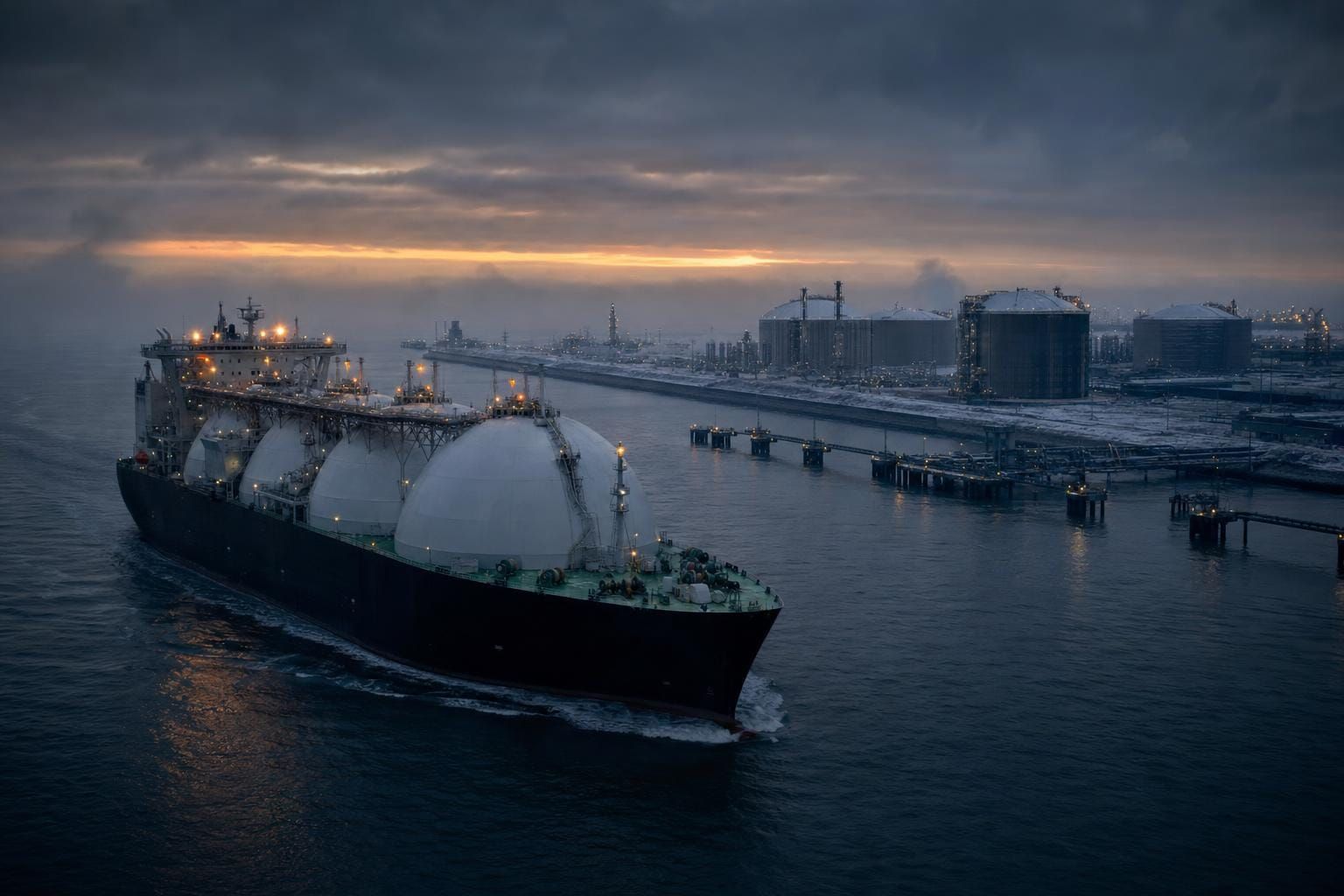
The Iran war broke it in a way nobody had priced. When the conflict closed the Strait of Hormuz earlier this year, it didn't just disrupt oil — it took the world's former top LNG exporter largely offline. QatarEnergy declared force majeure on its LNG exports and has extended it through December. Loadings have recovered to only about half of pre-war levels as more carriers slip through the strait, according to Bloomberg reporting. The International Energy Agency estimates the disruption could shrink global LNG supply by roughly 3% this year — the steepest annual decline on record, in a market that was supposed to be entering a supply glut.
Europe, structurally short gas and newly dependent on seaborne supply, became the bidder of last resort. Benchmark TTF prices are up roughly 70% year-over-year; Asian spot LNG is up about 80%. Global gas demand is down about 1.5% this year — not because anyone wanted to use less, but because prices forced it.
The irony is sharp: the continent that de-risked itself from one chokepoint (the Baltic pipelines) is now hostage to another one 4,000 miles away.
The Price Board
The numbers, as of Monday:
- Dutch TTF front-month: €86.58 per megawatt-hour — equivalent to about $28 per MMBtu at current exchange rates. Earlier this month TTF broke above €100 for the first time in four years, and front-month futures have averaged about €88 in November against €32 in the same month last year — nearly a threefold increase.
- U.S. Henry Hub front-month: $3.16 per MMBtu. American gas costs almost nine times less than European gas. That spread — not the absolute price — is the single most important number in the global gas market right now.
- U.S. LNG exports to Europe hit 6.89 million tons in October, up 1 million tons from September and the driver behind the second-highest monthly U.S. LNG export total in history, according to LSEG data. Shipments to Asia barely moved. Every incremental molecule is going to the highest bidder, and the highest bidder is Europe.
Prices have actually retreated almost a fifth from the late-October spike, helped by the mild start to winter and Washington's signaled preference for maintaining the shipping blockade and economic pressure on Iran rather than resuming open hostilities. The market is calmer. The storage math is not.
The Winter Math
The 90% storage target existed for a reason: it was the buffer that let Europe survive a cold snap, an import disruption, or both. This year the buffer is gone before December. Italy has publicly blamed delays in German storage filling for the autumn price spike — a preview of how quickly intra-EU solidarity frays when the cushion thins. Reuters has reported fears among officials and traders that a cold stretch could push prices to €150–180 per MWh, levels last seen in the 2022 crisis.
And the clock runs past March. The EU's ban on Russian LNG under long-term contracts takes effect January 1, 2027, with remaining Russian pipeline imports scheduled to end in autumn 2027. Whatever gas Europe burns this winter must be replaced next summer from a global LNG market that will have less Russian supply available to it and — unless Hormuz normalizes — still-impaired Qatari volumes.
Europe needs a mild winter, a faster Qatari recovery, and uninterrupted American export cadence, all at once. It might get all three. It has hedged none of them.
A free membership gets you access to every free article at AlphaBriefing.com: Join AlphaBriefing
The rest of this briefing is free — it just requires a free AlphaBriefing account: the three places the nine-times arbitrage actually gets captured (it isn't the drillers), the scenario board from a 5% carryout to a mild-winter fade, and why summer 2027 — not February — may be the real squeeze.
Create your free account → — 30 seconds, no card.