Why the Plane That Flew Itself Across America Couldn't Lift Its Own Stock
Joby just flew an aircraft 3,199 miles with no human touching the controls, put its air taxi into DFW's airspace, and entered the final stage of FAA certification. The stock made a 52-week low anyway. What the market is pricing — and what it may be missing.

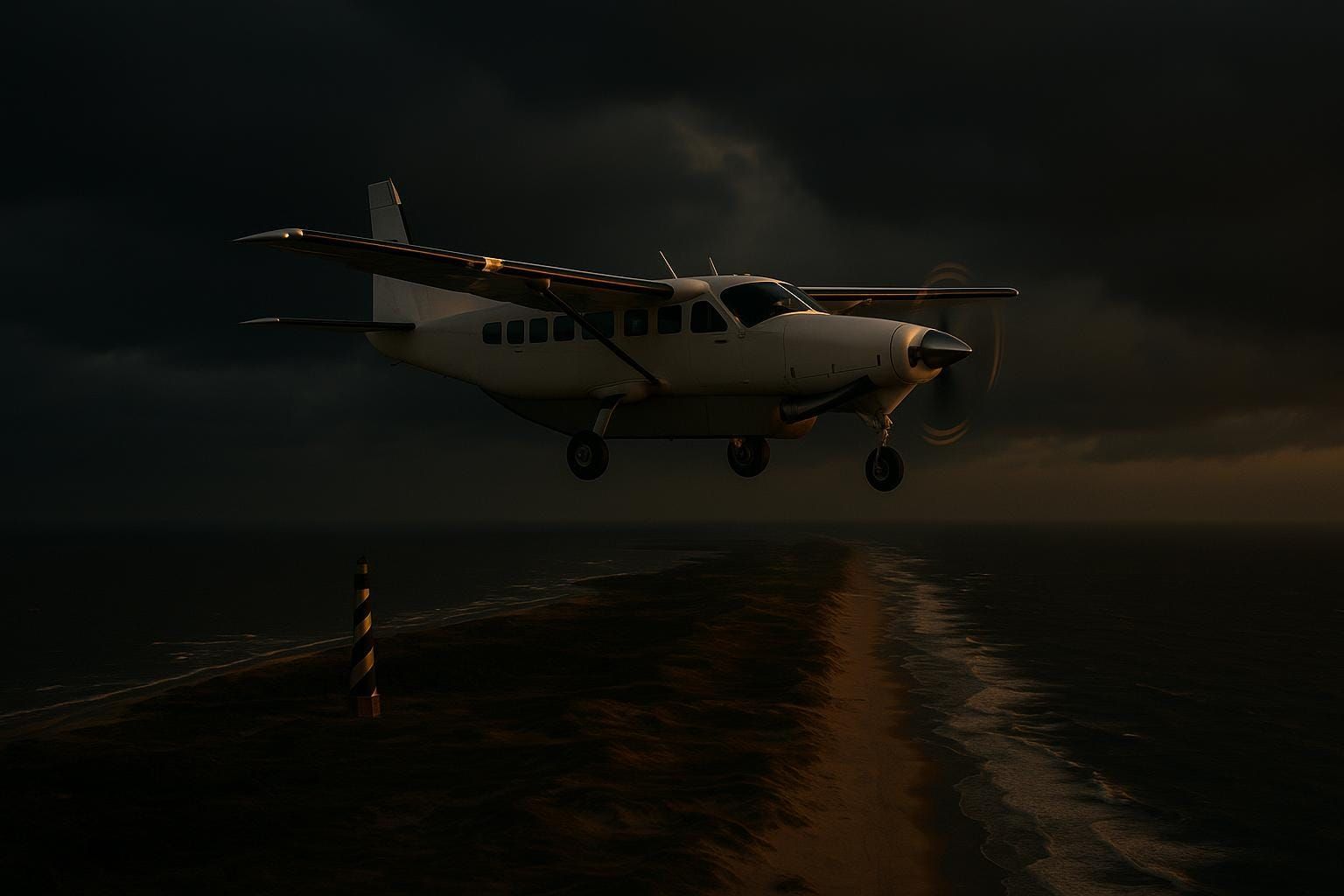
On September 18, a small white turboprop made a low pass over Kitty Hawk, North Carolina — the strip of sand where the Wright brothers started all of this in 1903. It had just flown 3,199 miles from the California coast. The safety pilot on board never touched the controls. Taxi, takeoff, cruise, rerouting around live thunderstorms, landing: all of it was handled by software, supervised remotely from as far as 2,323 miles away.
The aircraft belongs to Joby Aviation (NYSE: JOBY), and the flight — the first fully autonomous fixed-wing crossing of the United States, confirmed by the company and widely covered by the Wall Street Journal and others — capped the most operationally productive month in the company's history. Eight days earlier, Joby's electric air taxi was flying real routes across Dallas-Fort Worth, including landings inside the controlled airspace of DFW International Airport, with the U.S. Transportation Secretary and the FAA Administrator publicly cheering it on. The company is in the fifth and final stage of FAA type certification and still says it intends to carry its first paying U.S. passengers before the end of 2026.
The stock's response: on Thursday morning it traded just under $6 — a fresh 52-week low, down roughly 63% over the past twelve months and about 58% year to date.
A company at the technological frontier of an entire industry, hitting every visible milestone, repriced as if it were failing. Either the market knows something the engineers don't, or the engineers just built something the market hasn't priced. That gap is this briefing.
The Month Everything Worked
Start with the air taxi, because that is the business the stock was always priced on.
From September 10 to 14, Joby flew its eVTOL — electric vertical takeoff and landing aircraft — on real-world routes across North Texas under the eVTOL Integration Pilot Program (eIPP), the White House-backed initiative the Department of Transportation unveiled in March 2026 to get air taxis into American airspace ahead of full certification. Operating under TxDOT's winning Project Nexus proposal, the aircraft flew from Perot Field Fort Worth Alliance Airport into DFW — one of the busiest airports on Earth — plus demonstration routes over Arlington and along the planned corridor to Toyota's North American headquarters in Plano. Transportation Secretary Sean Duffy and Senator Ted Cruz attended the kickoff. The FAA says these flights generate exactly the operational data it needs to write the safety rules for commercial service at scale.
This wasn't a stunt in empty desert. The FAA and NASA have been studying electric air taxi integration in North Texas since 2018, and a 2023 high-fidelity simulation by Joby and NASA at NASA Ames examined running up to 50 electric air taxi operations per hour in the DFW terminal area. Joby has now leased a 45,000-square-foot permanent facility at Perot Field. The infrastructure is being built for a scheduled service, not a demo.
Then came the autonomous crossing. The aircraft, designated J208, is not the sleek air taxi — it's a converted Cessna 208B Caravan, a workhorse airframe that has been certified for decades, fitted with the autonomy stack Joby acquired when it bought Xwing's autonomy division in 2024. By the company's account, the system now has more than 400 flights and 800 automated flight hours behind it, and it has been proven in three major U.S. military exercises — including Air Force readiness exercise Agile Flag, where it delivered replacement parts 24 hours faster than conventional logistics, and REFORPAC, where aircraft flying in Hawaii were operated from Guam, nearly 4,000 miles away.
Read that structure carefully, because it is the most underappreciated fact in the whole story: Joby's autonomy business doesn't need a new aircraft to be certified. It rides on airframes the FAA approved decades ago. While the air taxi walks the long road of type certification, the self-flying Caravan is already doing useful work for the Pentagon.
What the Market Sees Instead
The market is not stupid, and the bear case is not subtle.
Joby guides to $115–125 million of total revenue in 2026 — and most of that comes from Blade, the conventional urban air shuttle business Joby operates in the United States and Europe, which did $36.2 million of revenue in the second quarter. The eVTOL — the thing the company is actually valued on — generates essentially nothing yet. Against that, Joby guided to burning $385–415 million of cash in the second half of 2026 alone, roughly $200 million a quarter. Five aircraft are flying and twelve more are in production, which is a manufacturing ramp — and manufacturing ramps eat cash before they return it.
The chart tells you how the market has processed this: no single crash, no scandal, just a monthly bleed from around $17 a year ago to under $6 today, through every milestone announcement. Rival Archer Aviation (NYSE: ACHR) is down about 50% over the same twelve months. The whole sector has been repriced from "the future is imminent" to "show me the revenue," and announcements that would have moved these stocks 20% in 2021 now get sold.
And hovering over everything is the one date nobody can print: the day the FAA signs the type certificate. Until that happens, every quarter is another $200 million subtracted from the balance sheet on faith.
So the real question for an investor isn't whether the technology works — September settled that. It's this: Joby is now three different businesses wearing one ticker — a pre-revenue air taxi developer, a small-but-real urban aviation operator, and a defense autonomy company that just wrote a half-billion-dollar check. Which of the three actually pays for the other two, when does it start, and does $2.3 billion of cash last long enough to find out?
Get the next briefing free in your inbox: Join AlphaBriefing
The rest of this briefing is for paid members: the three-business breakdown and which one turns profitable first, the cash-runway arithmetic through 2029, the five catalysts between now and spring — including a court ruling from this week most coverage missed — and where Boeing's surrender just left the competitive field.
AlphaBriefing Paid gets you every investment thesis, scenario framework, and catalyst brief we publish — the analysis private intel clients pay four figures for, at a fraction of that.