The Last Flagship
NASA's $4.3B Roman Space Telescope launched Sunday — a mission the White House tried to cancel five times, riding the final Falcon Heavy, with no funded successor behind it. The flagship industrial base just lost its order book, and the capacity is migrating.

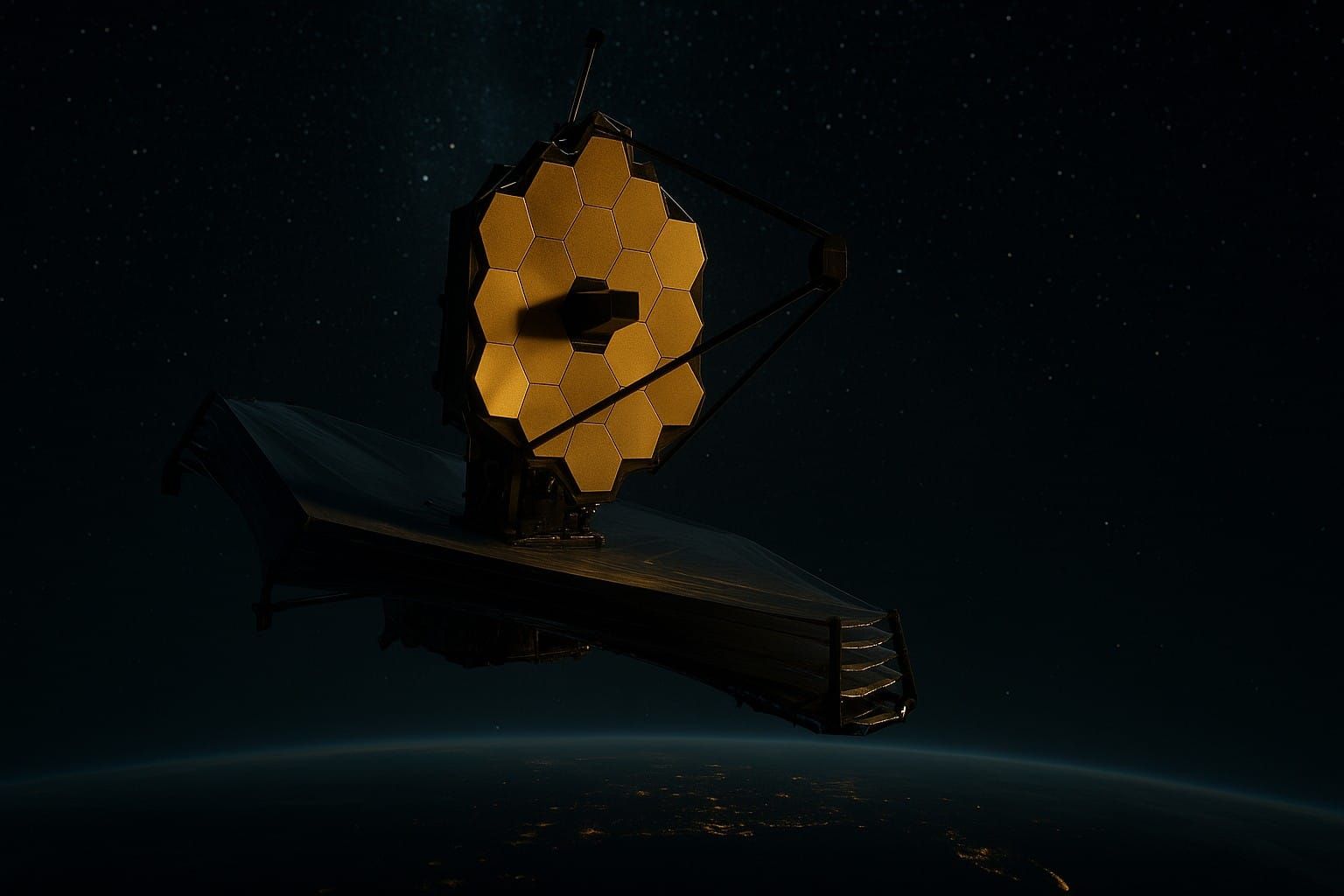
At 7:26 a.m. Eastern on Sunday, a Falcon Heavy lifted off from Launch Complex 39A at Kennedy Space Center carrying the Nancy Grace Roman Space Telescope. Thirty-one minutes later, the $4.3 billion observatory separated from the upper stage and began a 100-day cruise to a point 1.5 million kilometers from Earth. Two hours after that, President Trump phoned into the post-launch press conference to congratulate NASA. "We're the hottest in space," he told the room. "Let's keep it all going."
Here is what went unsaid on that call: this administration and its predecessor's budget office tried to cancel this telescope five separate times. And behind Roman, for the first time since the 1970s, NASA's astrophysics flagship pipeline is empty.
That second fact is the one that matters for money. The launch was flawless. The order book is not.
A Machine Built From a Spy's Leftovers
Roman is an unusual flagship. Its 2.4-meter primary mirror — the same diameter as Hubble's — was not built for NASA at all. It was donated in 2012 by the National Reconnaissance Office, surplus hardware from a spy satellite program, then reworked for astronomy by L3Harris in Rochester, New York. The Wide Field Instrument, a 300-megapixel infrared camera, was built by Ball Aerospace — now BAE Systems Space & Mission Systems. The infrared detector arrays inside it came from Teledyne.
The result is a survey machine unlike anything flying. Roman matches Hubble's resolution but sees a field of view at least 100 times larger, and it can survey the sky more than 1,000 times faster. "A survey that would take Roman a month would take a century for Hubble," senior project scientist Julie McEnery said before launch. Over its five-year prime mission it will observe 20 billion stars, 2 billion galaxies, and an expected 100,000 exoplanets — roughly 40 times the number currently known — while testing whether dark energy, the force accelerating the universe's expansion, is even constant over cosmic time.
It will also generate up to 1.4 terabytes of data per day, downlinked to ground stations in New Mexico, Australia, and Japan and pushed to a public cloud archive with no proprietary period. Every hedge-fund-adjacent data scientist who ever wanted to train a model on a live flagship science stream will have one, free, starting early 2027.
Five Attempts to Kill It
Roman's path to the pad reads like a stress test of American science funding.
As WFIRST, the mission was proposed for cancellation in three consecutive White House budget requests — fiscal years 2019, 2020, and 2021. Congress rejected all three and appropriated full funding. In 2025, an Office of Management and Budget "passback" document targeted the mission again, and the FY2026 budget request proposed a deep cut — despite the spacecraft being nearly complete and ahead of schedule. Congress again restored it, passing a $24.4 billion NASA budget in January that rejected what analysts had called "extinction-level" cuts to the agency's science program.
Five attempts, five congressional rescues. The telescope that the president praised on live television Sunday exists because the legislature overrode his own budget office, repeatedly, for eight years.
The Pipeline Behind It Is Empty
The FY2027 request, now in front of Congress, tries again — harder. It seeks $18.8 billion for NASA, a 23 percent reduction, with the science directorate cut roughly 47 percent. The Planetary Society estimates more than 50 missions would be terminated outright. The next astrophysics flagship — the Habitable Worlds Observatory, meant to photograph Earth-like planets around other stars — exists only as an early-stage formulation effort with no committed funding line and a notional launch in the 2040s.
Add the symbolism on the launch side: Sunday's flight was the final mission of Falcon Heavy, the rocket that carried Psyche, Europa Clipper, and now Roman. SpaceX is retiring it as it shifts to Starship. The last funded flagship left Earth on the last flight of the rocket built to carry flagships.
Hubble launched in 1990. Webb in 2021. Roman in 2026. After that, the calendar is blank — and the clean rooms, optics benches, and detector fabs that build these machines do not sit idle waiting for Congress to find its nerve. That capacity is already migrating to a different customer. Who profits from that migration is the actionable part of this story.
The rest of this briefing is for paid members: the contractor-by-contractor map of Roman's industrial base and what each firm loses when the flagship pipeline goes dark, where the optics and detector capacity is already migrating — including the listed names on the receiving end, the September appropriations dates that decide whether the 47 percent cut sticks, and the bottom-line positioning framework.
AlphaBriefing Paid gets you every investment thesis, scenario framework, and catalyst brief we publish — the analysis private intel clients pay four figures for, at a fraction of that.