The $1.4 Trillion Mobile Money Revolution: How Emerging Markets Are Building the World's Next Banking System
From Nubank's 131 million customers to MTN MoMo's $500 billion in annual transactions, the digitization of finance across Latin America and Africa is producing the most compelling growth stories in global banking — and most Western investors aren't watching.

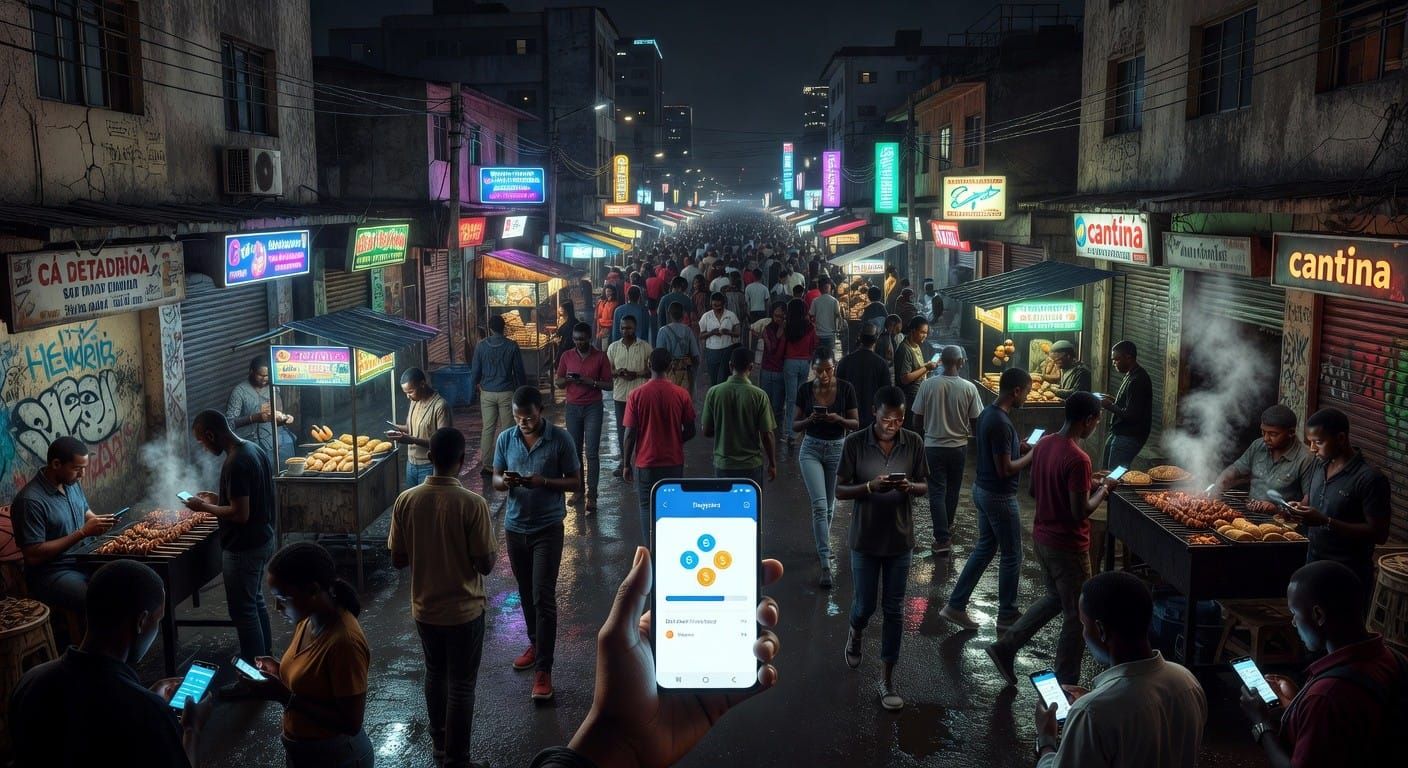
The world's next great banking revolution isn't happening in New York or London. It's happening on a smartphone screen in Lagos, São Paulo, and Nairobi — and the numbers are staggering.
Across Latin America and Africa, a new class of digital-first financial platforms is bypassing the legacy banking system entirely, serving hundreds of millions of people who were previously locked out of the formal financial system. In the process, they're building some of the most compelling growth stories in global finance — and most Western investors are barely paying attention.
This isn't a story about cryptocurrency speculation or niche DeFi experiments. It's about plain-vanilla banking services — payments, credit, savings, insurance — delivered via smartphone to markets where traditional banks failed to go. Add stablecoins and AI into the mix, and what's emerging is a financial infrastructure layer that could reshape how a billion-plus people interact with money.
The Scale of the Opportunity
Start with the baseline. According to the World Bank, roughly 1.4 billion adults globally remain unbanked. The vast majority live in sub-Saharan Africa, Latin America, and South and Southeast Asia. These aren't people who rejected formal banking — they were priced out of it. Traditional banks required minimum balances, charged high fees, and built physical branches in places that didn't pencil out economically.
Mobile money flipped that logic. In Africa alone, mobile money transaction volumes hit $1.43 trillion in 2025 — up 27% year-on-year — and Africa now accounts for roughly two-thirds of all global mobile money flows. The market, valued at $9.2 billion in 2025, is projected to reach $67 billion by 2034, a compound annual growth rate approaching 25%.
In Latin America, the trajectory is equally steep. Brazil's Nubank (NYSE: NU) has grown from a credit card challenger into the largest digital bank in the world by customer count, serving 131 million customers across Brazil, Mexico, and Colombia. To put that in perspective: Nubank now reaches approximately 62% of all Brazilian adults. Q4 2025 revenue hit $4.9 billion — up 58% year-on-year — with net income of $895 million and a return on equity approaching 30%.
These are not startup metrics. This is a profitable, scaling financial institution that didn't exist fifteen years ago.
Why Now?
Three structural forces are converging to accelerate this trend:
1. Smartphone penetration reaching critical mass. Mobile internet access in sub-Saharan Africa has crossed 50% and is climbing fast. In Latin America, smartphone penetration is already above 80% in most major markets. The device that unlocks financial services is now in more pockets than ever.
2. Real-time payment infrastructure going live. Brazil's Pix instant payment system, launched in 2020, now processes more transactions than credit cards and has become the backbone of the entire digital financial ecosystem. Africa is building analogous infrastructure — the Pan-African Payment and Settlement System (PAPSS) is designed to enable intra-African cross-border payments in local currencies, potentially eliminating the dollar-routing bottleneck that adds cost and delay to intra-continental trade.
3. Stablecoins solving the currency volatility problem. This is the under-covered pivot. In economies where the local currency loses 20–30% of its value in a bad year — Argentina, Nigeria, Venezuela, Zimbabwe — stablecoins denominated in dollars have become a genuine store of value and medium of exchange. Nubank already offers USDC access to 100 million-plus users and is piloting stablecoin-backed credit card payments. MTN's MoMo is integrating dollar-pegged products across its 17-market network. The stablecoin isn't replacing the bank account — it's extending it.
This is where the analysis gets actionable. AlphaBriefing members get the full investment framework — scenarios, positioning, and the bottom line.
Subscribe to AlphaBriefing — Free, Member, and Paid tiers available.