Cyanide, Floating Barriers, and the South China Sea War Nobody Is Covering

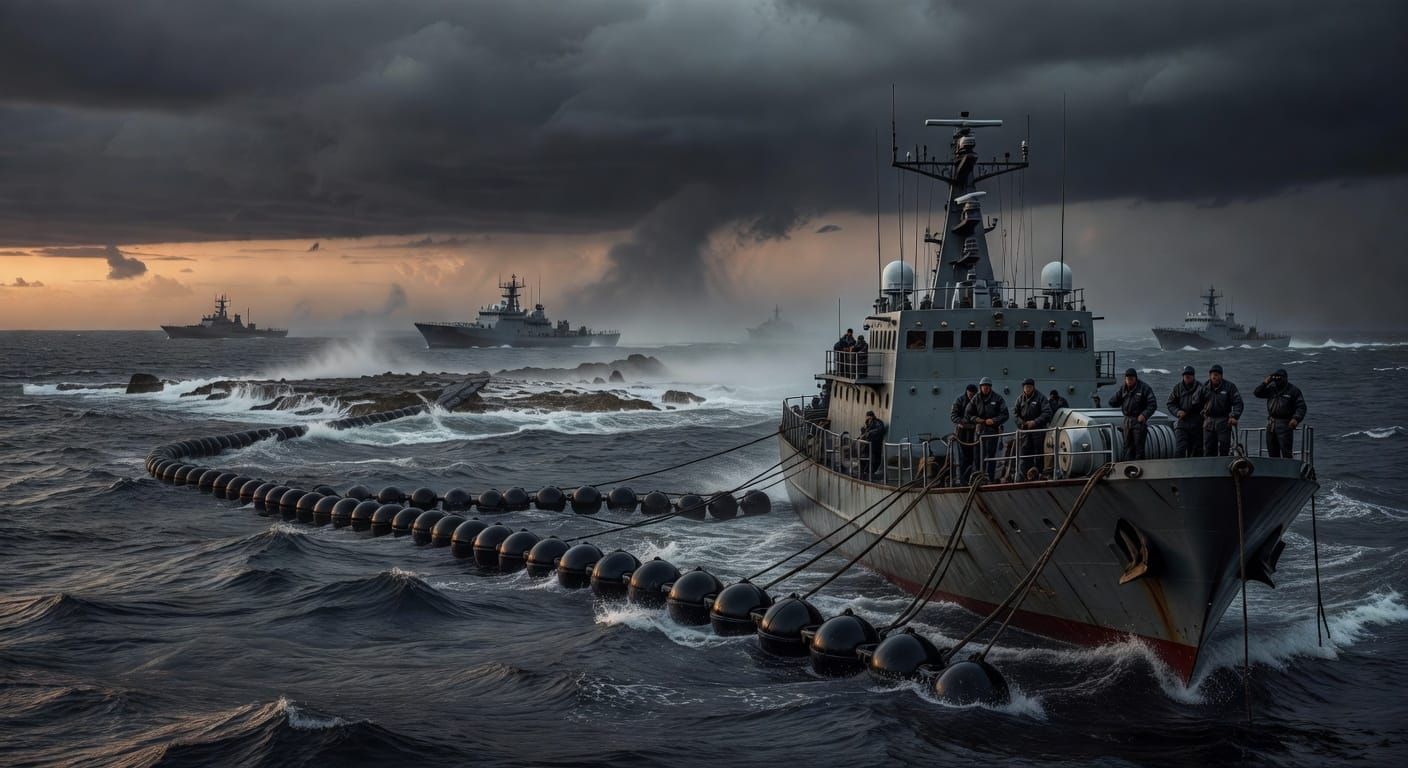
While the world watches the Strait of Hormuz, China is quietly rewriting the rules in the South China Sea — one covert act at a time.
In the past week alone, Beijing deployed a 352-meter floating barrier to blockade the entrance to Scarborough Shoal and was credibly accused of ordering fishing boats to dump sodium cyanide near a Philippine military outpost at Second Thomas Shoal. Both moves were deliberate. Neither has driven headlines. And that's precisely the point.
The Shoal That Defines the Dispute
Second Thomas Shoal — known in the Philippines as Ayungin Shoal — is a submerged reef about 105 nautical miles west of the Philippine island of Palawan. It lies well within Manila's Exclusive Economic Zone. It should, legally, belong to the Philippines.
It doesn't. Not in practice.
Since 1999, the Philippines has maintained a symbolic military presence there aboard the BRP Sierra Madre, a deliberately grounded World War II-era rust bucket that serves as a floating outpost. A small contingent of marines lives aboard. Their supply line — periodic resupply missions from the Philippine coast guard — has been the subject of repeated Chinese harassment for years: water cannons, vessel ramming, radio warnings, and now, allegedly, chemical sabotage.
Philippine Navy personnel seized yellow plastic bottles from small sampan boats launched by Chinese fishing vessels on at least four separate occasions in 2025 and early 2026. Lab tests confirmed the contents: sodium cyanide. According to the Philippine National Security Council, the goal was to poison the local fish population — one of the marines' key food sources — contaminate the surrounding water, and degrade the reef that supports the grounded vessel.
China's foreign ministry dismissed the allegations as a "stunt" and a "farce." Beijing claims the Philippines illegally seized Chinese fishing supplies and fabricated evidence.
That denial is unconvincing given the pattern. This is not a single incident. It is a playbook.
Scarborough Shoal: The Barrier Tactic
On April 10 and 11, 2026, satellite imagery captured by Vantor (formerly Maxar Technologies) confirmed that China deployed a 352-meter floating barrier across the entrance to Scarborough Shoal — a strategically vital atoll China seized from the Philippines during a 2012 standoff.
The Philippine Coast Guard confirmed 10 Chinese Coast Guard ships in the area between April 5 and 12, with six maritime militia vessels operating inside the shoal and three others blocking the entrance. A probable naval patrol vessel was also visible.
The barrier appeared to be removed over the April 13–14 weekend. But the message was sent.
This is not new either. Similar barriers were deployed and removed in 2023, 2024, and 2025 — always temporary, always provocative, always deniable. The pattern is consistent: apply pressure, demonstrate control, retreat before triggering a formal military response, then repeat.
The 2016 Permanent Court of Arbitration ruling declared Scarborough Shoal a traditional fishing ground accessible to all parties and invalidated China's nine-dash line claims over the broader sea. Beijing rejected the ruling entirely and has never complied.
The Grey Zone Is the Strategy
Beijing's South China Sea approach is a masterclass in what strategists call "grey zone" operations: coercive actions that fall below the threshold of armed conflict, denying an adversary's ability to escalate while steadily changing facts on the ground.
The tools are calibrated: Coast Guard vessels rather than warships. Maritime militia (nominally civilian fishermen who are, in practice, a paramilitary force) rather than PLA Navy. Floating barriers rather than artillery. Cyanide in fishing bottles rather than weapons.
Each incident, taken alone, is deniable and insufficient to trigger a formal military response. The 1951 US-Philippines Mutual Defense Treaty covers armed attacks on Philippine armed forces, public vessels, and aircraft anywhere in the South China Sea. Water cannons, barriers, and cyanide bottles fall into a grey zone that stops just short of that threshold — deliberately.
Taken together, the incidents are not grey at all. They represent a sustained campaign to degrade the Philippine military presence at Second Thomas Shoal, tighten control over Scarborough Shoal, and establish behavioral norms in which Chinese enforcement of its claims goes effectively unchallenged.
"China remains undeterred in the grey zone," concluded researchers at the East Asia Forum in February 2026. That assessment has only been validated since.
The $3 Trillion Chokepoint
The South China Sea is not merely a territorial dispute between the Philippines and China. It is the artery through which roughly $3 trillion in global trade flows annually. About 30% of all maritime shipping transits these waters — tankers carrying Middle Eastern crude to East Asian refineries, container ships linking Southeast Asian factories to Western consumers, LNG carriers supplying Japan, South Korea, and Taiwan.
Taiwan, crucially, relies on the South China Sea for 98% of its LNG imports. Any sustained disruption would hit its economy and energy security directly.
For now, shipping traffic continues. Markets have priced in essentially zero disruption risk from the SCS — especially while the Hormuz crisis commands attention. But the infrastructure for disruption is being assembled quietly.
Kpler tracking data from mid-April 2026 shows approximately 528 Chinese-flagged vessels loitering in Philippine EEZs and disputed waters. Many are slow-steaming or stationary. The floating barriers, the militia swarms, the resupply blockades — these are rehearsals, not random incidents.
The US Response: Reaffirmed, Not Activated
Washington has not been passive. In February 2026, the US-Philippines Bilateral Strategic Dialogue produced a joint statement explicitly reaffirming that the Mutual Defense Treaty covers attacks on Philippine armed forces, public vessels, and coast guard anywhere in the South China Sea. The statement condemned China's "illegal, coercive, aggressive, and deceptive activities" in explicit terms.
Balikatan 2026 — the annual US-Philippines military exercises — deployed over 17,000 troops, including new NMESIS missile systems and Tomahawk-capable assets. US, Australian, and Philippine forces conducted joint patrols near disputed areas in April, the second such exercise this year.
China responded by increasing CCG patrols and maritime militia presence.
The dynamic reflects a fundamental tension in US strategy: maximum deterrence short of direct confrontation. It has worked to prevent outright war. It has not deterred the grey zone campaign.
What Investors Need to Know
Markets are not pricing this risk correctly. Here is what to watch:
Shipping insurance premiums are the canary in the coalmine. When grey-zone incidents escalate, hull and war-risk premiums spike on SCS routes before equity markets move. The Baltic Exchange and Lloyd's war-risk indices are worth monitoring for early signals.
Energy exposure is asymmetric. The SCS holds an estimated 11 billion barrels of oil reserves and 190 trillion cubic feet of natural gas — most of it in disputed EEZs. Companies attempting exploration in Philippine or Vietnamese territorial waters face a coercion playbook that has already forced multiple projects to pause. Chinese joint venture proposals are likely to proliferate as the only viable access route.
Taiwan's energy vulnerability is underappreciated. An LNG disruption — even partial — would hit Taiwan's power grid and industrial capacity. Companies with heavy Taiwan supply-chain exposure should be modeling this scenario.
Defense spending in Southeast Asia is rising structurally. The Philippines announced a $35 billion military modernization plan in 2025. Vietnam, Indonesia, and Malaysia are all increasing defense budgets. European and US defense contractors are winning contracts in the region.
The diplomatic window is narrow. China-Philippines talks resumed in March 2026 and touched on potential joint energy development at Reed Bank. The Philippines holds the ASEAN chairmanship in 2026 and is pushing for a binding Code of Conduct on the South China Sea by mid-year. Most analysts are skeptical. The more the grey zone tactics continue, the narrower the diplomatic space becomes.
The Bottom Line
The world's attention is on Hormuz. China is quietly winning a different contest — one that doesn't require missiles or invasions, just patience, persistence, and a playbook Beijing has been executing for over a decade.
The cyanide bottles at Second Thomas Shoal and the floating barrier at Scarborough Shoal are not isolated provocations. They are moves in a long game. The question for investors is not whether the South China Sea eventually matters to markets. It is whether they will see it coming before it does.
Get this level of intelligence every day. Subscribe to AlphaBriefing — free, member, and paid tiers available.
Sources & Further Reading
- Reuters — China moves to block entrance to disputed South China Sea shoal, images show
- Al Jazeera — Philippines accuses China of using cyanide to poison South China Sea atoll
- The Diplomat — Philippines Accuses China of Cyanide Sabotage at South China Sea Shoal
- BBC News — Philippines accuses China of dumping cyanide near disputed shoal
- East Asia Forum — China remains undeterred in the grey zone
- Kpler — From Hormuz to Malacca: The Next Chokepoint Risk
- US State Department — Joint Statement on the Philippines-United States Bilateral Strategic Dialogue
- RAND Corporation — South China Sea Security and Grey Zone Escalation
Disclaimer
AlphaBriefing is an independent intelligence publication. The content in this article is produced for informational and educational purposes only. Nothing published by AlphaBriefing constitutes financial, investment, legal, tax, or regulatory advice, nor should it be construed as a solicitation or recommendation to buy, sell, or hold any security, asset, or financial instrument.
All views expressed are those of the author at the time of writing and are subject to change without notice. Markets are volatile and unpredictable; past performance is not indicative of future results. Any investment involves risk, including the possible loss of principal.
AlphaBriefing and its principals, employees, or contributors may hold positions in securities or assets mentioned in this article. This should be considered a potential conflict of interest. No material relationship with any company referenced exists unless explicitly disclosed. Readers should conduct their own due diligence and consult qualified financial, legal, and tax advisors before making any investment decisions.
Information in this article is drawn from public sources believed to be reliable at the time of publication. AlphaBriefing makes no warranty, express or implied, as to the accuracy, completeness, or timeliness of any information herein. AlphaBriefing accepts no liability for any loss or damage arising from reliance on this content.
© AlphaBriefing. All rights reserved. Unauthorised reproduction or distribution is prohibited.