SpaceX Just Made Sovereign Defense Infrastructure Tradable
The $1.77 trillion SPCX IPO isn't a markets story. It's the publicly-tradable inception of sovereign space-based defense as an asset class — and every defense-investing thesis written before 9:30 AM Eastern is now stale.

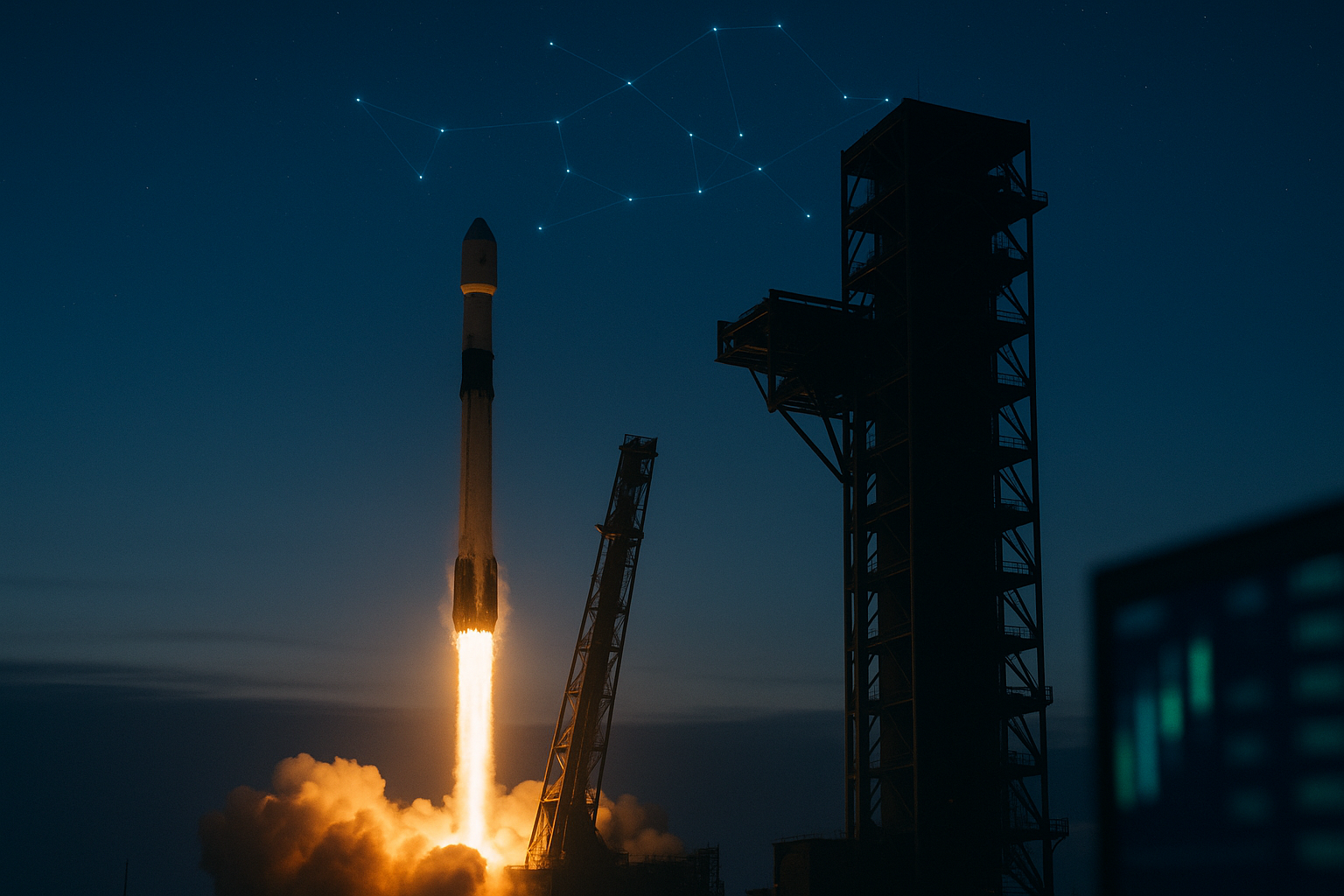
At 9:30 AM Eastern on Friday, June 12, 2026, Space Exploration Technologies Corp. opened on the Nasdaq under the ticker SPCX. The IPO priced at $135 the night before. Shares opened at $150. By 1:15 PM Eastern they were trading at $172.28, up 27.6% on the day, with intraday volume of 324 million shares and an implied market capitalization of $2.26 trillion.
That makes SPCX, on day one, more valuable than every other US defense contractor combined.
The $75 billion raised is the largest IPO in financial history. Polymarket had priced 69% odds of a close above $2 trillion before the open. By lunch in New York, the market had already settled that bet.
Most of today's coverage will lead with two numbers: the $1.77 trillion IPO valuation and the 10.3 million Starlink subscribers underpinning it. Those are the right numbers for a markets-desk story. They are not the right numbers for understanding what just changed in the defense industrial base.
The Starshield Footnote
Buried in the S-1 prospectus, in language carefully drafted to avoid spooking commercial Starlink customers, is a description of the Starshield program — a sovereign, hardened, end-to-end-encrypted satellite constellation that SpaceX builds for the Department of Defense, the National Reconnaissance Office, and what the filing describes as "allied national security customers."
Starshield is not a side business. It is a multi-billion-dollar-a-year revenue stream with classified contract terms, multi-decade engagement cycles, and the strategic importance of GPS itself. As of Q1 2026, public reporting suggests Starshield has booked more than $7 billion in awarded defense contracts and is the prime contractor on the NRO's next-generation low-Earth-orbit ISR architecture. The exact numbers are redacted in the prospectus.
What this means in plain language: as of this morning, sovereign space-based defense infrastructure is publicly tradable for the first time in human history.
That is not a markets story. That is a procurement story, a force-structure story, a strategic-rebalance story.
And every defense investor in the country is now repricing off it.
The Halo Effect Is Already Visible
Walk through what the SPCX open did to defense-adjacent names on Friday morning:
- Rocket Lab USA (RKLB) opened up 8% on the assumption that small-launch capacity becomes scarcer as SpaceX absorbs even more institutional capital
- AST SpaceMobile (ASTS) popped 6% on the read that direct-to-cell satellite services now have a defense-grade comparable that validates the multiple
- Iridium (IRDM) up 4% on the same logic
- Palantir (PLTR) flat — the read here is "we're already priced for sovereign software, we don't need a SPCX read-through"
- Lockheed Martin (LMT) down 2.5%, Northrop Grumman (NOC) down 3%, L3Harris (LHX) down 2% — the traditional space-prime ecosystem is being repriced against a vertically-integrated competitor who just raised $75 billion in primary capital and has Elon Musk's product organization behind it
The pattern is unambiguous. Money is flowing toward companies that ride SpaceX's wake (small-launch, smallsat, sovereign comms adjacents) and away from companies whose moat just got challenged (the legacy space primes, who lose share-of-wallet to a player with five times their cash on hand and one-third their per-pound launch cost).
This is the obvious halo effect. The non-obvious one is more interesting.
What Iran and Ukraine Just Got More Expensive
The strategic context for the $2 trillion valuation isn't Wall Street. It is Bakhmut and Bandar Abbas.
Starlink became indispensable in Ukraine over the course of 2022-2024. Russian electronic warfare has spent the same period iterating against it, with mixed results — the constellation remains operable, but the cost-per-degraded-sector keeps climbing. The Iranian regime is now reportedly using Chinese-supplied Tobol-class jammers to degrade Starlink coverage near sensitive sites. Israeli forces have been quietly testing Starshield-grade hardened terminals on F-35 reconnaissance fits since late 2025.
Every one of these conflicts is an advertisement for SpaceX's sovereign-space offering. Every public skirmish over Starlink terminals on the battlefield is, in market terms, a positive forward indicator for the Starshield contract book.
What SPCX's $2 trillion valuation now does is capitalize that forward indicator. The market has decided that the political-military future is one in which sovereign-grade space connectivity is treated the way sovereign-grade energy infrastructure has been treated for forty years — strategic, non-substitutable, and worth paying any price to control.
That has implications for every defense-tech investor that go far beyond the SPCX ticker itself.
The full battlefield map is below — including which adjacent names rerate hardest in three scenarios, the Musk-risk premium that just became a publicly-priced variable, and what closes most when the Iran ceasefire ink dries.
Subscribe to AlphaBriefing — Free, Member, and Paid tiers available.