The AI Boom Just Hit Your Electric Bill
Starting this month, 65 million Americans begin paying record grid costs driven by data centers. The collision between Big Tech and household power bills is the new front line of the AI economy.

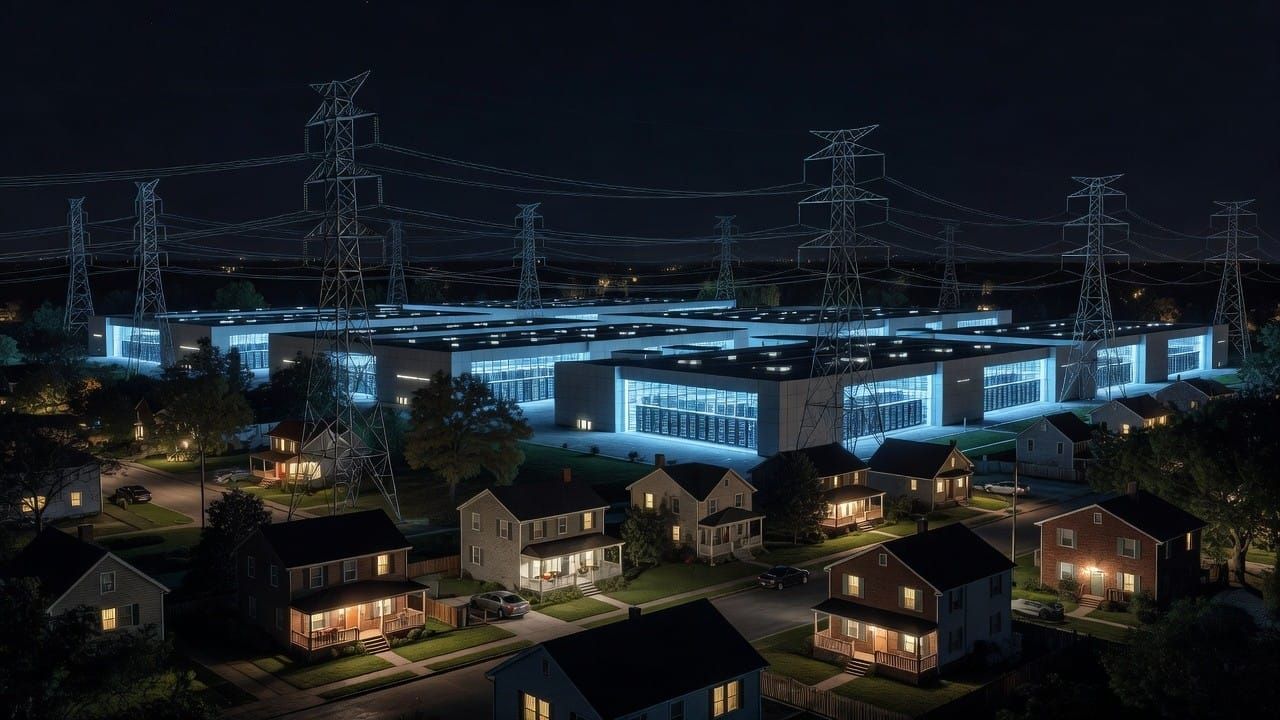
This month, something unusual happened to roughly 65 million Americans' electric bills: they became an AI story.
June 1 marked the start of a new "delivery year" for PJM Interconnection, the sprawling grid operator that keeps the lights on across 13 states and Washington, D.C. — a footprint that runs from Chicago to the Jersey Shore and covers the largest data center corridor on Earth in Northern Virginia. With the new delivery year, the results of PJM's record-shattering capacity auctions officially start flowing into retail electric rates. Ratepayers across the region will pay roughly $1.4 billion more in capacity costs alone over the coming year — and the grid's own independent watchdog says the overwhelming driver is data centers.
This is the moment the AI boom stopped being an abstraction in Nvidia's earnings reports and started showing up, line by line, on household utility bills. And it's setting up one of the most consequential political and financial fights of the decade.
The auction that broke the market
To understand what's happening, you need to understand one obscure mechanism: the capacity auction.
PJM doesn't just buy electricity for today — it pays power plants in advance to guarantee they'll be available years into the future. The price for that guarantee is set at auction, and for most of the last decade it was boring. Capacity was cheap because demand was flat. American electricity consumption barely grew for 20 years.
Then AI arrived. In PJM's most recent auction this past December, capacity prices slammed into the administrative price cap of $333.44 per megawatt-day across the entire region — the third consecutive auction to set a record. The total bill: $16.4 billion for the 2027–2028 delivery year, up from $14.7 billion the year before, which was itself a record.
PJM's independent market monitor, Monitoring Analytics, did the forensic accounting. Its conclusion: data center load accounted for $6.5 billion — 40 percent — of that $16.4 billion. Across the last three auctions combined, data center demand forecasts were responsible for roughly 45 percent of $47.2 billion in total capacity costs. For the 2025/26 delivery year that just began, the monitor previously estimated data centers drove 63 percent of the price increase, translating to $9.3 billion recovered from customers in higher rates.
In other words: this is not a vague "demand is up" story. The grid's own referee has put a number on it, and the number is enormous.
The bill arrives
The capacity auction is just one ingredient in a retail electric bill, but the broader trajectory is unmistakable. Average U.S. residential electricity prices hit about 19 cents per kilowatt-hour by the end of 2025 — up roughly 27 percent from 2019, and around 40 percent since 2021, outpacing overall inflation.
The pipeline of future increases is even more striking. In 2025, U.S. utilities asked state regulators to approve a record $31 billion in rate increases — more than double the $15 billion requested in 2024. In just the first three months of 2026, they filed for another $9.4 billion.
And the demand wave is still building. Data centers consumed about 4.4 percent of U.S. electricity in 2023; federal estimates put that at anywhere from 6.7 to 12 percent by 2028. In 2025, utilities received interconnection requests for at least 700 gigawatts of new data center capacity — more power than the entire United States consumed in 2023. Not all of that will be built (developers shop the same project to multiple utilities, inflating the queue), but even a fraction reshapes the system. The Federal Reserve Bank of Dallas estimates that if data center demand doubles over five years as expected, wholesale power prices could rise as much as 50 percent.
The Institute for Energy Economics and Financial Analysis ran the numbers on PJM specifically: if auctions keep clearing at elevated caps, cumulative capacity costs could reach $163 billion through 2033 — which works out to something on the order of $70 a month for an average household by the end of the period.
PJM, meanwhile, projects it will be six gigawatts short of its reliability requirement as soon as 2027. The grid isn't just getting more expensive. It's getting tighter.
The fairness fight
Here is where the story turns political, and fast.
The core question is deceptively simple: when a hyperscaler's campus demands as much power as a midsize city, who pays for the new generation and transmission it requires? Under the traditional utility model, infrastructure costs are socialized across all ratepayers. That worked when load growth came from thousands of small customers. It breaks down when a handful of trillion-dollar companies drive most of the growth — and when their speculative demand forecasts alone can move auction prices for everyone.
The backlash is already institutional. Pennsylvania Governor Josh Shapiro took PJM to court and extracted a settlement in 2025 that imposed the very price cap the December auction slammed into — a cap now set to expire. Ohio regulators approved a first-of-its-kind tariff requiring large data centers to pay for a high minimum share of the power they request, whether they use it or not, precisely to stop phantom forecasts from inflating costs. Similar "bring your own power" and special-rate-class proposals are moving through statehouses across the PJM footprint.
On the other side stands the Data Center Coalition — Google, Microsoft, Meta, Amazon, and dozens of others — which has fought mandatory cost-assignment rules and backed voluntary alternatives, such as agreeing to curtail consumption during grid emergencies. The industry's argument: data centers pay enormous sums into the system, anchor local tax bases, and are being scapegoated for cost pressures that also stem from fuel prices, storm hardening, and decades of underinvestment in transmission.
They have a point — up to a piece. A study released in March by the Institute for Energy Research found no statistically significant correlation between data center concentration and current retail electricity prices nationwide, and analysts note that grid maintenance and natural gas costs explain much of the increase since 2021. Both things can be true: bills were rising anyway, and data centers are now the dominant marginal force pushing capacity markets — the forward-looking part of the system — into record territory. That's exactly what PJM's monitor measured.
Why this matters for money
For investors, the repricing of American electricity is one of the cleanest structural themes on the board — and the politics are now part of the trade.
Generators are the obvious winners. Independent power producers with existing nuclear and gas fleets in PJM — the Constellations, Vistras, and Talens of the world — are selling capacity into a market that just hit its price cap three auctions running. Every megawatt they own was just repriced upward.
The picks-and-shovels layer is supply-constrained. Gas turbines are sold out for years. Transformers, switchgear, and high-voltage cable have multi-year lead times. Companies that build, electrify, and connect — from turbine makers to grid contractors — are running against a backlog that policy cannot quickly fix.
Utilities face a more complicated decade. Rate-base growth is the bull case; political blowback is the bear case. Utilities caught raising residential rates to serve Big Tech will become targets for every state attorney general and gubernatorial candidate in the country. Expect more Ohio-style tariffs that ring-fence data center costs — protecting consumers but also capping how much growth gets socialized into guaranteed returns.
And watch the hyperscalers' counter-move. The endgame for Big Tech is to exit the shared grid wherever possible: behind-the-meter nuclear deals, dedicated gas plants, restarted reactors, and eventually small modular reactors. Every dollar of political friction on the public grid accelerates the private one.
The bottom line
The United States is attempting something it hasn't done in two generations: grow electricity supply fast, under political scrutiny, with a grid built for a flat-demand world. The June bills landing in mailboxes across 13 states are the first broad-based consumer invoice for the AI buildout — and consumers vote.
The collision between the most capitalized companies in history and the most politically sensitive household expense in America has only begun. However it resolves — special tariffs, private power islands, federal intervention, or a demand forecast that turns out to be a mirage — the price of a kilowatt-hour is no longer a sleepy number. It's the new front line of the AI economy.
Get this level of intelligence every day. Subscribe to AlphaBriefing — free, member, and paid tiers available.
Sources & Further Reading
- Utility Dive — Data centers were 40% of PJM capacity costs in last auction: market monitor
- Utility Dive — PJM capacity prices hit record high as grid operator falls short of reliability target
- Monitoring Analytics — 2026 State of the Market Report for PJM (Q1)
- IEEFA — Projected data center growth spurs PJM capacity prices by factor of 10
- Canary Media — PJM's capacity costs hit record as grid falls short on supply
- Fortune — Electricity prices are up 40% since 2021, but data centers shouldn't get all the blame
- PJM — Auction Procures 134,479 MW of Generation Resources
- Belfer Center — AI, Data Centers, and the U.S. Electric Grid: A Watershed Moment
Disclaimer
AlphaBriefing is an independent intelligence publication. The content in this article is produced for informational and educational purposes only. Nothing published by AlphaBriefing constitutes financial, investment, legal, tax, or regulatory advice, nor should it be construed as a solicitation or recommendation to buy, sell, or hold any security, asset, or financial instrument.
All views expressed are those of the author at the time of writing and are subject to change without notice. Markets are volatile and unpredictable; past performance is not indicative of future results. Any investment involves risk, including the possible loss of principal.
AlphaBriefing and its principals, employees, or contributors may hold positions in securities or assets mentioned in this article. This should be considered a potential conflict of interest. No material relationship with any company referenced exists unless explicitly disclosed. Readers should conduct their own due diligence and consult qualified financial, legal, and tax advisors before making any investment decisions.
Information in this article is drawn from public sources believed to be reliable at the time of publication. AlphaBriefing makes no warranty, express or implied, as to the accuracy, completeness, or timeliness of any information herein. AlphaBriefing accepts no liability for any loss or damage arising from reliance on this content.
© AlphaBriefing. All rights reserved. Unauthorised reproduction or distribution is prohibited.