Can Washington Tell 42 Million Americans What Not to Eat?
On November 1, four more states switch off soda and candy purchases on EBT cards — a live experiment on the $100 billion SNAP program, and new NBER research shows exactly who wins and who pays.

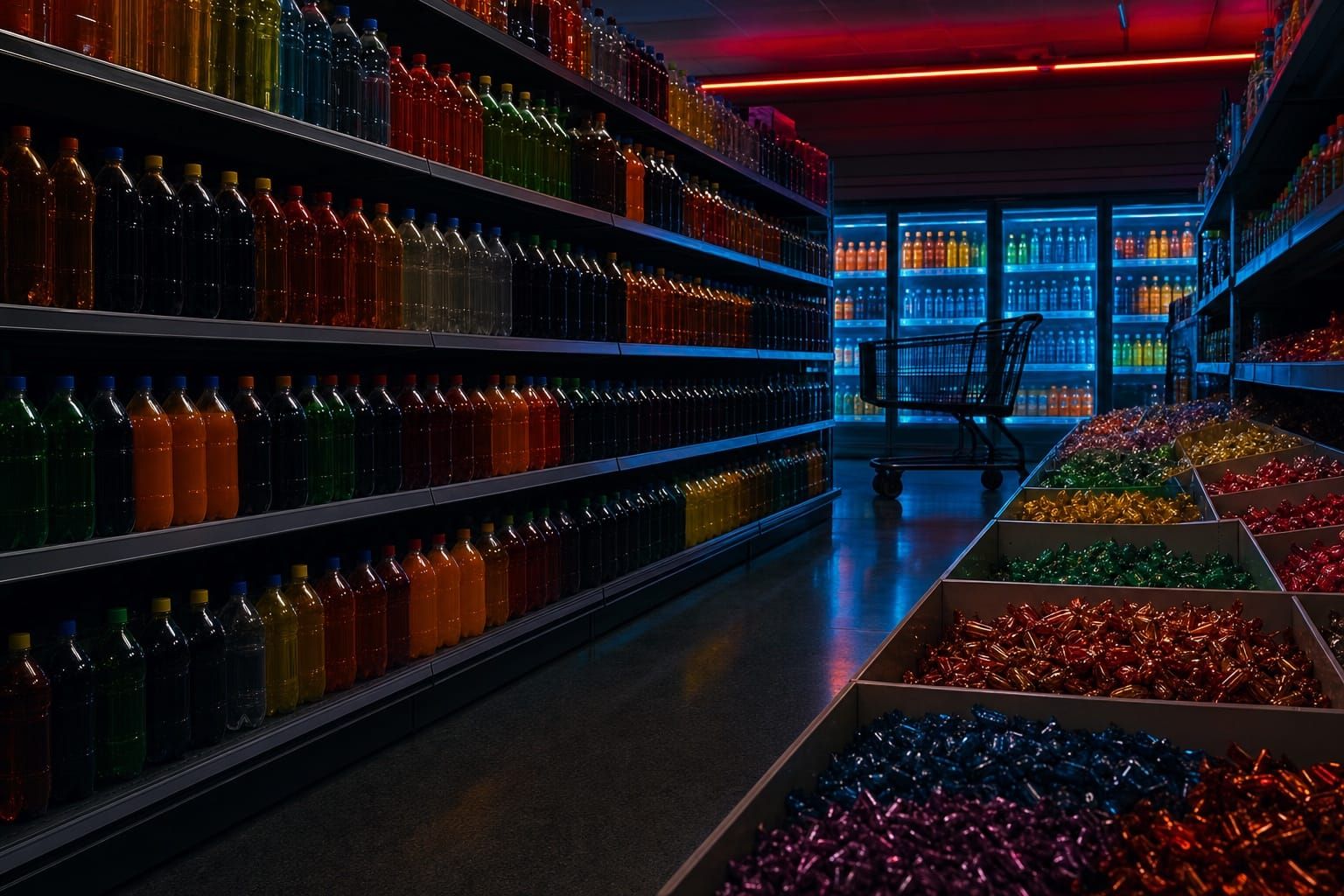
On Sunday — the day after Halloween — an EBT card swiped at a register in Richmond, Fargo, Columbia, or Billings will stop paying for a two-liter of Coke. Montana, North Dakota, South Carolina, and Virginia all switch on SNAP food-restriction waivers on November 1, joining eight states where bans on buying soda, candy, or energy drinks with food-stamp benefits are already live. That makes twelve states, covering a meaningful slice of the roughly 42 million Americans who rely on the Supplemental Nutrition Assistance Program — a program that cost just over $100 billion in fiscal 2025, according to USDA figures.
This is no longer a think-tank debate. It is a live, state-by-state experiment in whether the government can — and should — steer what its largest nutrition program actually buys. And for the first time, there is rigorous economic evidence on what happens when it tries.
What Changes at the Register on Sunday
The four new states drew the line in four different places, according to their own social-services agencies:
- Virginia restricts carbonated sweetened drinks only — including diet and "zero" sodas and carbonated drinks with 5 grams or more of added sugar per serving. Candy is untouched. Juice, iced tea, lemonade, milk drinks, and kombucha stay eligible.
- South Carolina blocks candy, energy drinks, and soft drinks — but, unlike Virginia, allows diet and zero-sugar sodas. Protein bars, granola bars, baking ingredients, and bakery items are not treated as candy.
- North Dakota restricts sweetened drinks with 5 grams or more of added sugar or any artificial sweetener, energy drinks with 65 milligrams or more of caffeine per 8 ounces, and candy. Sweetened tea, sports drinks, and bottled coffee with added sugar are out too.
- Montana goes furthest: candy, beverages with more than 10 grams of sugar per 8 fluid ounces, energy drinks, and shelf-stable packaged desserts like cookies and snack cakes. The state is giving retailers roughly 90 days to work out product-classification problems.
Benefit amounts do not change in any of the four states — only what the card will pay for. Restricted items can still be bought with cash or a debit card; the register simply prompts for another form of payment. The rules follow the store's location, not the shopper's home state, and in North Dakota they extend to online grocery orders delivered to an in-state address.
Retailers carry the operational load. Every grocery chain, convenience store, and dollar store in those states has to update its point-of-sale product files to flag thousands of items — and the definitions differ across state lines. A chocolate bar is restricted in Montana and not in Virginia; a Diet Coke is restricted in Virginia and not in South Carolina. For a chain operating in all twelve waiver states, "candy" is now twelve slightly different legal definitions.
Briefings like this are free to read with a free AlphaBriefing membership. Join free →
How We Got Here: MAHA Meets the Food Stamp Program
The waivers are a flagship of the Trump administration's Make America Healthy Again initiative. Agriculture Secretary Brooke Rollins has framed them as states promoting "healthier options for families in need." HHS Secretary Robert F. Kennedy Jr. was blunter: "For years, SNAP has used taxpayer dollars to fund soda and candy — products that fuel America's diabetes and chronic disease epidemics."
The underlying tension is old — Minnesota petitioned USDA to ban soda and candy purchases as far back as 2004 and was turned down — but the scale is new. As of July 2026, 23 states had approved policies restricting SNAP purchases of sugary drinks, according to a National Bureau of Economic Research working paper published in August. Indiana, Utah, Idaho, Oklahoma, Louisiana, Texas, Florida, and Arkansas got there first; Sunday's four make twelve live; more states have waivers queued for 2027 and 2028.
The legal ground, however, is contested. On June 22, U.S. District Judge Amy Berman Jackson vacated the waivers for Colorado, Iowa, Nebraska, Tennessee, and West Virginia, ruling that USDA lacked statutory authority to approve state restrictions on what SNAP recipients can buy. USDA has appealed, according to the food-law firm Keller and Heckman, and in the meantime the agency asked South Carolina and North Dakota to push their original late-summer start dates to November 1 while it collected public comments. The program now runs on two tracks: live bans in twelve states, vacated bans in five, and an appellate ruling that could sweep either group into the other.
What the Evidence Actually Says
The August NBER paper — by Hunt Allcott, Amy Finkelstein, Anna Grummon, and Matthew Notowidigdo, some of the most cited applied economists working — is the first serious measurement of these restrictions in the wild, using nationwide grocery-purchase panel data across the first ten states.
The headline findings cut both ways:
- Restrictions reduced the average SNAP household's retail purchases of excluded drinks by 12 percent in the first half of 2026. The common objection — that households would simply re-buy the same soda with cash — is only partly true.
- Where states excluded only some sugary drinks, households partially substituted into the non-excluded ones. Loophole design matters: Virginia's diet-soda ban and South Carolina's diet-soda exemption will produce different outcomes by construction.
- Scaled nationwide, the authors estimate excluding all sugary drinks from SNAP would cut publicly funded health-care costs by roughly $800 million per year.
- But the restrictions carry a real cost for recipients: measured stigma rose by 0.17 standard deviations, which the authors monetize at $430 to $660 million per year nationwide. Their stark conclusion: restrictions "appear to harm SNAP recipients but increase social welfare" — because taxpayers, not recipients, capture the health-care savings.
That is an unusually honest trade-off to put on paper, and it explains why the politics scramble the usual red-blue map: fiscal conservatives and public-health progressives both find something to like, while anti-hunger groups and the beverage industry — rarely allies — both oppose.
The Money at Stake
Why does a program rule about soda matter to markets? Because SNAP is one of the largest single funding streams flowing through the American grocery checkout, and sweetened beverages have historically been one of its biggest line items. A widely cited 2016 USDA analysis of SNAP purchase data found sweetened beverages accounted for roughly 9 percent of SNAP household grocery spending — among the largest of any product category. Against a program that now distributes over $100 billion a year, the addressable dollars are in the billions annually, concentrated in exactly the zero-margin-for-error territory of beverage and snack volumes.
The industry has treated it accordingly. The American Beverage Association — whose largest members include Coca-Cola, PepsiCo, and Keurig Dr Pepper — has publicly argued that "SNAP restrictions won't make anyone healthier or save taxpayer dollars" and has lobbied against the waivers since the first ones were approved.
The market impact so far is an overhang, not an earnings event. As of Thursday, Coca-Cola (KO) trades around $92, up roughly 33 percent year to date, and Keurig Dr Pepper (KDP) around $35, up about 26 percent. PepsiCo (PEP), at about $133, is down roughly 7 percent this year, and Hershey (HSY), at about $164, is down around 10 percent. Those moves have many drivers — SNAP restrictions are not what produced them. But they add a slow-building structural headwind to the most price-sensitive end of the volume base — and the NBER finding that purchases actually fall 12 percent, rather than fully substituting to cash, is precisely the number the industry did not want printed.
Watch three things from here: the appeal of the June ruling, which could either void all twelve live bans or re-arm the five vacated ones; the 2027 waiver cohort, which would push the policy toward half the country; and whether any of this shows up in beverage companies' measured-channel volume data in waiver states — the first real-world read on whether a $100 billion program can bend American consumption at scale.
If this analysis was useful, this is what AlphaBriefing does every day — policy and markets, connected to what it means for your money. A free membership gets you access to every free article on AlphaBriefing.com; paid members get the investment frameworks, scenario pricing, and catalyst calendars behind the paywall.
A free membership takes 30 seconds: Join AlphaBriefing
Sources & Further Reading
- Reuters — US judge blocks Trump administration SNAP restrictions on soda, candy
- NBER Working Paper 35659 — The Effects of SNAP Sugary Drink Restrictions on Consumption and Welfare
- FOX Television Stations — SNAP junk-food purchase bans begin Nov. 1 in Montana, North Dakota, South Carolina, and Virginia
- Food World News — SNAP Soda Limits Start Nov. 1, but Candy Rules Differ by State
- Virginia Department of Social Services — SNAP Healthy
- North Dakota Health and Human Services — SNAP Healthy Choice Waiver
- Montana DPHHS — SNAP Food Restriction
- American Beverage Association — Statement on SNAP Restrictions
Disclaimer
AlphaBriefing is an independent intelligence publication. The content in this article is produced for informational and educational purposes only. Nothing published by AlphaBriefing constitutes financial, investment, legal, tax, or regulatory advice, nor should it be construed as a solicitation or recommendation to buy, sell, or hold any security, asset, or financial instrument.
All views expressed are those of the author at the time of writing and are subject to change without notice. Markets are volatile and unpredictable; past performance is not indicative of future results. Any investment involves risk, including the possible loss of principal.
AlphaBriefing and its principals, employees, or contributors may hold positions in securities or assets mentioned in this article. This should be considered a potential conflict of interest. No material relationship with any company referenced exists unless explicitly disclosed. Readers should conduct their own due diligence and consult qualified financial, legal, and tax advisors before making any investment decisions.
Information in this article is drawn from public sources believed to be reliable at the time of publication. AlphaBriefing makes no warranty, express or implied, as to the accuracy, completeness, or timeliness of any information herein. AlphaBriefing accepts no liability for any loss or damage arising from reliance on this content.
© AlphaBriefing. All rights reserved. Unauthorised reproduction or distribution is prohibited.