The Transcontinental Railroad Is Trading at 87 Cents on the Dollar
Union Pacific's $85 billion bid for Norfolk Southern faces its decisive window: all opposition lands at the STB by November 18, BNSF has declared war, and the arb spread says the market has real doubts. Here's the scenario math.

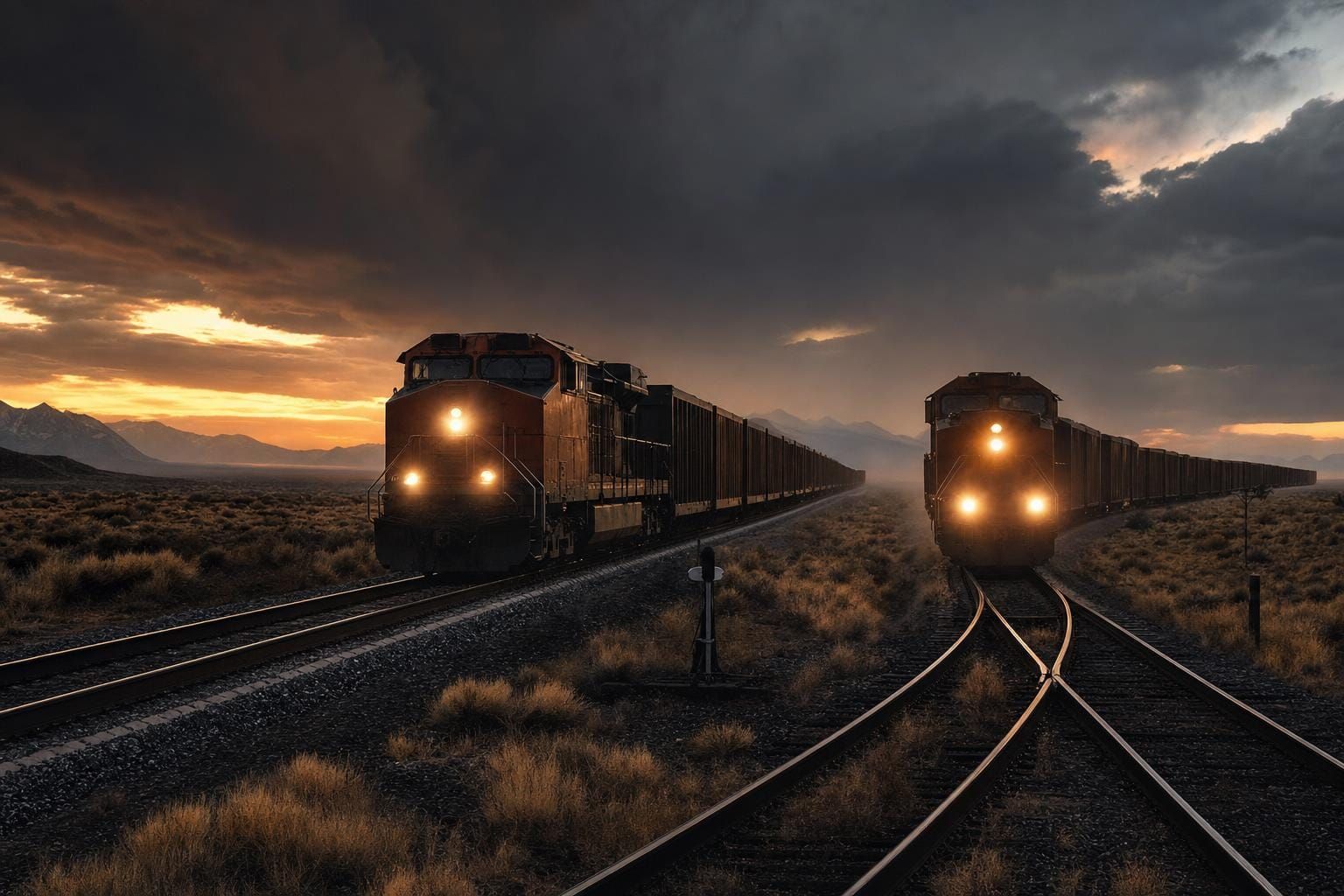
On November 18 — three weeks from today — the formal opposition to the largest railroad merger in American history hits the docket. Every shipper group, labor union, state attorney general, and rival railroad that wants to stop, shrink, or tax Union Pacific's $85 billion acquisition of Norfolk Southern must file its case with the Surface Transportation Board by that date. One of those rivals, Berkshire Hathaway-owned BNSF Railway, has already told its customers exactly where it stands: "absolute opposition."
Meanwhile, the market has rendered an interim verdict of its own. Under the deal's terms, each Norfolk Southern share converts into one Union Pacific share plus $88.82 in cash — a package worth $390.15 at Union Pacific's price in midday New York trading on October 28. Norfolk Southern changed hands at $341.15. That is 87 cents on the implied deal dollar, a gap of roughly 14% that has persisted more than a year after the agreement was signed and nearly a year after Norfolk Southern's own shareholders approved it with almost 99% of votes cast.
Spreads like that are not noise. They are a price on doubt — about whether the first coast-to-coast railroad in American history gets built, when, and at what regulatory cost. This briefing walks through the battle lines, the calendar, and what the spread is actually pricing.
A Deal Built for the History Books
Union Pacific and Norfolk Southern announced their agreement in July 2025 with unusually grand framing: America's first true transcontinental railroad. The combined system would connect more than 50,000 route miles across 43 states and link roughly 100 ports, joining Union Pacific's western network to Norfolk Southern's eastern one at the Mississippi River gateways where freight has changed hands between railroads since the nineteenth century.
The terms: 1.0 Union Pacific common share plus $88.82 in cash per Norfolk Southern share — about 72% stock, 28% cash — which implied $320 per share when the deal was struck, a 25% premium to Norfolk Southern's 30-day average price at the time, and an enterprise value of roughly $85 billion. Norfolk Southern's shareholders blessed the transaction at a special meeting on November 14, 2025. The companies originally targeted a close by early 2027.
That target is already gone. The only approval that matters now belongs to a five-member federal board most investors had never thought about before this deal — and the board has made clear it will not be rushed.
Briefings like this are free to read with a free AlphaBriefing membership. Join free →
The Regulator That Said "Not So Fast"
Rail mergers do not go through the Justice Department's antitrust division. They go through the Surface Transportation Board, which applies a broader "public interest" standard — and which rewrote its major-merger rules in 2001, after the last wave of consolidation ended in service meltdowns, specifically to raise the bar for deals like this one. No combination of this scale has been tested under those rules: the 2023 Canadian Pacific–Kansas City Southern merger was reviewed under the older regime thanks to a grandfathered exemption for Kansas City Southern. Union Pacific–Norfolk Southern is the modern rulebook's first real exam.
So far, the Board has graded hard. In January 2026 it rejected the original application as incomplete. The companies refiled on April 30; the Board accepted the revised application on May 28 but immediately froze the proceeding, demanding supplemental information on nine fronts — from the integrity of the claimed public benefits to service assurance, market-share projections, and the fate of shippers who would see their rail options drop from two carriers to one. Union Pacific and Norfolk Southern answered in July with what they called customer protections that go "beyond those provided in any prior rail merger." On August 18 the Board lifted the freeze and set a schedule. In September it denied motions to kill the application summarily — a win for the railroads — and on October 6 it accepted four additional late-filed notices from parties planning responsive applications of their own.
Note what the Board has actually decided on the merits so far: nothing. Every ruling to date has been procedural. The substance starts November 18.
One Rival Is Fighting. Another Took the Toll.
The most instructive split in this fight is between the two railroads flanking the deal.
BNSF — Union Pacific's only peer in the western United States, owned outright by Berkshire Hathaway — is waging total war. In its October filing and a remarkably blunt letter to customers, BNSF argued that no conditions could fix the merger, that the combined company would control roughly half of all U.S. rail volume, and that a market share of that size "presumptively blocks transactions in other industries." It says its full opposition case lands November 18, and it cites a coalition behind it: shipper associations, seven state attorneys general, six labor unions, and more than 100 members of Congress from both parties. Yet BNSF also hedged — as STB procedure requires — by listing the price it would demand if the Board approves the deal anyway: overhead trackage rights on roughly 824 route miles of Norfolk Southern lines from Chicago to eastern Pennsylvania, a neutral switching railroad on the Gulf Coast, and potentially broader open-access requirements.
Canadian National took the opposite path. In September, CN signed a memorandum of understanding with Union Pacific securing new access to Kansas City — including a lease of UP's Neff Yard — trackage rights toward East St. Louis, and protections for shippers in Illinois and Iowa who would otherwise lose a competitive option. In other words: one major railroad concluded the deal is worth fighting to the death, and another concluded it is worth a negotiated toll. Both decisions tell you something about the probability each assigns to approval.
Which brings us to the only question that matters for positioning: what probability should you assign — and what is the 87-cent price already assuming? That is where the actionable part of this briefing begins.
A free membership gets you access to every free article at AlphaBriefing.com: Join AlphaBriefing
The rest of this briefing is for paid members: the full arbitrage math on the Norfolk Southern spread, the three-scenario framework with price zones for approval, conditioned approval, and denial, the catalyst calendar through the final decision, and the second-order trade nobody is pricing yet.
AlphaBriefing Paid gets you every investment thesis, scenario framework, and catalyst brief we publish — the analysis private intel clients pay four figures for, at a fraction of that.