The Reshoring Boom Is Real. The Jobs Aren't.
America has announced $1.6 trillion in new factories while manufacturing employment falls and Asian imports hit a four-year high. Both datasets are right — and the gap between them is a three-phase trade most investors are pricing as one.

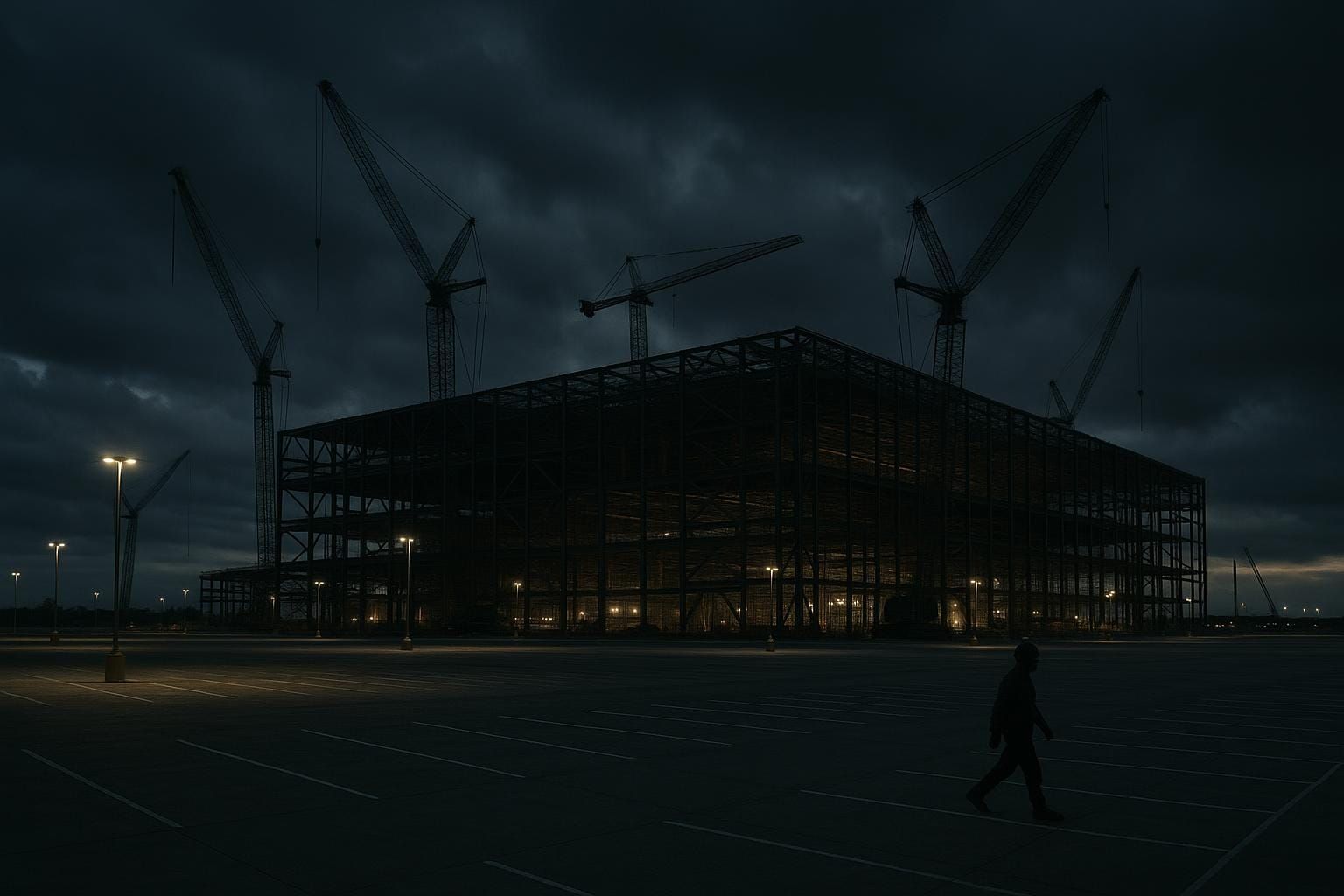
September 2026 marks eighteen months since the "Liberation Day" tariffs were rolled out with a single promise attached: the factories are coming home. By the scoreboard Washington prefers, the promise is being kept spectacularly. Roughly $1.6 trillion in private-sector manufacturing commitments has been announced, according to IndustrialSage's investment tracker. The Reshoring Initiative counts some 244,000 reshoring-linked job announcements. In Q1 2025, companies citing tariffs as a reason to reshore jumped 454% year over year.
By the scoreboard the Bureau of Labor Statistics keeps, the promise is failing. Manufacturing payrolls have fallen by more than 80,000 jobs since the tariffs took effect — an unbroken skid that Reuters was still documenting in January. Manufacturing construction spending, the leading indicator that should turn first, peaked in early 2025 and has been declining since, dragged down by a 44% collapse in electronics and semiconductor fab construction from its mid-2024 high. And Kearney's 2026 Reshoring Index — the cleanest measure of whether America is actually substituting domestic production for Asian imports — remains in negative territory at -86, with imports from 14 Asian low-cost countries up $60 billion to a four-year high.
Both scoreboards are accurate. The most expensive mistake an investor can make right now is picking one of them and calling the other a lie.
The Announcement Economy
The commitments are not vapor. Wistron is ramping mass production of AI servers in Dallas by late 2026. Whirlpool is putting $300 million into its Clyde and Marion, Ohio operations, with 450–600 new jobs projected. TSMC, Micron, Eli Lilly, and Novartis have all broken ground on multi-billion-dollar US campuses. The Reshoring Initiative's 2026 survey of OEMs and contract manufacturers, released this month, finds reshoring intent still trending upward.
And the quality of what's coming back is the underreported story: 88% of reshored positions in 2024 were classified high-tech or medium-high-tech, with average compensation for reshored roles at $135,525 — up 13.1% in a year. This is not the return of low-margin assembly work. It is capital-intensive, automation-heavy production that employs fewer people at much higher wages.
The Measured Economy
The problem is that announcements are intentions, and the measured data captures what firms are actually doing this quarter. What they are doing is waiting. The ISM's own survey chair described the mechanism plainly: when policy is uncertain, you don't buy capital equipment and you don't hire, because hiring and training people you may have to lay off is expensive. The factory sector spent most of the past year in contraction on the ISM gauge.
Strip out electronics and the picture improves — non-electronics factory construction is up 5.6% since the tariffs began. Meaningful, but a rounding error against the headline numbers, and nothing like a boom.
The reconciliation between the two scoreboards is a timeline, not a contradiction. A semiconductor fab runs roughly nine years from announcement to full employment — Intel's Ohio campus has slipped to 2030–31. Pharmaceutical plants need five to seven years of construction and FDA validation before the first commercial batch ships. The $1.6 trillion is real, but it arrives on an industrial clock, not a news-cycle clock. The jobs data isn't refuting the boom. It's early.
Which raises the only question that matters for positioning: if the buildout is real but slow, who gets paid, in what order — and which of those trades is already over?
Get the next briefing free in your inbox: Join AlphaBriefing
The rest of this briefing is free — it just requires a free AlphaBriefing account: the three-phase payout sequence for the reshoring buildout (and which phase just peaked), the specific automation and electrification names positioned for phase two, and the reason Kearney's negative index may actually be a bullish signal.
Create your free account → — 30 seconds, no card.