America's First Transcontinental Railroad Is on Trial
Union Pacific's $85 billion bid for Norfolk Southern just entered its merits phase at the STB — with every rival railroad, two unions, and half the shipping industry against it. The 16% merger spread says the market is pricing a coin flip.

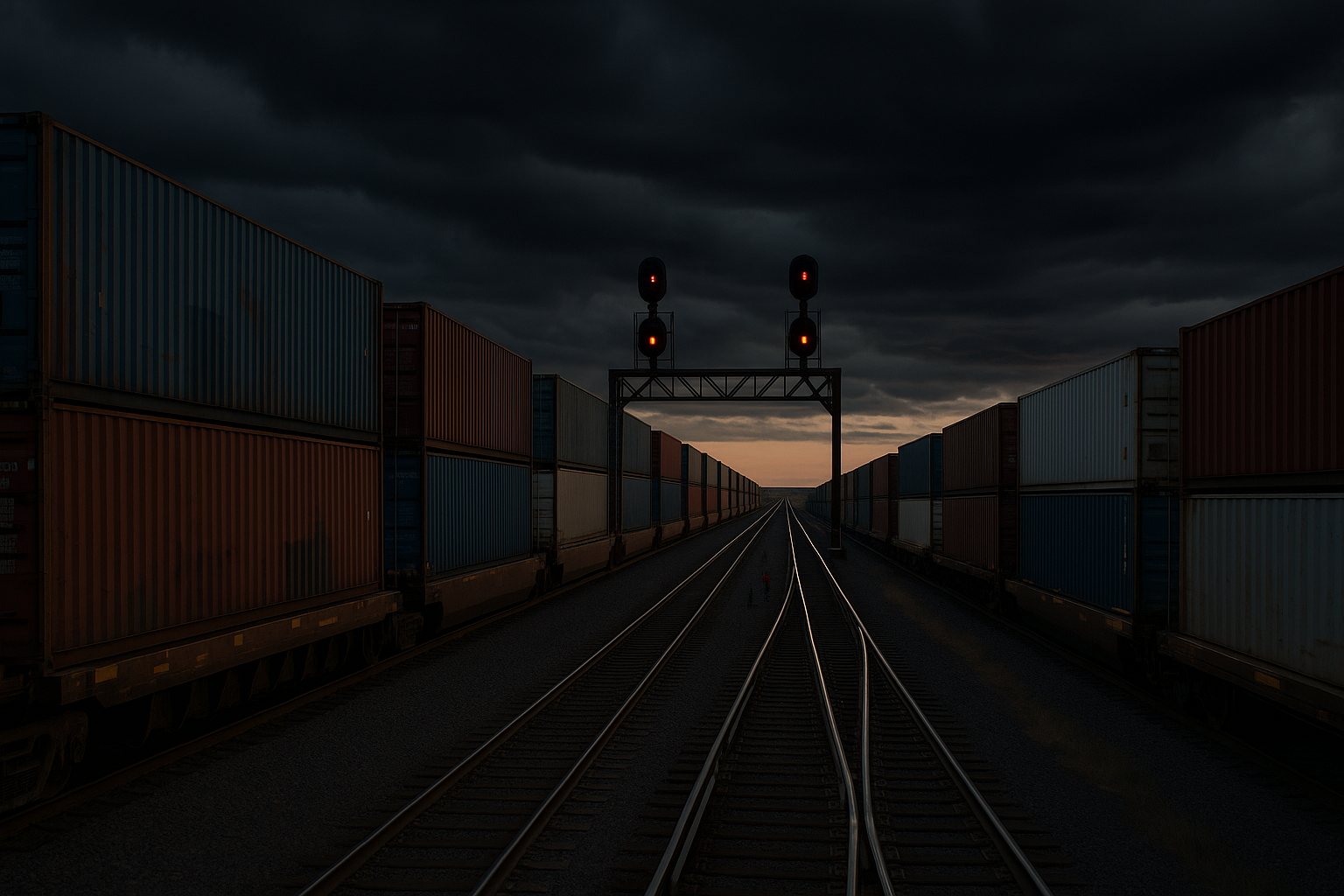
On September 30, the window closes. Any railroad, shipper, union, port, or city government that wants a formal voice in the largest railroad merger in American history has until that date to file a notice with the Surface Transportation Board. After that, the trial begins in earnest.
That trial — and it is functionally a trial — will decide whether Union Pacific's $85 billion acquisition of Norfolk Southern creates America's first true transcontinental railroad, or joins the long list of rail mega-mergers that regulators killed in the crib. On August 18, the STB lifted the proceeding out of a months-long procedural limbo and published the schedule that runs from now until a final decision, likely in the fall of 2027. The board was explicit: this is not an approval. It is merely permission for the fight to start.
The fight will be worth watching, because almost everyone showed up to oppose it.
A Deal That Refuses to Move Quickly
The terms were struck in July 2025: Norfolk Southern shareholders receive $88.82 in cash plus one Union Pacific share for each share they own — roughly $320 per share at announcement, about $85 billion in total, and a premium north of 20%. Shareholders of both companies approved the transaction by overwhelming margins. In a normal industry, this deal would be closing about now.
Railroads are not a normal industry. The companies' first application, filed in December 2025, was rejected by the STB within a month as incomplete. A revised application landed on April 30, 2026. The board accepted it in May — then immediately froze the proceeding and demanded supplemental information, which arrived in two tranches in July. Only in August did the board decide the record was full enough to proceed, and even then it ordered Union Pacific and Norfolk Southern to refile key workpapers with their data unfiltered, and refused their request to fast-track a divestiture of the Terminal Railroad Association of St. Louis.
None of that reads like a regulator eager to say yes.
What a Transcontinental Railroad Actually Changes
No single railroad has ever run coast to coast in the United States. Freight crossing the country today is handed off between a western carrier (Union Pacific or BNSF) and an eastern one (Norfolk Southern or CSX), mostly at Chicago, Memphis, St. Louis, or New Orleans. Those interchanges cost time — often a day or more — and are where service reliability goes to die.
A combined UP–NS would erase that handoff across a network of roughly 50,000 route miles handling close to half of the nation's rail traffic. The applicants claim $3.5 billion in annual shipper savings and more than a million truckloads a year converted to rail. Opponents have noticed what the application does not say: as BNSF put it in its own filing, the applicants are "careful not to promise" that any efficiency gains will reach customers as lower rates.
Briefings like this land in members' inboxes before the market prices them in. Join free →
The Wall of Opposition
The roster of formal opponents is remarkable even by the standards of contested mergers:
- BNSF, owned by Berkshire Hathaway, has declared "absolute opposition" and is bankrolling a "Stop the Rail Merger Coalition" of shippers and trade groups. Its motivation is existential: if UP–NS closes, BNSF becomes the only western railroad without an eastern partner.
- CPKC — whose CEO Keith Creel says the deal "puts our supply chains and economy at needless risk" — argues the application still lacks the required market-impact analysis.
- CSX contends the applicants have not even attempted to meet the governing legal standard, offering "no proposal to enhance rail-to-rail competition."
- Labor: the two largest rail unions, together representing more than half of the combined companies' workforce, have come out against the deal.
- Cities and states: the National League of Cities successfully petitioned to extend the participation deadline to September 30; state officials and shipper associations from chemicals to agriculture have lined up in opposition.
One carrier broke ranks in a telling way. Canadian National is not opposing the merger outright — it is filing for competitive-access conditions. That is the behavior of a railroad that thinks the deal might actually pass, and wants to be paid for it.
Hanging over all of this is a legal standard no one has ever tested. The STB's 2001 merger rules — written in the aftermath of the 1990s consolidation meltdowns precisely to prevent deals like this one — require that a major merger affirmatively enhance competition, not merely avoid harming it. UP–NS is the first major transaction ever judged against that bar, and nobody, including the board, knows exactly what clearing it looks like.
Which brings us to the market's verdict — because Wall Street has already put a number on all of this uncertainty, and it is written in Norfolk Southern's share price. The stock trades roughly $50 below the current value of Union Pacific's offer. That gap is one of the widest spreads on any signed, shareholder-approved deal in the market today. What it implies, what a deal-break looks like, and who actually wins in each scenario is where this gets actionable.
Get the next briefing free in your inbox: Join AlphaBriefing
The rest of this briefing is free — it just requires a free AlphaBriefing account: the arbitrage math behind the 16% spread and the break-even scenarios, the three-outcome map for NSC, UNP, CSX, and BNSF, and the full catalyst calendar through the fall 2027 decision.
Create your free account → — 30 seconds, no card.