The $3 Billion Frozen Asset: How Serbia's Jadar Mine Became the EU-China Minerals War's Most Important Battleground
Rio Tinto's Jadar lithium mine holds 10–15% of Europe's battery needs. It's been frozen since November 2025. Inside the EU-China rivalry reshaping the Balkans — and what it means for your portfolio.

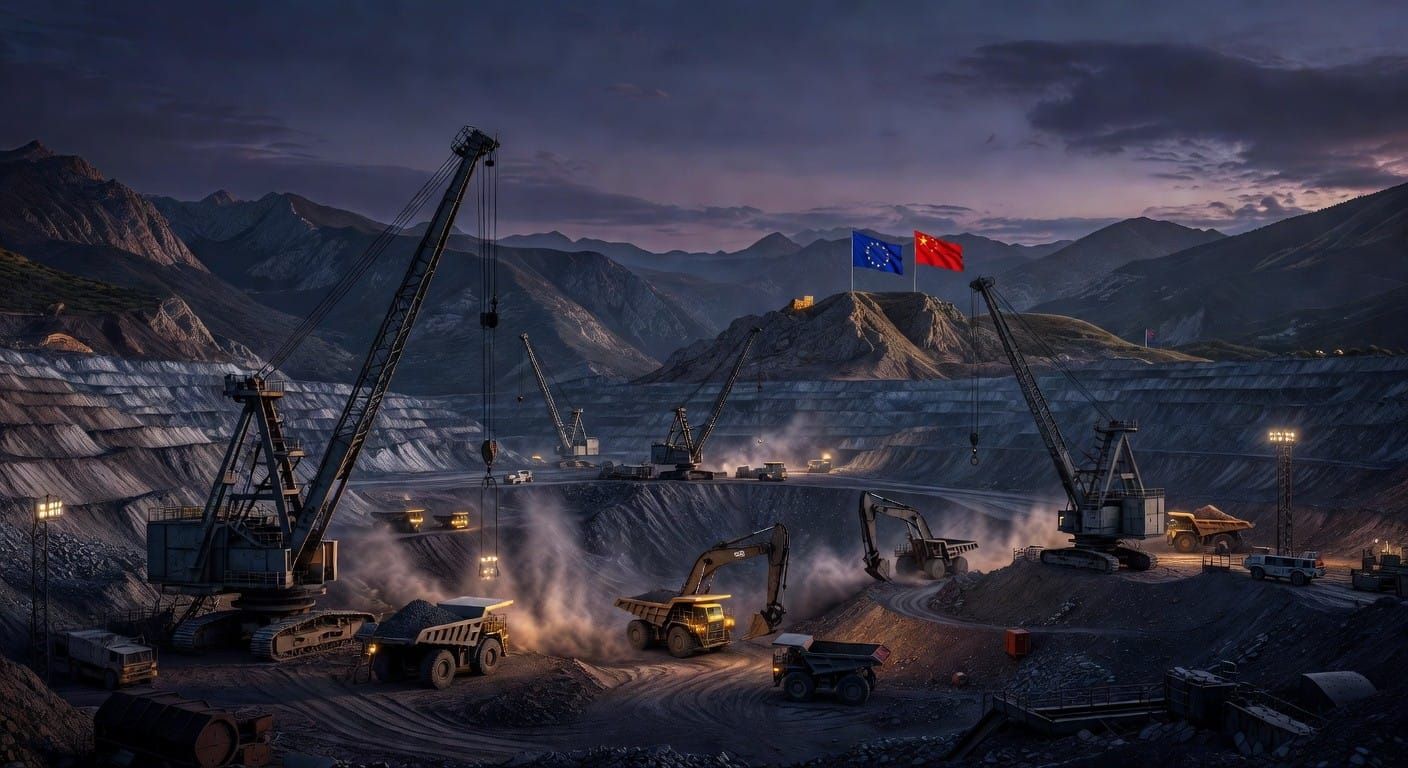
Europe's green transition runs on lithium. And right now, the largest lithium deposit on the continent is frozen — caught between Brussels' ambitions, Beijing's money, and a Serbian hillside that refuses to give way quietly.
The Jadar Valley in western Serbia holds what could be Europe's most strategically important piece of ground. Rio Tinto's project here — if it ever comes online — would supply roughly 58,000 tonnes of battery-grade lithium carbonate annually. That's enough to power approximately one million electric vehicles per year, or meet between 10 and 15 percent of the EU's projected lithium demand for decades.
It is also, as of April 2026, completely frozen.
The Mine That Europe Desperately Needs
Discovered in 2001, the Jadar deposit is not merely large — it is uniquely high-grade and long-life, sitting beneath some of the most fertile farmland in the western Balkans. Rio Tinto has invested more than $700 million to develop it, and the EU designated it a "strategic project" under the Critical Raw Materials Act in June 2025.
Then, in November 2025, Rio Tinto indefinitely suspended development. The official reasons: permitting delays, cost pressures under new CEO Simon Trott, and a pivot toward higher-priority assets. The company now holds the project in "care and maintenance" mode, with no capital expenditure planned for 2026.
The EU's reaction was muted — a quiet acknowledgment that Europe's critical minerals ambitions had collided, messily, with Serbian politics and local opposition.
And the opposition is intense. A February 2026 analysis showed 63.5 percent of Serbians surveyed oppose the mine, driven by more than 120 protests, expert warnings about irreversible water contamination, and fears over the health impacts of lithium and boron in a region of 22 villages and productive agricultural land. For Serbian farmers and environmentalists, the deposit beneath their fields is not a strategic asset — it is a threat.
Vučić's Balancing Act
President Aleksandar Vučić has made EU accession a stated cornerstone of Serbian foreign policy since 2012. As of April 2026, after 14 years as a candidate, Serbia has opened 22 of 35 EU accession chapters — and provisionally closed only two. Analysts put membership no earlier than 2029–2030.
The stall has not been accidental. Vučić has mastered a four-pillars foreign policy — cultivating ties simultaneously with the EU, the United States, Russia, and China — that gives him maximum leverage and minimum accountability. Brussels won't fast-track a country that refuses to join sanctions on Russia, struggles with rule-of-law reforms, and keeps cutting deals with Beijing. Vučić knows this, and plays it.
The EU, meanwhile, needs Serbia more than it wants to admit. Not just for lithium — but for the signal it sends across the Western Balkans. If Brussels cannot keep Serbia in its orbit, the precedent for Bosnia, Kosovo, North Macedonia, and Montenegro is alarming.
This is where the analysis gets actionable. AlphaBriefing members get the full investment framework — scenarios, positioning, and the bottom line.
Subscribe to AlphaBriefing — Free, Member, and Paid tiers available.