How a Lake 85 Feet Above the Sea Is Repricing Global Trade
With Hormuz closed, the Panama Canal was the world's fallback — until El Niño began draining Gatun Lake. Transit slots now auction for $2.5 million, and the bill is landing on trans-Pacific freight just as holiday shipping season begins.

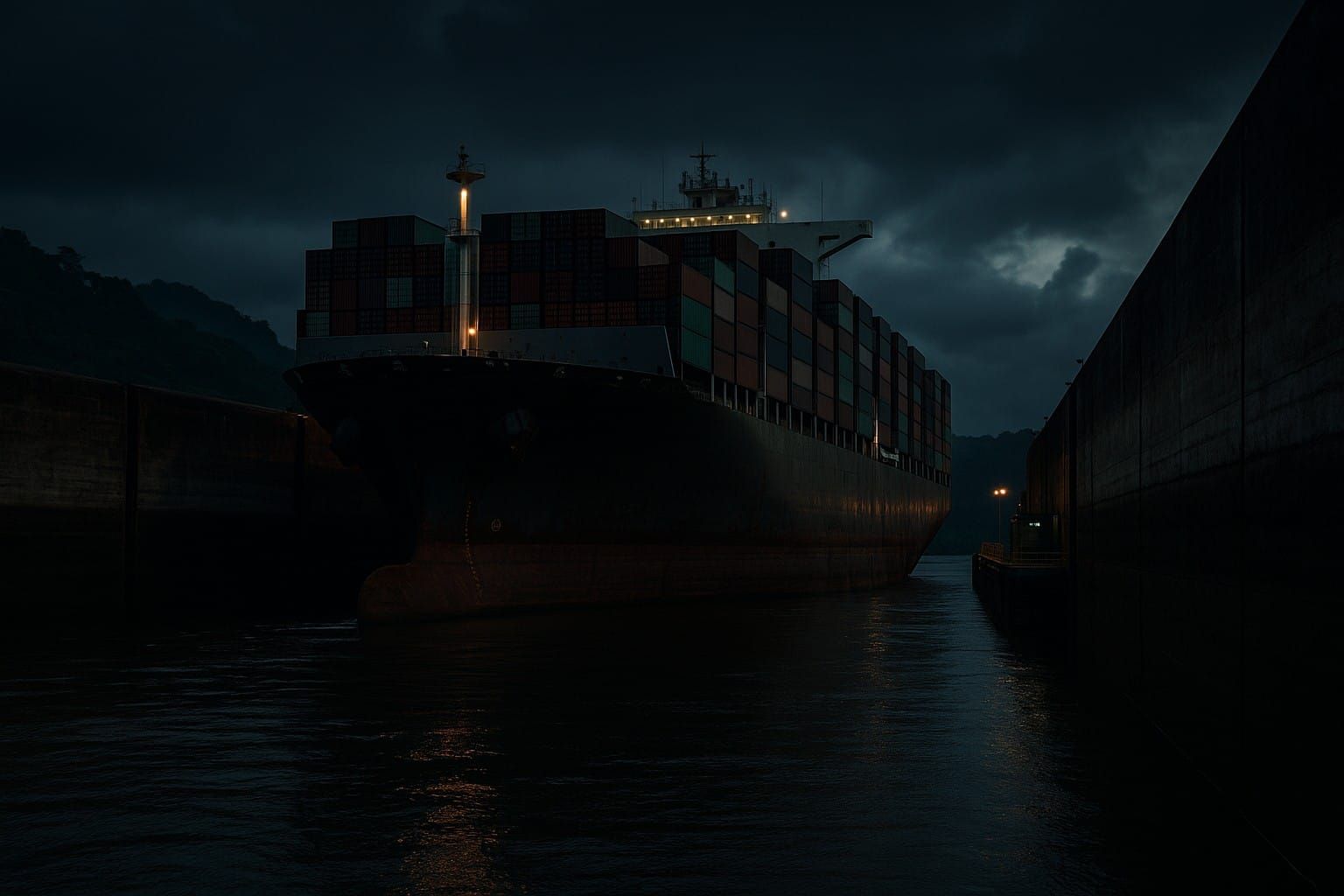
A container ship paid nearly $4 million this week for the right to sail through the Panama Canal. Not for fuel. Not for cargo handling. For a reservation — one transit slot, sold at auction, on top of the regular toll.
That bid is not an outlier. The average auction price for a Neopanamax slot — the larger locks that handle the big container ships and gas carriers — has climbed to $2.5 million, an all-time record. Across all vessel classes, daily average auction prices in August are running around $1.1 million, according to Argus Media data — more than 16 times what the same slot cost a year ago.
The strange part: the crisis driving this is not the war. It's rain — or the lack of it.
The canal runs on fresh water, and the fresh water is running out
The Panama Canal is not a sea-level ditch. Ships crossing the isthmus are lifted roughly 85 feet up and over the continental divide through a staircase of locks, and every lift is powered by gravity-fed fresh water from Gatun Lake, the rain-fed reservoir at the canal's summit. Each transit flushes tens of millions of gallons of that lake into the ocean. No rain, no lake. No lake, no canal.
Right now, an intensifying El Niño has cut deep into Panama's wet season. Gatun Lake stood at 84.3 feet in early August — already below its five-year seasonal average — and the Panama Canal Authority's own forecast has it sliding to 82.8 feet by mid-October. For reference, the catastrophic 2023–24 drought bottomed the lake at just over 79 feet and forced transits down from 36 a day to roughly 22.
The Authority is already rationing. Maximum draft for Neopanamax vessels was cut to 49 feet on July 24, trimmed again to 48.5 feet in mid-August, with two more half-foot reductions penciled in for late August and September. Every half-foot of lost draft means hundreds of containers left on the dock — or a heavier bid for one of the shrinking number of deep-draft slots.
The result is textbook scarcity pricing, executed in public. Around 35 transits a day are still moving, but 78 booked vessels were queued on August 12, with average waits of eight days northbound and nearly ten southbound. When capacity is fixed and falling, the auction becomes the market — and the market is currently clearing at seven figures per ship.
The war closed the exits
None of this would sting so badly if the world's other shortcuts were open. They are not.
The Strait of Hormuz remains closed by the Iran war, and the Red Sea remains hostile, which has pushed east-west trade onto long routings around the Cape of Good Hope and funneled a disproportionate share of Asia–Americas cargo toward the one chokepoint that was still functioning cleanly: Panama. We covered that demand shock in May — the war made Panama the most valuable waterway on Earth.
What's new, and what makes this phase more dangerous, is that the supply side of the canal is now failing at the same time. In 2023–24, shippers could dodge Panama's drought by routing through Suez. In 2026, there is no Suez option and no Hormuz option. The fallback has no fallback. That is why a reservation — not the transit, the reservation — now costs more than many ships' annual charter.
And the timing could hardly be worse: the bids are spiking exactly as trans-Pacific holiday shipping season hits full volume.
The rest of this briefing is free — it just requires a free AlphaBriefing account: the freight-rate data showing exactly how canal scarcity is bleeding into what importers pay, who captures the windfall (and which carriers are quietly repricing), the 2023 playbook for how this resolves — and the two numbers to watch into October.
Create your free account → — 30 seconds, no card.