How 600 Rusting Tankers Defeated Western Sanctions
A fleet of 600 rusting tankers rewired the global oil trade and made the G7 price cap on Russian crude meaningless. The system is now cracking — and the trade has shifted.

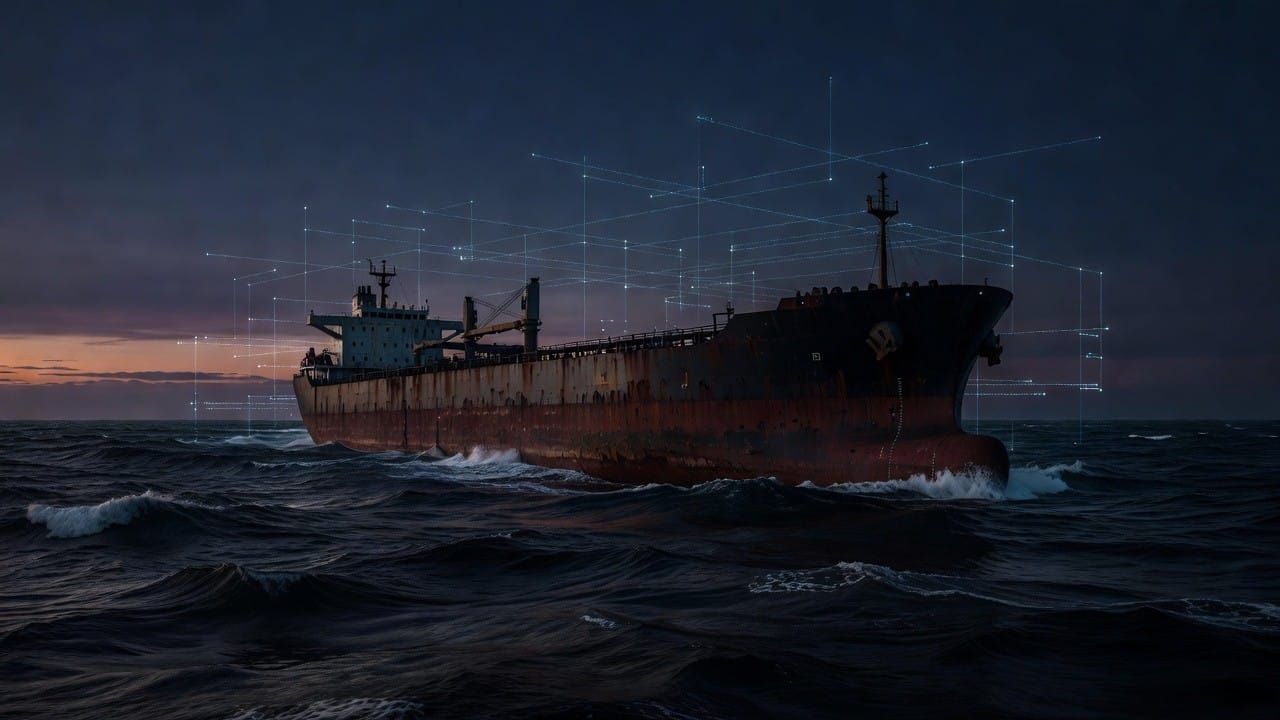
In December 2022, the G7 introduced what officials called the most ambitious financial weapon in the history of energy markets: a $60-per-barrel price cap on Russian crude. The mechanism was elegant on paper. Western insurers, brokers, and shipping registries dominate global maritime trade. Without their services, Russian oil could not move. If Moscow refused to sell below the cap, its barrels would sit at the dock.
Three and a half years later, Russian crude is still flowing — and at prices that have, for most of the period, been comfortably above $60. The Kremlin's oil revenue in the first quarter of 2026 came in roughly 15% above pre-war averages by the IEA's reckoning. Discounts to Brent have narrowed from their 2023 peaks. The Urals grade, once the punching bag of the futures market, now trades at a premium some weeks against the cap.
What happened is one of the more consequential financial intelligence failures of the decade, and it is increasingly being studied at Treasury, OFAC, and at every commodities desk that took the cap seriously when modeling 2024-2026 spreads. Russia did not break the cap. It rebuilt the plumbing of global oil shipping around it.
The instrument was a fleet of roughly 600 elderly tankers — most of them between 15 and 22 years old, most of them sold for scrap value, most of them flagged in jurisdictions that until recently were rounding errors in shipping registries. By the end of 2025, that fleet was moving an estimated 70% of Russia's seaborne crude exports. It is the largest off-book shipping operation since the Iranian oil routes of the 1980s, and it has fundamentally rewired the way sanctioned energy flows.
This is the story of how it was built, who profited, and what it now means for the next round of Western sanctions — including the ones Treasury is reportedly drafting against Iran.
The Anatomy of a Ghost Fleet
The shadow fleet has three load-bearing components, and removing any one of them collapses the model. Western sanctions enforcement has, until recently, addressed none of them at scale.
The first is the tankers themselves. A Suezmax-class crude carrier built in 2003 will typically be scrapped around year 20 of its hull life. From late 2022 through 2024, opaque buyers — most registered in the UAE, Hong Kong, Türkiye, and a constellation of single-purpose shell companies in India — acquired roughly 600 such vessels at premiums of 30% to 60% above scrap. The buyers had no operational history. The sellers, often Greek and Norwegian owners eager to dispose of aging tonnage at the top of the market, asked few questions.
The second is the flag. A ship needs a state to register under, and registration confers the legal nationality that determines port access, insurance recognition, and maritime law. Panama, Liberia, and the Marshall Islands have run the open-registry market for decades. But the shadow fleet largely avoided them. Instead, an unlikely cluster of microstates — Gabon, the Cook Islands, San Marino, Cameroon, and at one point Eswatini — saw their flagged tonnage multiply tenfold or more. Gabon's tanker registry grew by over 700% between 2022 and 2025. These registries operated with minimal vetting, accepted payment in cryptocurrency in some cases, and offered effectively no compliance backstop.
The third — and most consequential — is insurance. Marine protection and indemnity (P&I) coverage, which insures shipowners against pollution and third-party liability, has historically been concentrated in the International Group of P&I Clubs, all of which are Western and all of which are bound by sanctions. Without P&I, no major port will accept a tanker, no terminal will permit discharge, and no legitimate buyer will sign a bill of lading. The shadow fleet's answer was to build a parallel system.
Russia's National Reinsurance Company began issuing P&I-equivalent certificates in 2023, backed by the sovereign balance sheet. Several smaller insurers in the UAE and India followed, often underwritten by Russian state credit. The receiving ports — primarily in India, China, and a handful of African terminals — agreed to accept the new certificates. The system was not pretty. Insurance claims under it would, in any serious incident, be effectively unenforceable. But it cleared the operational hurdle. The cargo moved.
Why the Cap Failed
The cap was designed assuming Western shipping was a chokepoint. It was — until it wasn't.
Three structural realities went underweighted in the original modeling, all of which can be read in retrospect as obvious. First, the marginal cost of standing up parallel infrastructure was high but finite. Russia spent an estimated $10 billion to $20 billion acquiring tonnage and building reinsurance capacity. Against an oil export base that generates over $180 billion a year, that capex was trivial.
Second, the buyers' side of the trade had no incentive to enforce. India and China, the two largest takers of Russian crude, viewed cheap energy as a strategic gift and Western insurance norms as Western problems. New Delhi explicitly told refiners to accept the parallel insurance. Beijing did not need to be told.
Third, enforcement was geographically impossible. The crude leaves Russia, transits the Baltic or Pacific, and arrives in non-Western ports. The only Western chokepoints are the Danish Straits — where international maritime law forbids stopping commercial shipping — and the Bosporus, which Türkiye controls and has zero incentive to use as a sanctions tool. Once the cargo is on a non-Western flag, on a non-Western hull, with non-Western insurance, the Western enforcement perimeter has nothing to grab.
The Catalyst That Changed Things in 2025
For about two years, this system ran with remarkable smoothness. The breakdown began not because the West got smarter, but because the fleet itself began to fail.
In late 2024 and into 2025, a series of incidents made the operational risks impossible to ignore. A Cook Islands-flagged tanker, the Eagle S, was credibly tied to the severing of multiple Baltic undersea cables in December 2024 and seized by Finnish authorities. A Gabon-flagged Aframax ran aground in the Kerch Strait in early 2025 and spilled an estimated 5,000 tonnes of crude. A Cameroon-flagged vessel suffered a steering failure off the Danish coast and required emergency intervention. Each incident exposed the same underlying problem: the parallel insurance was insufficient and the operational practices were degraded.
The political response was sharper than at any point since the cap was introduced. The EU's 14th and 15th sanctions packages began listing individual shadow-fleet vessels by IMO number, denying them access to European ports, services, and waters. The UK followed. The Biden administration, in its final months, sanctioned a Russian P&I insurer outright. By mid-2025, over 200 individual vessels were on Western lists.
The Trump administration's stance is more ambiguous, but the trajectory has continued. Treasury added another 84 vessels to the SDN list in March 2026, and the EU's 18th package is now expected to add roughly 250 more. The friction is starting to show. Discounts on Russian crude to compliant buyers widened by roughly $4 per barrel between February and May. Indian refiners have begun quietly sourcing more from the Gulf and West Africa. Sovereign-issued Russian P&I certificates are being rejected at a handful of Chinese ports.
This is the inflection. The shadow fleet won the first round. The question now is whether it can survive the second.
This is where the analysis gets actionable. AlphaBriefing members get the full investment framework — scenarios, positioning, and the bottom line.
Subscribe to AlphaBriefing — Free, Member, and Paid tiers available.