Hoover Dam Is Five Feet From Losing Most of Its Power
Lake Mead just broke its 1930s-era record low and sits five feet above the elevation where Hoover Dam loses 12 of its 17 turbines. Upstream, Glen Canyon Dam may stop generating entirely within months. The Southwest's cheapest electricity is vanishing — here's who pays, and who collects.

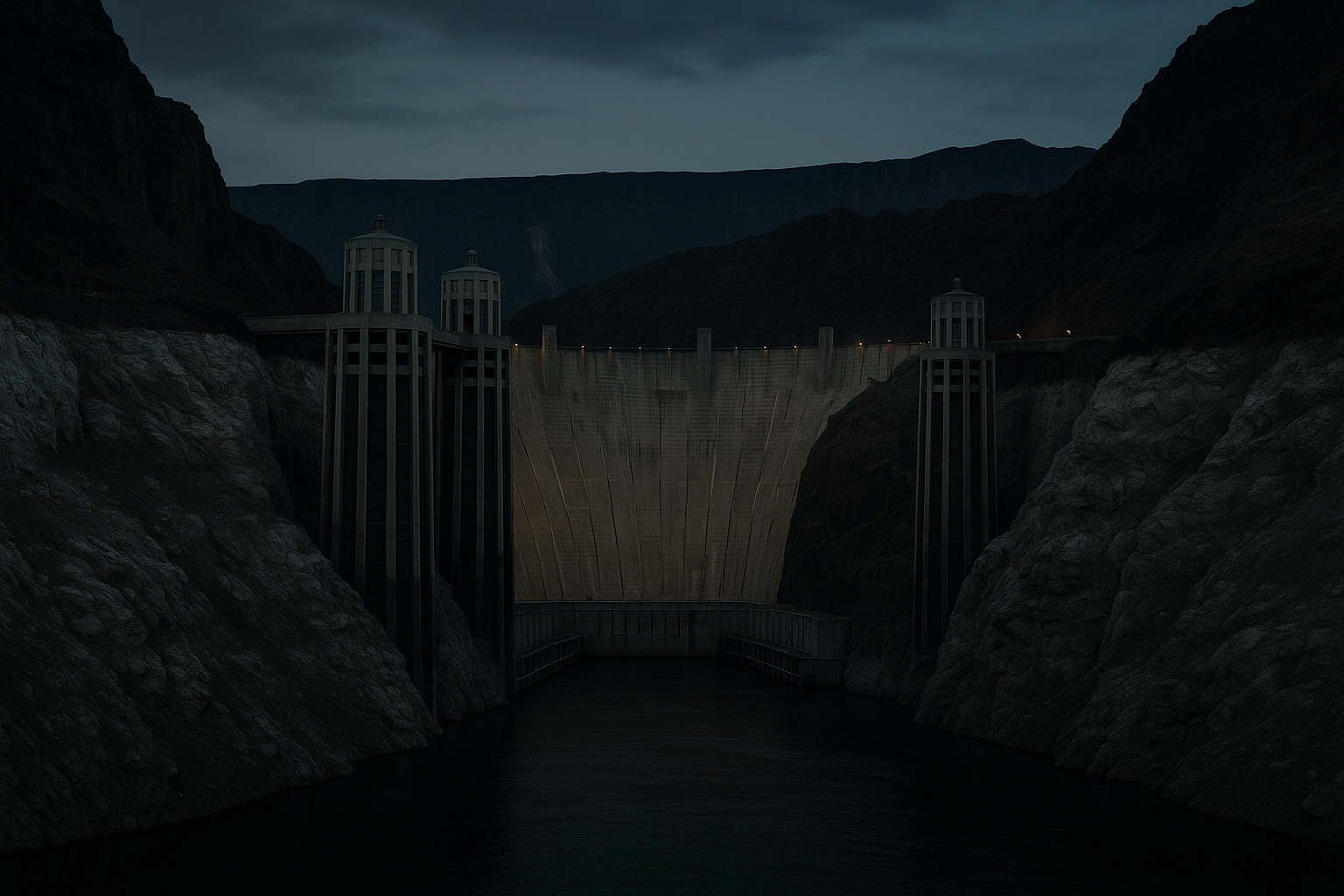
Between midnight and 1 a.m. on August 7, the Bureau of Reclamation's gauges at Lake Mead recorded an elevation of 1,040.46 feet above sea level. That number beat the July 2022 record — the lowest the reservoir had been since it was first filled in the 1930s — by about four inches. Almost nobody outside the water world noticed, because America has been reading Lake Mead headlines for five years and the story always ends the same way: less water, more cuts, another round of negotiations.
But this record is different, because the next threshold down isn't a water number. It's an electricity number.
Lake Mead now sits just above 1,039 feet. At 1,035 feet — roughly five feet below today's surface — 12 of Hoover Dam's 17 turbines can no longer operate. Generating capacity at the most famous power plant in America falls by roughly 70 percent. Federal forecasters say the crossing could come as early as this fall and probably no later than next spring, and their own 24-month study projects the lake grinding to new record lows nearly every month through 2028.
Upstream, the situation is worse. Lake Powell, the system's other giant reservoir, stood about 41 feet above Glen Canyon Dam's minimum power pool of 3,490 feet in late May — the elevation at which the penstocks feeding its eight turbines lose the water depth they need to run safely and hydropower stops entirely. Reclamation's spring forecast pulled that crossing forward from December to as early as this summer. Combined storage in the two reservoirs is now the lowest since 1957, when Glen Canyon Dam was still under construction.
The American Southwest is about to lose most of its cheapest electricity, at the exact moment its grid is under more demand pressure than at any point in its history. The water story everyone knows is turning into a power story almost nobody has priced.
The machine beneath the marble
Hoover Dam is not a large power plant by modern standards — about 2,080 megawatts of nameplate capacity, a fraction of what a single gas-heavy utility fleet carries. What makes it economically unusual is who gets the power and at what price.
Hoover's output is not sold into wholesale markets. It is allocated — under federal contracts signed in 2016 and running to 2067 — to more than 70 recipients across Arizona, Nevada, and Southern California: municipal utilities, irrigation districts, tribes, and state power authorities. The largest blocks flow to Southern California, where among other things the Metropolitan Water District uses Hoover electricity to pump Colorado River water over the mountains to Los Angeles. Contractors pay cost-of-service rates — historically a fraction of wholesale market prices — because the dam was paid off decades ago and the fuel is free.
Glen Canyon Dam anchors an even wider network. Its power is marketed through the Colorado River Storage Project to more than five million customers across the interior West — including roughly 50 Native American tribes and a long list of rural electric cooperatives for whom federal hydropower is the cheapest line item on the books and, in some cases, the difference between solvency and rate shock.
This is the detail the "Hoover is only 2 gigawatts" shrug misses. The Southwest grid can physically replace the megawatt-hours. What cannot be replaced is the price. The loss is not spread across the market — it lands, concentrated, on a specific and identifiable list of cities, tribes, co-ops, and water agencies whose budgets were built on 1930s economics.
How the cliff got closer
The immediate reason Lake Mead is falling this fast is a deliberate federal choice. To keep Lake Powell above Glen Canyon's power cutoff, Reclamation cut this year's releases from Powell down to Mead from 7.48 million acre-feet to 6.0 million — the largest operational reduction it has ever made under existing authority. The agency is, in effect, draining its downstream reservoir to defend its upstream power plant. Hoover's output is already down roughly 40 percent as a result, and Mead's decline toward the 1,035-foot turbine threshold has accelerated accordingly.
Meanwhile the political machinery that might change the trajectory is jammed. The framework that governs the river's operations expires on December 31, and the seven basin states remain deadlocked. Washington has proposed a 10-year cuts framework; Nevada has already rejected its legal basis, with the state's lead negotiator putting it bluntly: "The crisis is now." Whatever operating regime replaces the old rules will decide how the pain is split between water users and power users — because on this river, every acre-foot held back for one purpose is subtracted from the other.
Arizona's Power Authority has already told its customers where this is heading: Hoover power, the director warned, may soon become "unaffordable" for many of the utilities that depend on it. That sounds like a paradox — how does the cheapest power in America become unaffordable? The answer to that question is where the investment story starts.
The rest of this briefing is for paid members: the cost-of-service math that makes shrinking hydropower more expensive per unit, the specific utilities, water agencies, and muni credits that absorb the hit, the firm-capacity trade on the other side of it — including the Nevada generator best positioned for the gap — and the five dated catalysts between now and January that decide how fast this reprices.
AlphaBriefing Paid gets you every investment thesis, scenario framework, and catalyst brief we publish — the analysis private intel clients pay four figures for, at a fraction of that.