The Fed's $2.5 Trillion Cushion Is Down to $226 Million
The Fed decides on rates today, but the real story is in the plumbing: the overnight buffer that absorbed four years of Treasury borrowing is gone, bank reserves are falling, and overnight money is trading above the Fed's floor.

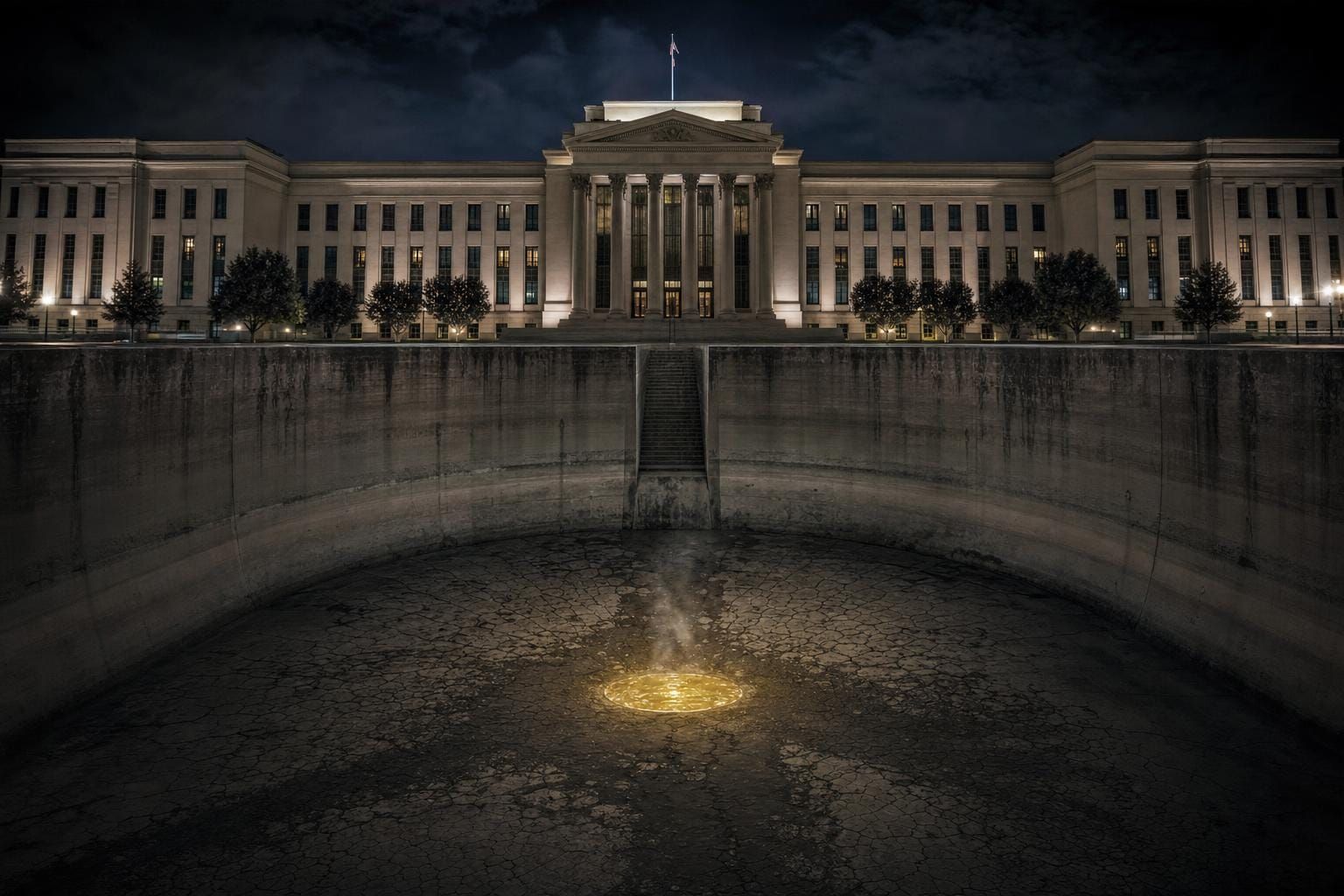
At Tuesday's close, the Federal Reserve's overnight reverse repo facility — the parking lot where the financial system's spare cash sleeps — held $226 million. Not billion. Million.
At its peak on December 30, 2022, that same facility held $2.55 trillion.
Less than one-hundredth of one percent of the cushion remains. And at 2:00 p.m. Eastern today, the Federal Open Market Committee walks out of a two-day meeting into a market that will be listening for one word on rates — hold — while the more consequential story is happening in the plumbing underneath.
What the cushion was
The overnight reverse repo facility (ON RRP) is simple in mechanics and enormous in consequence. Money market funds and other cash-rich institutions lend the Fed money overnight and get paid a fixed rate for it. When pandemic-era QE flooded the system with more cash than anyone could use, the RRP became the overflow reservoir: by late 2022, $2.55 trillion sat there every night, doing nothing, waiting.
That reservoir turned out to be the most important shock absorber in American finance. Starting in mid-2023, when the debt-ceiling deal unleashed a historic wave of Treasury bill issuance, money market funds paid for those bills by pulling cash out of the RRP. Trillions in new government borrowing got financed without draining a dollar from the banking system. The reservoir emptied so the banks didn't have to.
That phase is over. The reservoir is dry.
Now every dollar comes out of the banks
With the RRP at functionally zero, every new Treasury bill that settles pulls cash from the only pool left: bank reserves at the Fed.
The latest Fed data shows exactly that. Reserve balances fell to $2.96 trillion in the week ending October 21 — down $59.5 billion in a single week. The money didn't vanish; it moved. The Treasury's checking account at the Fed, the Treasury General Account, climbed $69 billion to $952 billion over the same week as tax receipts and bill settlements piled up.
And this week the pipeline is crowded. A 10-day cash-management bill settled Monday. Four-, 8- and 17-week bills settled Tuesday. Six-, 13-, 26- and 52-week bills settle Thursday, and a 5-year note settles Friday — which also happens to be month-end, when money-market desks say the housing agencies pull cash from repo markets to make monthly mortgage-bond payments, and when Canadian banks' October 31 fiscal year-end adds balance-sheet window-dressing on top.
Every one of those settlements now drains reserves directly. There is no buffer left to absorb any of it.
Briefings like this are free to read with a free AlphaBriefing membership. Join free →
The floor is creaking
You can already see the pressure in the single most-watched rate in finance.
SOFR — the Secured Overnight Financing Rate, the price of borrowing cash overnight against Treasury collateral, with more than $3.1 trillion changing hands daily — printed at 3.95% on Tuesday. The Fed pays banks 3.90% on reserves (IORB), which is supposed to act as a magnet holding overnight rates near the floor of the system. A week ago, SOFR sat two basis points below that magnet. Now it trades five basis points above it, and the top 1% of repo trades printed at 4.04% or higher.
Five basis points is not a crisis. It is a tell. Secured funding is where reserve scarcity always shows up first, because repo is where cash and collateral meet with no cushion in between. The unsecured federal funds rate, by contrast, is still sitting quietly at 3.88% — the stress is isolated, for now, exactly where the textbook says it starts.
Anyone who traded through September 2019 remembers how fast "isolated" can end. On September 16, 2019, SOFR was 2.43%. The next day it printed 5.25% — more than doubling overnight as a tax date and a Treasury settlement collided with reserves that turned out to be scarcer than anyone, including the Fed, believed. The Fed was running emergency repo operations within a day — and buying bills within a month — to rebuild the buffer. The lesson of 2019 is that "ample reserves" is not a number anyone knows in advance. The Fed found the floor by hitting it.
Why this is (probably) not 2019 — yet
Two things are genuinely different this time.
First, the Fed built a fire exit. The Standing Repo Facility, created in 2021, lets banks and dealers borrow cash against Treasuries on demand at the top of the policy range — the facility that didn't exist in 2019 and had to be improvised in a weekend. So far, usage is token: the largest draw in the past two weeks was $110 million on October 15, and this morning's operation took just $3 million. Tight, but orderly. Nobody is being rationed.
Second, the Fed already stopped shrinking. Quantitative tightening ended on December 1, 2025, and the balance sheet has been held essentially flat near $6.75 trillion since. The drain on reserves now comes from the Treasury's swelling cash pile — not from the Fed actively pulling liquidity out.
The risk, in other words, is not a sudden crash. It is a slow squeeze: a regime where overnight money persistently costs more than the Fed intends, where every heavy settlement week pushes repo a little further above the floor, and where the central bank gradually loses fine control of the very rate it is supposed to set.
The awkward part of today's meeting
Here is what makes this moment genuinely strange: the Fed is tightening while its liquidity floor erodes.
In September, the FOMC raised rates by a quarter point to 3.75%–4.00% — a unanimous vote, with the statement bluntly noting that "inflation remains elevated." Futures markets price today's decision as a hold, and press coverage of economist surveys and CME FedWatch data points to another quarter-point hike being widely expected in December.
That collision is the story. If reserves keep falling toward whatever the true floor turns out to be, the Fed will have to start growing its balance sheet again — buying Treasury bills to replace the reserves the TGA is absorbing. Doing that while simultaneously raising rates invites a communications nightmare the Fed has been dreading for years: explaining to markets, and to Congress, why buying billions in government debt during a hiking cycle is "reserve management," not QE. It is technically true. It will not sound true.
Listen for it at the 2:30 p.m. press conference. Any mention of "reserve management purchases," "money market pressures," or the standing repo facility will matter more than anything said about December.
What to watch
Four dials, in order of importance:
- The SOFR–IORB spread. If SOFR is still printing 5+ basis points above IORB after this week's settlement wave passes, the tightness is structural, not seasonal.
- Standing Repo Facility usage. Token draws are noise. A sustained move into the billions is the system telling the Fed the floor has been found.
- Reserve balances. Now $2.96 trillion. The last time they were this low and falling — late October 2025, when they hit $2.85 trillion — the Fed's response was to end QT on the spot. That lever has already been pulled.
- The Fed's own language today about its balance sheet. The admission that bill purchases are coming — whenever it arrives — is the regime change.
For portfolios, the transmission is direct. Funding stress hits leveraged Treasury positions first — the basis trades that now underpin a large share of Treasury market liquidity — then bank funding costs, then everything priced off the front of the curve. In 2019 the spillover was contained in weeks. The reason to pay attention now is that the Treasury is issuing far more, the buffer is at zero rather than merely low, and the Fed is leaning against inflation instead of easing into the problem.
Bottom line
The $2.55 trillion cushion that quietly financed the government's borrowing binge for two and a half years is down to $226 million — a rounding error on a rounding error. From here, the system runs without a shock absorber, reserve scarcity is no longer theoretical, and the Fed is navigating toward a floor it cannot see and has only ever located by collision. Today's rate decision is the headline. The plumbing is the plot.
A free membership gets you access to every free article at AlphaBriefing.com: Join AlphaBriefing
If this analysis was useful, this is what AlphaBriefing does every day — geopolitics and markets, connected to what it means for your money. A free membership gets you access to every free article on AlphaBriefing.com; paid members get the investment frameworks, scenario pricing, and catalyst calendars behind the paywall.
Sign up free → — upgrade whenever it earns it.
Sources & Further Reading
- Federal Reserve Bank of New York — Secured Overnight Financing Rate (SOFR) Data
- FRED — Overnight Reverse Repurchase Agreements (RRPONTSYD)
- FRED — Reserve Balances with Federal Reserve Banks (WRESBAL)
- Federal Reserve — H.4.1 Statistical Release (Factors Affecting Reserve Balances)
- Federal Reserve — FOMC Statement, September 16, 2026
- Federal Reserve — FOMC Statement, October 29, 2025 (end of balance sheet runoff)
- Federal Reserve Bank of New York — Repo and Reverse Repo Operations
- CME Group — FedWatch Tool
Disclaimer
AlphaBriefing is an independent intelligence publication. The content in this article is produced for informational and educational purposes only. Nothing published by AlphaBriefing constitutes financial, investment, legal, tax, or regulatory advice, nor should it be construed as a solicitation or recommendation to buy, sell, or hold any security, asset, or financial instrument.
All views expressed are those of the author at the time of writing and are subject to change without notice. Markets are volatile and unpredictable; past performance is not indicative of future results. Any investment involves risk, including the possible loss of principal.
AlphaBriefing and its principals, employees, or contributors may hold positions in securities or assets mentioned in this article. This should be considered a potential conflict of interest. No material relationship with any company referenced exists unless explicitly disclosed. Readers should conduct their own due diligence and consult qualified financial, legal, and tax advisors before making any investment decisions.
Information in this article is drawn from public sources believed to be reliable at the time of publication. AlphaBriefing makes no warranty, express or implied, as to the accuracy, completeness, or timeliness of any information herein. AlphaBriefing accepts no liability for any loss or damage arising from reliance on this content.
© AlphaBriefing. All rights reserved. Unauthorised reproduction or distribution is prohibited.