China Is Annexing the South China Sea With Paperwork
A nature reserve, a stack of ecological reports, and an empty ocean: while America's Iran war pulls the last carrier from the Pacific, China is annexing Scarborough Shoal with administrative law — and markets price the world's busiest trade artery at zero risk.

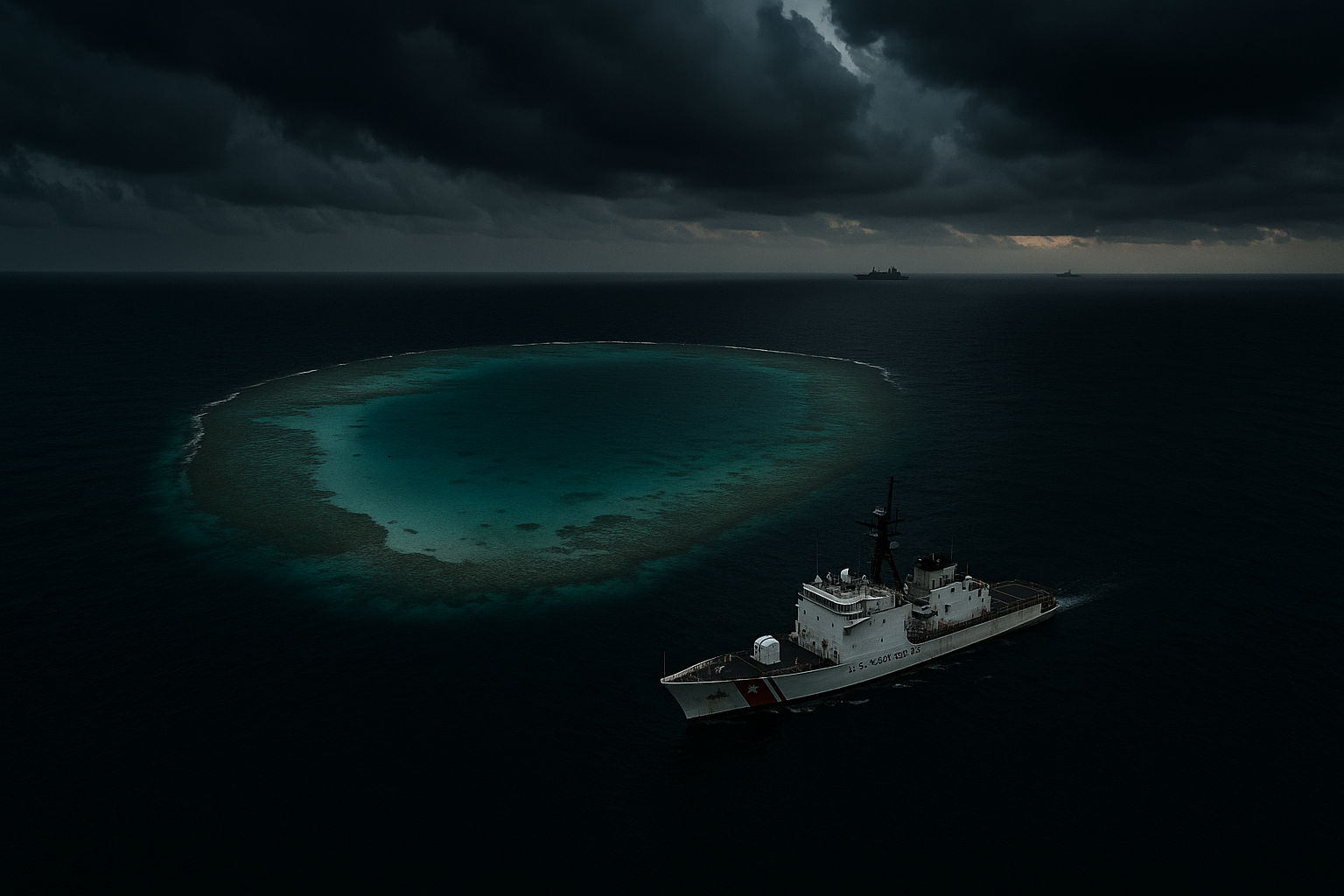
On August 14, the Philippines quietly deposited a document with the United Nations. Chart No. 1567 delineates the baselines, territorial sea, and contiguous zone of Bajo de Masinloc — the reef the world knows as Scarborough Shoal. One day later, China's Ministry of Natural Resources published ecological assessment reports on nine disputed South China Sea features, framing coral surveys as proof of sovereignty. And within another 24 hours, the USS George Washington departed Asia for Middle East operations against Iran — leaving the western Pacific without a single American aircraft carrier.
Three bureaucratic events in 72 hours. No shots fired. But together they mark the most consequential week in the South China Sea this year — because China has found a way to annex territory without a landing craft in sight, and it is executing the play at the exact moment America's navy is busiest somewhere else.
The Nature Reserve That Isn't About Nature
Last September, China's State Council approved a "national nature reserve" covering 3,523 hectares of Scarborough Shoal — a reef that sits 124 nautical miles off the Philippine coast, well inside Manila's exclusive economic zone, and that a 2016 international arbitral tribunal ruled is a traditional fishing ground where China's sweeping claims have no legal basis.
Beijing ignored that ruling. But rather than build another island fortress — the Spratly playbook that cost it years of diplomatic damage — it reached for a subtler instrument: conservation law. A nature reserve comes with regulations. Regulations require enforcement. Enforcement requires patrols, monitoring stations, and the authority to exclude — starting with the Filipino fishermen who have worked those waters for generations. Manila's foreign ministry called the reserve "illegitimate and unlawful" and demanded its withdrawal. Washington backed the protest. Beijing responded this month with ecological reports on nine more features.
This is annexation by administrative law. Every coral survey, every environmental regulation, every scientific report builds a paper record that Beijing will one day cite as decades of "continuous administration" — the raw material of sovereignty claims. The Philippine Coast Guard warned on August 15 what comes next: militarization of Scarborough would complete an "iron triangle" of Chinese positions spanning the Paracels, the Spratlys, and Scarborough — a geometry that covers the entire South China Sea.
Briefings like this land in members' inboxes before the market prices them in. Join free →
The Empty Ocean Problem
Timing is the tell. America's war with Iran has consumed the US Navy. The blockade of Iran's coastline, the reopened fight over Hormuz, escort duty in the Gulf — every hull committed there is a hull not in the Pacific. When the George Washington sailed west on August 15–16, it left the region that Washington has called its priority theater for fifteen years with zero carrier presence.
Beijing noticed. The ecological reports landed the same week. So did a Chinese attempt to recharacterize a routine naval exercise with an Indonesian frigate as a joint operation inside "China's sovereign EEZ" east of Taiwan. None of these moves individually justifies a crisis response — that is precisely the point. Gray-zone lawfare is calibrated to stay below every threshold that would trigger one.
The world has spent 2026 learning what happens when a chokepoint closes. The Strait of Hormuz has been shut since early July; 8.3 million barrels a day of Gulf output is off the market; Brent is above $93. The South China Sea carries roughly a third of global maritime trade — over $3 trillion a year, an order of magnitude more traffic than Hormuz. It is the one artery the global economy cannot afford to lose next.
Which raises the question that matters for your portfolio: what does the market think this risk is worth right now — and what happens to shipping, insurance, defense, and semiconductor pricing if that assumption breaks?
The rest of this briefing is for paid members: the chokepoint math if South China Sea freight reprices the way Hormuz did, the specific defense and shipping names levered to Manila's $35 billion rearmament, the three-scenario probability framework, and the 90-day catalyst calendar to watch.
AlphaBriefing Paid gets you every investment thesis, scenario framework, and catalyst brief we publish — the analysis private intel clients pay four figures for, at a fraction of that.