The Beijing Gambit: Inside the Trump-Xi Summit That Could Reshape Global Markets
Trump heads to Beijing May 14 for the most consequential US-China summit in years. Here's what's on the table — and what investors need to watch.

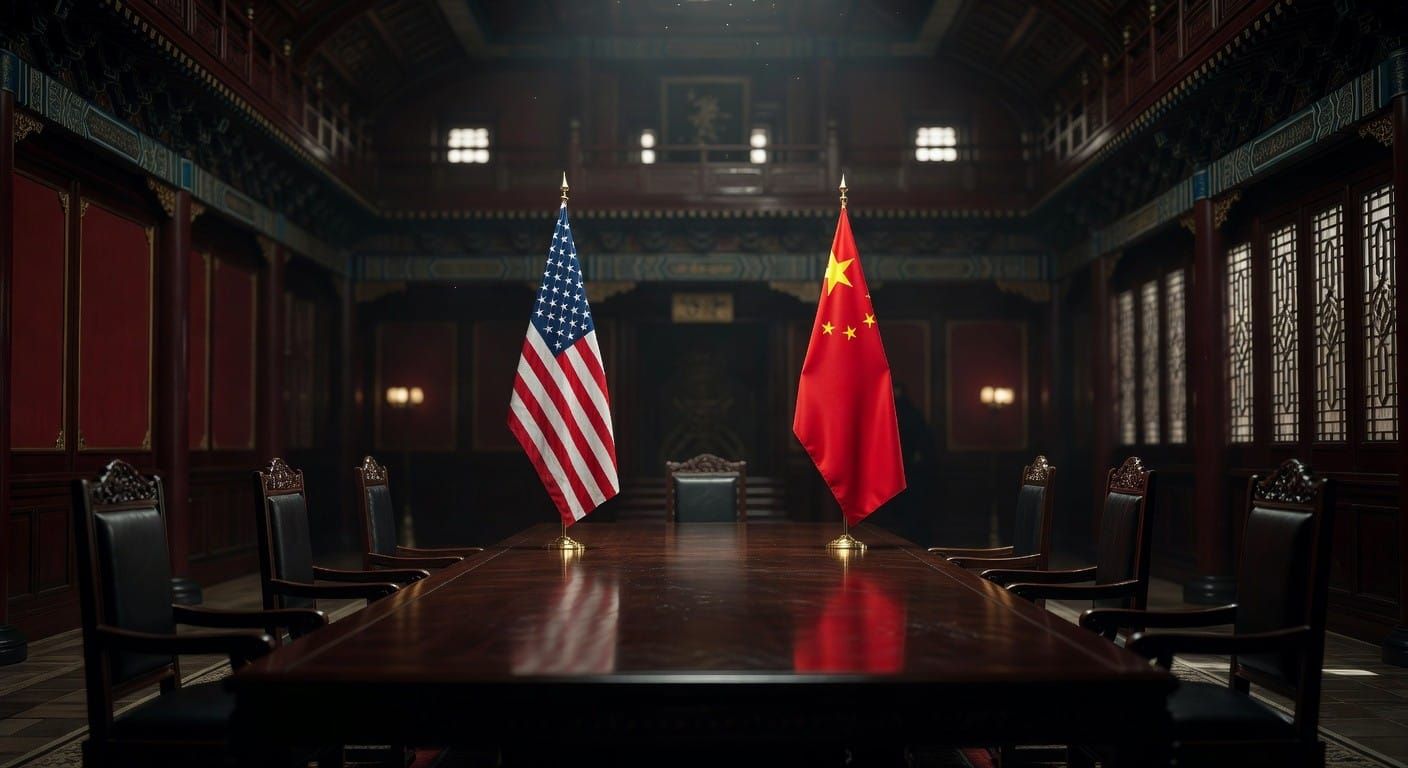
The most consequential diplomatic event of 2026 is eight days away — and the market isn't pricing it.
On May 14-15, President Donald Trump will arrive in Beijing for his first in-person summit with President Xi Jinping on Chinese soil since returning to the White House. The meeting, postponed from March because of the Iran conflict, carries stakes that extend far beyond photo opportunities and state dinner toasts.
This is a summit that will shape tariff policy, technology access, Taiwan risk, and the rules of great-power competition for the rest of the decade. For investors, it may be the single most important macro event of the spring.
Here's what you need to know — and what to watch.
Why This Summit Is Different
Trump and Xi last met face-to-face in Busan, South Korea, in October 2025. That encounter produced a fragile trade truce: China agreed to purchase American agricultural goods and Boeing aircraft, and both sides stepped back from the brink of a full tariff escalation that had rattled global markets.
But Busan was a sidebar meeting at a multilateral summit. Beijing is something else entirely.
A state visit to China carries symbolic weight that both leaders understand. For Xi, hosting Trump in the capital signals to domestic audiences that China is being treated as an equal. For Trump, the trip signals that he's pursuing a deal — and he'll want to return with something he can call a win.
The problem is that the ground has shifted dramatically since October.
The Post-SCOTUS Tariff Vacuum
In February 2026, the Supreme Court delivered a 6-3 ruling in Learning Resources, Inc. v. Trump that struck down the administration's sweeping tariffs imposed under the International Emergency Economic Powers Act (IEEPA). Chief Justice Roberts wrote that IEEPA does not authorize tariffs — taxation is Congress's domain, full stop.
The ruling gutted more than $130 billion in duties overnight. The administration terminated the IEEPA tariffs within days and pivoted to proposing a new 10-15% universal tariff under different statutory authority, but that requires Congressional action that hasn't materialized.
This leaves Trump in an awkward position heading into Beijing. His biggest leverage tool — the threat of punitive tariffs — has been legally defanged. Beijing knows this. Chinese officials have been "ramping up trade leverage" in the weeks before the summit, according to Reuters, introducing new export rules on critical minerals and signaling that they view the post-SCOTUS landscape as an opportunity.
For investors, the critical question is: what replaces the tariff stick?
The Five Flashpoints on the Table
Analysts at Brookings, the Foreign Policy Research Institute, and the Asia Society have identified five core issues that will dominate the summit:
1. Trade Architecture
The most likely deliverable is a bilateral "Board of Trade" — a standing mechanism to identify non-sensitive sectors where both sides can make purchase commitments and limited tariff adjustments. Think of it as managed trade with guardrails. Expect announcements of Chinese purchases of American soybeans, Boeing jets, and possibly LNG. These will be packaged as headline wins, but they're largely extensions of existing patterns.
The deeper question is whether Trump pushes for — or Beijing offers — a framework for restoring some tariff structure through Congressional channels. If Beijing senses that Trump is weakened on trade authority, they have little incentive to concede anything significant.
2. Technology and AI
The US semiconductor export-control regime targeting China has been the sharpest edge of strategic competition. Washington has restricted advanced chip sales and chipmaking equipment; Beijing has retaliated by restricting exports of gallium, germanium, and other critical minerals essential to defense and technology supply chains.
Neither side is expected to make major concessions here. The technology rivalry is structural, not transactional. But watch for any language about AI safety cooperation or joint "guardrails" on autonomous systems — this would be a symbolic but meaningful step toward what some analysts call "managed competition."
3. Taiwan
This is the most dangerous wildcard. Brookings analyst Richard Bush has flagged that China is "signaling that Taiwan cannot be avoided" at the summit. Xi may press Trump for changes to American declaratory policy on Taiwan's legal status or constraints on arms sales to Taipei.
Any shift in US Taiwan policy — even rhetorical — would send shockwaves through semiconductor markets (TSMC supplies over 90% of the world's most advanced chips) and across the Indo-Pacific security architecture. Analysts warn that preparations for the Taiwan discussion appear thin on the US side, raising the risk of unscripted concessions.
4. Iran and the Strait of Hormuz
The Iran conflict is the elephant in every room. Trump has just paused "Project Freedom" — the US military operation escorting ships through the Strait of Hormuz — citing "great progress" toward a deal with Tehran. Meanwhile, Iran's Foreign Minister Abbas Araqchi is in Beijing meeting his Chinese counterpart, Wang Yi, in what looks like a coordinated play ahead of Trump's arrival.
China has been the biggest economic beneficiary of the Hormuz crisis. As AlphaBriefing has previously reported, Beijing has positioned itself as a peace broker while quietly expanding its diplomatic leverage over Tehran. Trump arriving in Beijing while Iran's top diplomat is already there creates a complex dynamic that could produce unexpected outcomes.
5. Putin in the Wings
There are signals that Russian President Vladimir Putin may visit Beijing shortly after Trump departs. If Xi rolls out the red carpet for Putin immediately following the US summit, it would undermine any narrative of a special US-China rapport. Trump — famously sensitive to perceived slights — could interpret this as a power play. Brookings analyst Ryan Hass has flagged this as a genuine risk to the summit's aftermath.
The "Coexistence" Framework
The most important word to listen for in Beijing won't be "deal" or "agreement." It will be "coexistence."
Chinese officials have been laying the groundwork for framing 2026 as a year of "mutual respect and peaceful coexistence." Xi told Trump in a recent call that issues can be resolved "one by one" through dialogue. Analysts at Asia Times argue the best realistic outcome is "codifying new US-China coexistence rules" — informal guardrails for managing structural rivalry without accidental escalation.
This isn't détente. There's no ideological softening, no shared strategic vision. It's closer to what Cold War historians called "competitive coexistence" — an acknowledgment by both sides that they can hurt each other badly, and an agreement to limit the damage.
For markets, this framework is actually more stabilizing than a grand bargain that nobody believes. If the summit produces credible crisis-communication mechanisms and guardrails around the South China Sea and Taiwan Strait, it reduces tail risk. That's worth something.
What the Market Is Missing
Equity markets have been largely focused on the Iran-Hormuz situation and earnings season. The Trump-Xi summit has received surprisingly little attention from sell-side strategists, despite its potential to reshape trade policy, technology access, and geopolitical risk premiums across multiple asset classes.
Here's what investors should be watching:
Sectors with direct exposure:
- Agriculture (soybeans, corn, pork) — likely beneficiary of any purchase commitment announcements
- Aerospace (Boeing, defense suppliers) — Chinese aircraft orders are a traditional summit deliverable
- Semiconductors — any Taiwan language or export-control shifts would move TSMC, NVIDIA, ASML, and the entire supply chain
- Critical minerals and rare earths — if China signals a relaxation of export restrictions, it would benefit EV makers, defense primes, and electronics manufacturers
- Energy (LNG) — possible Chinese LNG purchases as a goodwill gesture
Macro signals to watch:
- USD/CNY — the renminbi is a barometer of trade sentiment
- US Treasury yields — any sign of renewed Chinese buying (or selling) of Treasuries
- Copper and industrial metals — a proxy for market confidence in the bilateral relationship
- VIX — tail-risk reduction from a successful summit could compress volatility
The Bottom Line
Don't mistake low expectations for low stakes. The Brookings assessment is blunt: "Outside observers should have low expectations." But low expectations can be exceeded — and the gap between "managed stability" and "renewed escalation" is enormous for portfolio positioning.
The most likely outcome is a package of incremental deliverables — purchase commitments, a trade board mechanism, vague language about coexistence — wrapped in a headline-friendly press conference. That's actually positive for risk assets, even if it doesn't solve any fundamental problem.
The tail risks are real, though. An unscripted Taiwan concession, a perceived slight that triggers Trump's retaliatory instincts, or a breakdown in talks that reopens the tariff war — any of these could turn the summit from a stabilizer into an accelerant.
Eight days. Watch this space.
Get this level of intelligence every day. Subscribe to AlphaBriefing — free, member, and paid tiers available.
Sources & Further Reading
- Brookings — What Will Happen When Trump Meets Xi?
- Asia Times — Trump-Xi Summit at Best May Codify New US-China Coexistence Rules
- Reuters — Trump Calls Xi Meeting "Important Trip," Says US Leads AI
- Reuters — White House Quiet as China Ramps Up Trade Leverage Before Summit
- SCMP — Why Experts Say Trade Wins Aren't Enough for Xi-Trump Summit
- SCOTUSblog — Supreme Court Strikes Down Tariffs
- PIIE — What the Supreme Court's Tariff Ruling Changes and What It Doesn't
Disclaimer
AlphaBriefing is an independent intelligence publication. The content in this article is produced for informational and educational purposes only. Nothing published by AlphaBriefing constitutes financial, investment, legal, tax, or regulatory advice, nor should it be construed as a solicitation or recommendation to buy, sell, or hold any security, asset, or financial instrument.
All views expressed are those of the author at the time of writing and are subject to change without notice. Markets are volatile and unpredictable; past performance is not indicative of future results. Any investment involves risk, including the possible loss of principal.
AlphaBriefing and its principals, employees, or contributors may hold positions in securities or assets mentioned in this article. This should be considered a potential conflict of interest. No material relationship with any company referenced exists unless explicitly disclosed. Readers should conduct their own due diligence and consult qualified financial, legal, and tax advisors before making any investment decisions.
Information in this article is drawn from public sources believed to be reliable at the time of publication. AlphaBriefing makes no warranty, express or implied, as to the accuracy, completeness, or timeliness of any information herein. AlphaBriefing accepts no liability for any loss or damage arising from reliance on this content.
© AlphaBriefing. All rights reserved. Unauthorized reproduction or distribution is prohibited.