America's Battery Recycling Bet Went Bankrupt. The Bet Might Still Pay Off.
Ascend Elements raised nearly $1 billion to close America's battery materials loop, then filed for Chapter 11. This week its flagship Georgia plant restarted under a new owner that bought it debt-free with $1 billion in offtake already signed. The shakeout, not the collapse, is the story.

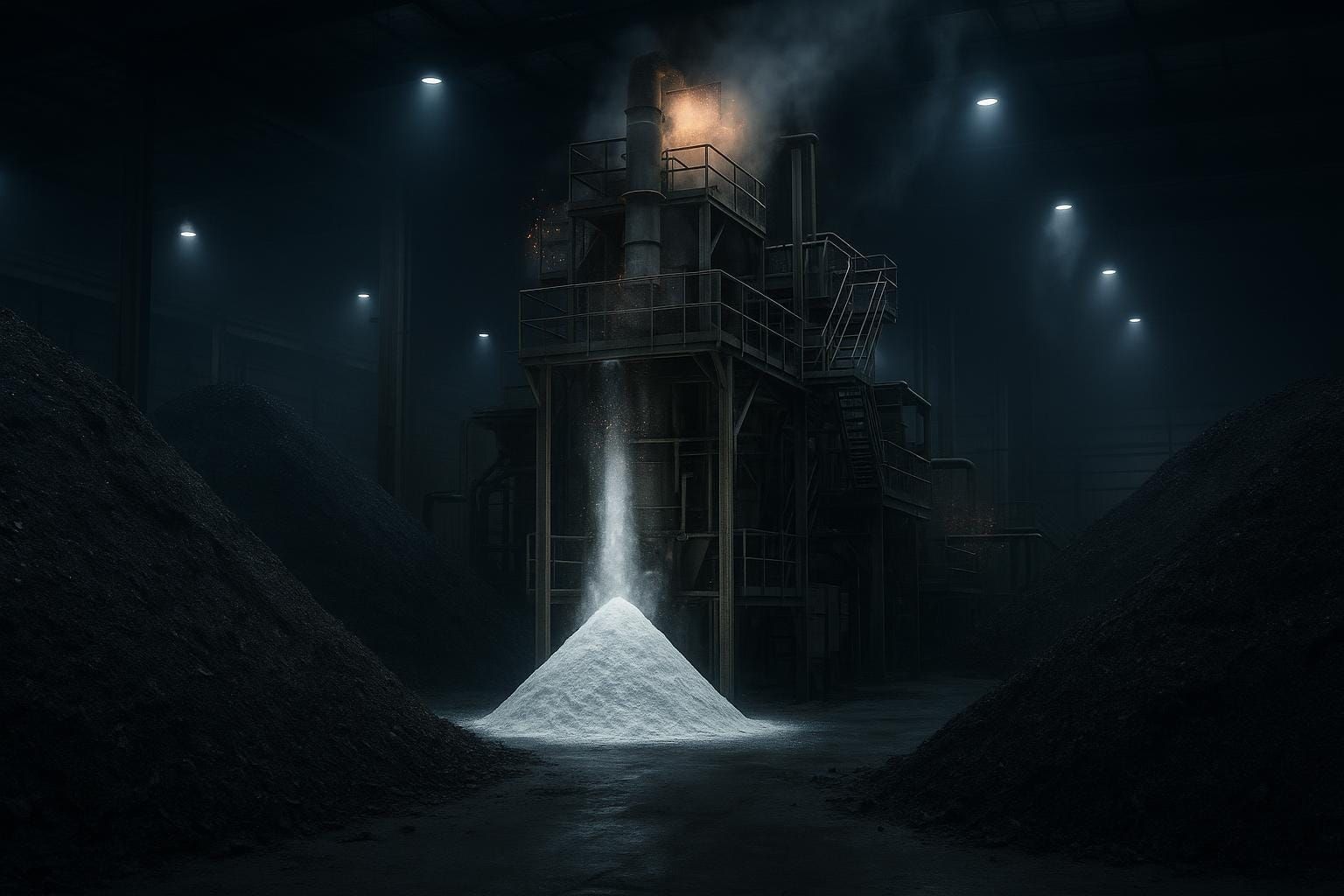
On Wednesday, a company almost nobody has heard of announced the start of operations at a 154,000-square-foot plant in Covington, Georgia, about 35 miles east of Atlanta. The machines inside recover lithium carbonate — the white powder at the heart of every lithium-ion battery — from shredded dead batteries and factory scrap. The production line is the same one that ran last year. The chief executive is the same person. Much of the team is the same.
What changed is everything else. The company that built the plant, Ascend Elements, raised nearly $1 billion in equity and government backing, achieved something no American firm had done before — and filed for Chapter 11 bankruptcy in April. The startup that now owns the site, R3 Lithium, bought it in July with no liabilities attached, raised a comparatively tiny $15 million Series A, and walked in the door holding more than $1 billion in customer contracts.
That sequence — build, collapse, restart at a fraction of the cost — is not a footnote in the clean-energy trade press. It is the clearest picture available of what is actually happening to America's attempt to build a domestic battery materials industry. The shakeout has arrived. And shakeouts, history shows, are where the durable owners get made.
The plant worked. The company didn't.
Ascend Elements was, for a while, one of the flagship names of the American battery push. Founded in Massachusetts a decade ago, it developed a patented "Hydro-to-Cathode" process for turning end-of-life batteries and manufacturing scrap directly into new battery materials. In 2025, its Covington facility became the first commercial-scale plant in the United States to produce lithium carbonate at better than 99 percent purity from fully recycled feedstock. That is the purity threshold that matters — the point at which recycled output competes with mined and refined material rather than trading at a discount to it.
The technology, in other words, crossed the finish line. The balance sheet never got there.
In April, Ascend filed for Chapter 11. The bankruptcy analytics firm Bondoro summarized the causes in one sentence: a construction dispute at its flagship Kentucky plant, federal grant cancellations, and a lithium price collapse. Chief executive Linh Austin, who had inherited the situation, added "longstanding financial issues and outstanding liabilities" that predated his tenure.
The unwinding produced casualties in every direction. In July, Ascend agreed to a $7.5 million settlement with the Department of Energy after the government alleged the company inflated labor hours, tool purchases, and equipment rental costs on roughly $5.3 million in construction reimbursements at its Apex 1 site in Hopkinsville, Kentucky. (Ascend self-reported the problem and received credit for cooperating; the claims were allegations, resolved without a finding of liability.) A Korean partner, SK Ecoplant, watched a contingent liability of roughly 100 billion won become real. And a facility built with approximately $150 million of investment went on the block.
Why the model broke
It is tempting to file this under "another green startup that burned out." That reading misses what actually failed. Three forces converged on Ascend — and on the entire first generation of American battery recyclers.
The commodity turned against them. Battery recyclers sell commodities: lithium carbonate, nickel, cobalt. When lithium prices collapsed from their 2022 highs, recyclers' revenue per ton fell with the market — while their construction costs, locked in at boom-era prices, did not. A plant financed when lithium was scarce had to operate in a world where lithium was cheap.
Washington reversed. The sector was built on the assumption of durable federal support. The One Big Beautiful Bill Act eliminated the $7,500 EV tax credit, US electric vehicle sales sagged, and federal grant awards — including Ascend's — were canceled mid-construction. What had been a policy tailwind became policy risk, priced accordingly by every lender and investor in the space.
The feedstock hasn't arrived yet. The core promise of battery recycling is circular: old EVs die, their batteries become new ones. But the great wave of retired EV batteries is still years away. Today's feedstock is mostly manufacturing scrap from battery plants — and the buildout of those plants slowed just as recycling capacity came online. The first generation of recyclers built for a 2030 world on 2026 revenue.
Ascend was not the first to hit this wall. Li-Cycle, once the sector's most prominent public company, sought creditor protection in 2025, and its assets ended up with the commodities giant Glencore. The pattern is consistent: the technology survives; the original capital structure does not.
Briefings like this land in members' inboxes before the market prices them in. Join free →
The restart: what the new owners understand
Now look at what R3 Lithium actually acquired, and how.
The company bought the Covington site — the one with the proven, first-in-the-nation production line — free of the liabilities that sank its builder. It kept the leadership that got the plant to commercial scale, including CEO Linh Austin and Ascend co-founder Eric Gratz as chief technology officer. It raised $15 million from investors including TDK Ventures, Integral GlobalTech Partners, and Axial Partners — enough to upgrade the lithium line, because the expensive part already exists. And critically, it entered the market with more than $1 billion in offtake agreements in hand, including a take-or-pay contract with Trafigura, one of the world's largest commodity traders.
The plant can shred 30,000 metric tons of battery material a year and produce 2,500 metric tons of lithium carbonate, with floor space reserved for a second line. R3 says future facilities across North America and Europe will be built in modular 5,000-ton units — and only where offtake agreements already exist. Demand first, steel second: the inverse of the boom-era model.
One number in R3's announcement deserves a longer look. The company projects that at full volume next year, Covington will account for more than half of all US-produced lithium carbonate. Read that again: a single 2,500-ton production line in a converted warehouse outside Atlanta would represent the majority of American output of the most important battery chemical. That is not a statement about how big R3 is. It is a statement about how small America's lithium refining base still is — and how much room there is to run for whoever owns the surviving capacity.
This is a very old playbook wearing new clothes. Railroads in the 1890s, fiber-optic networks after the dot-com crash, solar plants after 2012: capital-intensive infrastructure gets built by optimists at full price, wiped out in a downturn, and bought by realists at a discount. The second owner — the one who pays cents on the dollar for assets that already work and adds contracts before capacity — is historically the one who makes the money.
What to watch
The strategic case for battery recycling did not go bankrupt with Ascend. China still refines the dominant share of the world's battery-grade lithium, cobalt, and graphite. Grid-scale battery storage is booming even as US EV sales stall, pulled by data centers and utilities. And critical-minerals independence remains one of the few genuinely bipartisan industrial priorities in Washington, because drones, munitions, and grid resilience all run on the same chemistry as sedans.
For readers tracking the sector, the signals worth following:
- The lithium price. It is the master variable. Every recycler's economics move with it, and the current price assumes abundant supply that a genuine EV recovery — or a geopolitical disruption in refining — would erase quickly.
- Whether R3 hits full volume in 2027. If a debt-free plant with locked-in offtake can't make the economics work, the problem is the business, not the balance sheet. If it can, expect the distressed-asset buyers to move fast on the rest of the sector.
- Who is doing the buying. Commodity traders — Trafigura on the offtake side, Glencore via Li-Cycle's remains — are quietly positioning themselves across the recycled-materials loop. The circular battery economy may end up owned not by venture-backed founders but by the same firms that have always owned the world's material flows.
- The taxpayer ledger. Facilities seeded with federal grant money are being transferred, debt-free, to private buyers at steep discounts. As DOE audits continue across the grant portfolio, expect more settlements like Ascend's — and more questions about what the public got for its money.
The bottom line
The lesson from Covington is not that battery recycling failed in America. The chemistry crossed its commercial threshold — 99 percent purity at scale — before the company that achieved it did. The lesson is that in capital-intensive energy infrastructure, being right early is nearly indistinguishable from being wrong: the pioneers absorb the construction risk, the policy risk, and the commodity cycle, and the assets pass to owners with cleaner books and better timing.
America will almost certainly close its battery materials loop. It just won't be closed by the companies that started it — and for investors, that distinction is the entire game.
If this analysis was useful, this is what AlphaBriefing does every day — geopolitics and markets, connected to what it means for your money. Free members get the daily brief in their inbox; paid members get the investment frameworks, scenario pricing, and catalyst calendars behind the paywall.
Get this level of intelligence every day. Subscribe to AlphaBriefing — free, member, and paid tiers available.
Sources & Further Reading
- CleanTechnica — What Lithium EV Battery Shortage? New Recycler Picks Up Where Ascend Elements Left Off
- electrive — R3 Lithium launches lithium recycling facility in Georgia
- WHOP — Ascend Elements to pay $7.5 million to DOE for inflated service reimbursements
- LinkedIn — Linh Austin, "Opening the Door on a New Era at Ascend Elements"
- Argonne National Laboratory — Li-Bridge public-private alliance for the US battery supply chain
Disclaimer
AlphaBriefing is an independent intelligence publication. The content in this article is produced for informational and educational purposes only. Nothing published by AlphaBriefing constitutes financial, investment, legal, tax, or regulatory advice, nor should it be construed as a solicitation or recommendation to buy, sell, or hold any security, asset, or financial instrument.
All views expressed are those of the author at the time of writing and are subject to change without notice. Markets are volatile and unpredictable; past performance is not indicative of future results. Any investment involves risk, including the possible loss of principal.
AlphaBriefing and its principals, employees, or contributors may hold positions in securities or assets mentioned in this article. This should be considered a potential conflict of interest. No material relationship with any company referenced exists unless explicitly disclosed. Readers should conduct their own due diligence and consult qualified financial, legal, and tax advisors before making any investment decisions.
Information in this article is drawn from public sources believed to be reliable at the time of publication. AlphaBriefing makes no warranty, express or implied, as to the accuracy, completeness, or timeliness of any information herein. AlphaBriefing accepts no liability for any loss or damage arising from reliance on this content.
© AlphaBriefing. All rights reserved. Unauthorised reproduction or distribution is prohibited.