America Is About to Tariff Its Own Medicine Cabinet
On July 31, Trump's Section 232 tariffs hit the world's most globalized supply chain. Big Pharma bought its way out with $480B in pledges. The generic industry — 90% of America's prescriptions — can't.

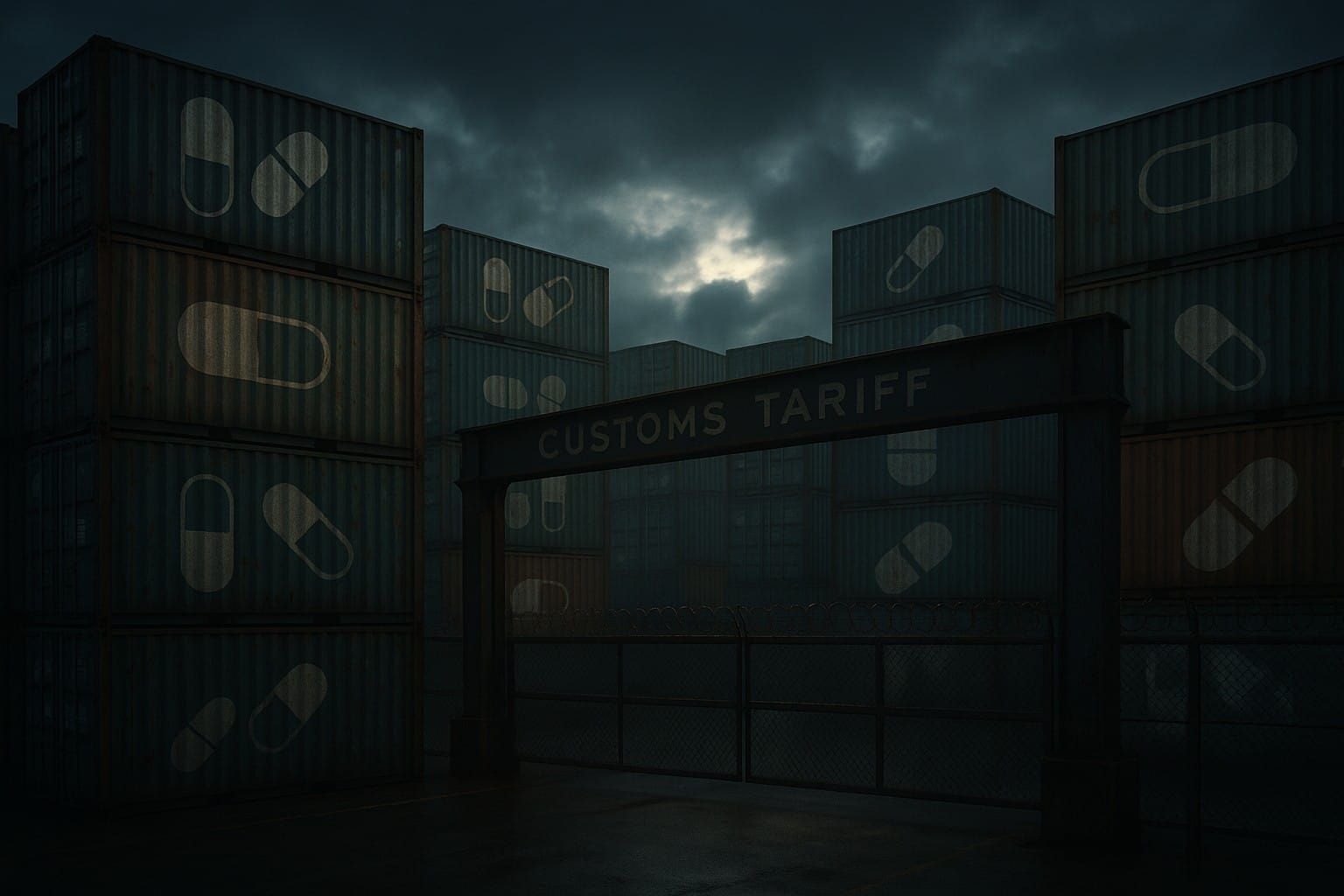
On July 31, the most globalized supply chain on earth meets an American tariff wall. The question isn't whether drug prices rise — it's which drugs, for whom, and how fast the shortages follow.
Eight days from now, a policy that has been building since spring finally bites. Under a Section 232 proclamation President Trump signed on April 2, the United States begins levying tariffs of up to 100% on imported patented pharmaceuticals and the active ingredients that go into them. July 31 is the hinge date: it's when the duties take effect for most companies, and it's the deadline for the world's largest drugmakers to finalize onshoring deals that cut their rate from 100% down to 20%. Branded shipments that don't make the cut face full exposure by September 29.
This is not a trade skirmish over steel or semiconductors. It is a tariff aimed squarely at the medicine cabinet — a supply chain where more than 90% of American prescriptions are filled with generic drugs, and where the overwhelming majority of those pills, and the chemical ingredients that make them, are manufactured an ocean away. Washington has decided to reshore that chain by force. The industry's biggest players can buy their way out. The part of the industry that actually supplies America's daily medications largely cannot.
Here is what that split means for your money, your pharmacy, and the companies caught on the wrong side of it.
The deal Big Pharma already cut
Start with the winners, because they moved first and they moved loud.
Since Eli Lilly opened the bidding in 2025 with a multibillion-dollar US manufacturing commitment, the branded pharmaceutical industry has pledged more than $480 billion in domestic production — a wave of announcements that reads less like capital planning and more like a negotiation conducted in press releases. Pfizer signed a direct agreement with the White House: roughly $70 billion in US R&D and manufacturing in exchange for a three-year moratorium on tariffs. Johnson & Johnson committed $55 billion over four years. Roche pledged $50 billion. Novartis outlined $23 billion across ten US sites. Lilly stacked another $27 billion on top of its earlier $23 billion. AbbVie, AstraZeneca, Bristol Myers Squibb, Gilead, GSK, Merck, Novo Nordisk, and Sanofi all joined the parade.
Tally it up and the pledges point to roughly 22 new manufacturing sites and about 44,000 jobs. On paper, it looks like the tariff worked before it even started.
The mechanics explain why branded drugmakers folded so willingly. A patented, on-patent blockbuster carries gross margins that can exceed 80%. When your product sells for thousands of dollars a course, absorbing a tariff — or pre-empting it with a US plant — is an accounting decision, not an existential one. Better still, the reshoring pledges are denominated in future capital spending over four to ten years, much of which these companies were going to deploy anyway. The 20% rate is the reward for playing along. For the branded majors, that's a manageable toll.
Briefings like this land in members' inboxes before the market prices them in. Join free →
The 90% the tariff can't reach
Now the part Washington's press releases skip over.
The drugs Americans actually take every day are not $3,000 branded biologics. They are the $4 generics — the blood-pressure pills, the antibiotics, the metformin, the antidepressants — that make up more than nine of every ten prescriptions filled in this country. And that market runs on the opposite economics of Big Pharma. Generic manufacturing survives on margins measured in pennies per pill.
The geography is stark. India supplies roughly 40% of all generic drugs sold in the United States and more than 80% of the active pharmaceutical ingredients used to make them. More than 92% of the facilities producing generic APIs for the US market sit overseas — concentrated in India, China, and Italy. This is the most globalized supply chain in the modern economy, and it was engineered over three decades precisely to squeeze every cent of cost out of the system.
Drop a 100% tariff on that, and the math breaks. For a generic maker earning a few cents per tablet, a tariff that doubles the landed cost of the ingredient doesn't inspire a new factory in Ohio — it inspires an exit. Building a compliant sterile-injectables plant in the US takes four to six years and hundreds of millions of dollars, and the finished product still can't compete on price with an Indian facility that has been optimized since the 1990s. Faced with that arithmetic, the rational generic manufacturer doesn't reshore. It discontinues the product.
That is the quiet danger in this policy. Washington structured the generic tariff with a two-year delay — the 100% rate (rising toward 200% for holdouts) doesn't fully land until 2028 — precisely because everyone understands the branded reshoring timeline of 2028–2030 doesn't apply here. You cannot rebuild the world's low-margin pill factory in eighteen months. And a generic drug that becomes unprofitable doesn't get more expensive. It vanishes from the shelf.
What actually happens to prices — and shelves
Two distinct effects are now in motion, and they arrive on different clocks.
The near-term effect is on branded and specialty drugs — the biologics, the cell and gene therapies, the newer patented medicines still manufactured in Ireland, Switzerland, and Singapore. Here the tariff largely becomes a cost that flows through to list prices, insurers, and ultimately premiums. Companies with unfinished US plants and no White House side-deal face the full 100% on September 29. Expect margin pressure, renegotiated payer contracts, and a scramble to relabel "US-made" any product with even a final finishing step on American soil.
The longer-term effect — and the more dangerous one — is on generics. The US already lives with chronic shortages of sterile injectables, chemotherapy agents, and basic antibiotics. Layering a tariff onto the thinnest-margin corner of the drug economy doesn't build resilience; it accelerates the exit of marginal suppliers and thins out an already fragile system. The risk isn't a price spike. It's an empty shelf where a $4 generic used to be, and a sole-source supplier with newfound pricing power over the drugs that don't disappear.
For investors, the map sorts cleanly:
- Relative winners: Branded majors that already signed onshoring deals (Pfizer's tariff moratorium is the template), US-based contract manufacturers (CDMOs) about to see reshoring demand, and domestic API startups positioned as the "friend-shoring" alternative.
- Squeezed in the middle: Generic manufacturers with heavy India/China exposure and no path to profitable US production — the companies whose entire model was cost, now facing a policy that taxes exactly that.
- The wildcard: Drug distributors and pharmacy-benefit intermediaries, who sit between the tariff and the patient and will fight over who eats the cost.
The through-line: this is a policy that rewards the drugs with the fattest margins and punishes the ones with the thinnest — which is to say, it protects the medicines Americans can already afford to have made anywhere, and destabilizes the ones they can't.
The bottom line
Tariffs are usually framed as a fight over factories and jobs. This one is a fight over your prescription. The branded giants have already negotiated their exemption in exchange for capital pledges that stretch to the next decade. The generic industry — 90% of what America swallows every morning — has no such deal to cut, because its margins were never built to absorb one.
July 31 is the date the branded tariff bites. But the story to watch runs to 2028, when the generic tariff fully lands on a supply chain that physically cannot be rebuilt in time. Reshoring a $3,000 cancer drug is a capital decision. Reshoring a $4 antibiotic is a market that may simply stop existing. Washington has bet it can force both. It's only right about one.
If this analysis was useful, this is what AlphaBriefing does every day — geopolitics and markets, connected to what it means for your money. Free members get the daily brief in their inbox; paid members get the investment frameworks, scenario pricing, and catalyst calendars behind the paywall.
Sign up free → — upgrade whenever it earns it.
Sources & Further Reading
- Crowell & Moring — Trump Administration Imposes Section 232 Tariffs on Patented Pharmaceutical Imports; Tiered Rates Begin July 31, 2026
- PharmExec — Preparing for the July 31 Pharma Tariff Deadline
- FiercePharma — Pharmas Have Promised $370B+ in US Investments Amid the Onshoring Boom
- BioSpace — J&J Joins Pharma Peers With $55B US Manufacturing Boost Following Tariff Threats
- FreightWaves — Trump's Tariff on Drugs Targets One of the World's Most Globalized Supply Chains
- AJMC — How Trump's Trade Policy Could Raise Costs and Deepen Drug Shortages
- Eastern Herald — Trump 100% Tariff Threatens US Generic Drug Supply
Disclaimer
AlphaBriefing is an independent intelligence publication. The content in this article is produced for informational and educational purposes only. Nothing published by AlphaBriefing constitutes financial, investment, legal, tax, or regulatory advice, nor should it be construed as a solicitation or recommendation to buy, sell, or hold any security, asset, or financial instrument.
All views expressed are those of the author at the time of writing and are subject to change without notice. Markets are volatile and unpredictable; past performance is not indicative of future results. Any investment involves risk, including the possible loss of principal.
AlphaBriefing and its principals, employees, or contributors may hold positions in securities or assets mentioned in this article. This should be considered a potential conflict of interest. No material relationship with any company referenced exists unless explicitly disclosed. Readers should conduct their own due diligence and consult qualified financial, legal, and tax advisors before making any investment decisions.
Information in this article is drawn from public sources believed to be reliable at the time of publication. AlphaBriefing makes no warranty, express or implied, as to the accuracy, completeness, or timeliness of any information herein. AlphaBriefing accepts no liability for any loss or damage arising from reliance on this content.
© AlphaBriefing. All rights reserved. Unauthorised reproduction or distribution is prohibited.