America Can't Find Enough Electricians — and the AI Build-Out Is Paying for It
The trillion-dollar AI data-center boom has hit an old-fashioned wall: there aren't enough electricians to wire the buildings. Here's why the shortage is structural — and who profits when labor becomes the bottleneck.

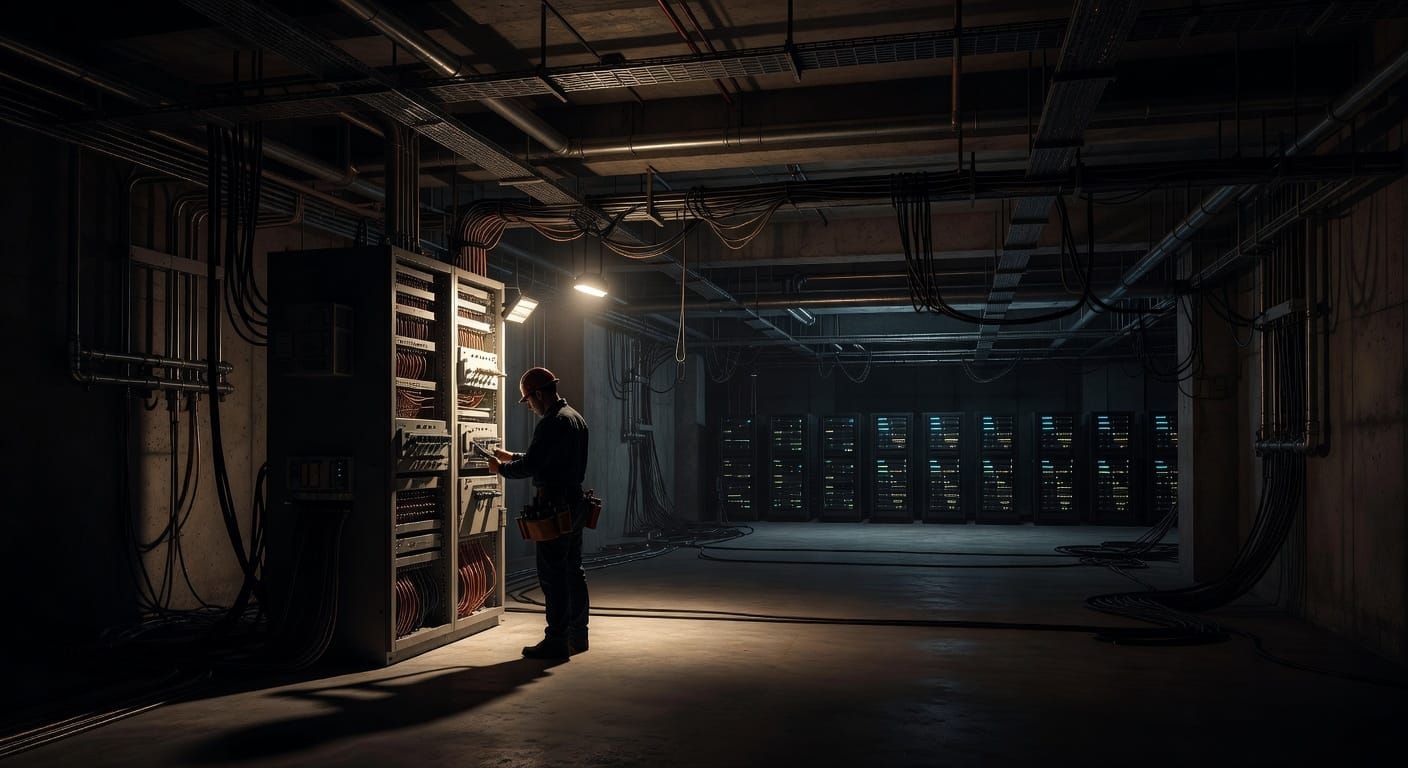
Last spring, Microsoft President Brad Smith was asked to name the single biggest obstacle to building out the data centers that power America's artificial-intelligence boom. Not chips. Not capital. Not even electricity itself. His answer: the shortage of electricians to wire the buildings.
He is not alone. Oracle has watched completion dates on data centers it is building for OpenAI slip from 2027 into 2028. Goldman Sachs now flags skilled-labor scarcity as a bottleneck that, in its words, "can't be vibe-coded away." Ford CEO Jim Farley calls it a "full-blown" crisis. The most advanced industry in the world has run headfirst into one of the oldest constraints there is: not enough people who know how to bend conduit and terminate a panel.
This is the unglamorous chokepoint hiding behind the trillion-dollar AI capital-expenditure story. And for investors, it is one of the few places where the supply-demand imbalance is so structural, so demographically locked-in, that it is hard to see how it resolves in under a decade.
The scale of the gap
Start with the headline numbers. The U.S. construction industry needs an estimated 530,000 additional workers in 2026 alone, on top of normal hiring, according to industry trade groups. Roughly 7.6 million trade jobs sit unfilled across the economy. By 2030, consultancy JLL projects that as many as 2.1 million skilled-trades positions — electricians, plumbers, pipefitters, HVAC technicians, equipment operators — could go unfilled. The U.S. Department of Education has put the potential annual economic loss at around $1 trillion.
Electricians are the sharp end of the spear. The data-center build-out alone is estimated to require more than 300,000 new electricians, and the trade is bleeding talent from the top: about 20,000 electricians retire each year — roughly 200,000 over the coming decade — and nearly 30% of unionized electricians are between 50 and 70 years old. As of 2023, 39% of electricians were already 45 or older.
The pipeline isn't keeping pace. Last year, close to 600,000 jobs were posted across the major skilled trades, while only about 150,000 new workers entered through apprenticeship programs. The retirement-to-replacement ratio in the trades is running near 5-to-2. You don't need a model to see where that leads.
Why electricians, specifically, throttle AI
Data centers are not normal buildings; they are essentially enormous electrical machines wrapped in concrete. Electrical work accounts for an estimated 45% to 70% of total data-center construction cost, according to the IBEW. Switchgear, transformers, distribution, the high-density power runs feeding GPU racks that now draw more electricity per square foot than almost any structure ever built — all of it is electrician-intensive, and almost none of it can be automated or shipped in from overseas.
The result is visible in the project pipeline. Workforce shortages have become the leading cause of data-center construction delays, with surveys showing roughly 45% of contractors hit by at least one staffing-driven delay in the past year. Backlogs for specialized electrical contractors now stretch 8.5 to 12 months. Of the roughly 12 GW of U.S. data-center capacity announced for 2026, nearly half — about 7 GW — has been delayed or canceled, with labor and power infrastructure the binding constraints.
How America talked itself into this
The shortage isn't an accident; it's the predictable result of two decades of policy and culture. A generation was funneled toward four-year degrees and away from the trades, which were quietly recoded as a consolation prize. Vocational programs were gutted in high schools. Apprenticeship slots never scaled to replace a retiring boomer cohort that had entered the trades en masse in the 1970s and 80s.
The irony is that the math has now inverted. Electricians earn a median around $62,000, with top earners well past $106,000 and specialists in hot markets clearing six figures comfortably — often $10,000 to $20,000 more than the average four-year graduate, and without the student debt. Electrician employment is projected to grow 9.5% through 2034, more than triple the average for all occupations. The trades are no longer the fallback. The market is screaming for bodies, and the bodies aren't there.
This is where the analysis gets actionable. AlphaBriefing members get the full investment framework — scenarios, positioning, and the bottom line.
Subscribe to AlphaBriefing — Free, Member, and Paid tiers available.