Your Electric Bill Is About to Spike. The Reason Is AI.
Power bills are climbing across the eastern United States — and the surge is being driven by AI data center demand the grid was never designed to absorb.

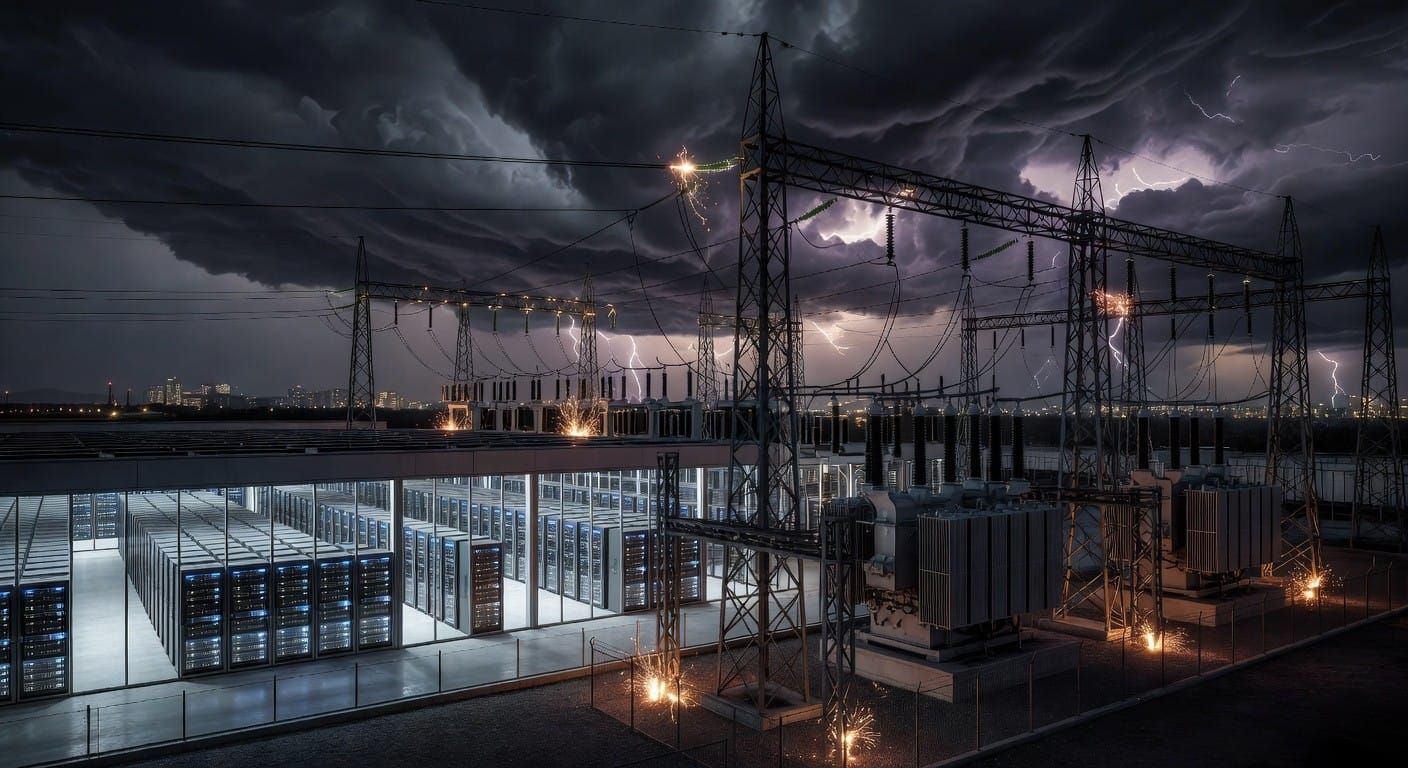
The cost of keeping the lights on in America just hit a wall — and the people paying for it are not the ones building the trillion-dollar AI economy. They are the ones living next door to it.
This summer, electricity grids across the eastern United States will operate with the thinnest reserve margins in nearly two decades. The North American Electric Reliability Corporation (NERC) is preparing to issue a Level 3 alert — its second-highest — over the bizarre new phenomenon of gigawatt-scale AI data centers suddenly disconnecting from the grid, dropping a thousand megawatts of load at a time and forcing emergency rebalancing. PJM Interconnection, the regional grid that serves 65 million people from Chicago to Washington, just cleared its capacity auction at the legal price cap for the second year in a row.
The bills tied to all of this are about to land on doormats from Newark to Norfolk. And they are going to hurt.
The Numbers Behind the Squeeze
Three years ago, PJM auctioned reserve power for $28.92 per megawatt-day. Last summer, the price hit $269. The 2026/27 auction cleared at $329.17 — the FERC-approved ceiling. That is an 11-fold increase in two years.
PJM itself estimates the pass-through will add between $11 and $18 to the average residential bill every month, depending on the state. In western Maryland and parts of Ohio, the cost will sit closer to $20. Multiply that across 65 million customers and the bill for ratepayers in PJM alone runs to roughly $9.3 billion — money that did not exist as a line item three years ago.
The Union of Concerned Scientists, scrubbing through the auction data, has flagged that data centers were responsible for 63 percent of the 2025–26 auction price jump. In other words: when you open your June electric bill and find an extra forty dollars on it, you are subsidizing the training run for somebody's next foundation model.
Why It Broke
The story most people have heard is that AI uses a lot of power. That is true but incomplete. The deeper problem is where and how fast the demand is arriving.
Roughly 70 percent of the world's internet traffic still routes through a 30-mile corridor in Northern Virginia known as "Data Center Alley." The cluster grew there for prosaic reasons — proximity to government contracts, cheap land, and the historic accident of MAE-East. But in the AI era, that same patch of Loudoun County has become the single most concentrated load on any electricity grid in the developed world. Dominion Energy, Virginia's utility, projects its peak demand will roughly double by 2039. The bulk of that growth is data centers.
Building a hyperscale data center takes 18 to 24 months. Building the transmission lines and substations to feed one takes seven to ten years. The math does not work, and grid operators have been saying so since 2023. NERC's latest long-term reliability assessment forecasts a 24 percent jump in peak demand over the next decade — the steepest sustained increase since World War II — with data centers as the primary driver. Eighteen gigawatts of additional data center load is queued through 2035. That is equivalent to adding the entire generating capacity of Texas's wind fleet, in racks, in a handful of counties.
ERCOT, the Texas grid, faces the same crunch in a different flavor. Its long-term planners pencil in 112 gigawatts of summer peak by 2030. Its near-term operators just walked that down to 90–98 gigawatts because the interconnection queue is not moving fast enough. The cliff is not whether the load is coming. It is whether the wires and turbines arrive on schedule.
The Disconnection Problem
Then there is the strange new behavior NERC is now scrambling to model. Modern AI training clusters, by design, can throttle down to near zero in milliseconds — typically because a training job ended, a fault tripped, or the cluster's operator decided to chase cheaper power somewhere else. The grid was built for loads that grow and shrink gracefully. It is not built for a 1,200-megawatt customer that vanishes between one tick and the next.
This happened repeatedly in 2024 and 2025. In one Texas event, more than 1,500 megawatts of computational load dropped off in seconds, sending frequency wobbling and forcing peaker plants to scramble. Across PJM, similar events have shown up dozens of times in the past 18 months. The pending NERC Level 3 alert — the first one in years tied specifically to a customer-class behavior — is an attempt to write new operating rules before one of these disconnections triggers a cascading outage on a 100-degree afternoon.
For the grid operator, the headache is not the average load. It is the variance.
Who Pays, Who Doesn't
Until now, the cost of building out the grid to serve hyperscalers has been socialized across the rate base. A Virginia retiree on a fixed income has been paying, through her monthly bill, for the substation upgrades that make it possible for Amazon to train Anthropic's next model. The Union of Concerned Scientists puts that quiet subsidy at billions of dollars annually.
Politically, that arrangement is now collapsing. In November 2025, Virginia's State Corporation Commission approved a new rate class that will, starting in January 2027, force large-scale data center customers to pay for at least 85 percent of contracted transmission and distribution demand and 60 percent of generation demand — whether they use it or not. Take-or-pay, in other words. The Virginia model is being studied in Ohio, Maryland, Texas, Georgia, and Arizona. Expect copycats.
The implications go beyond fairness. If hyperscalers have to write firm checks for every megawatt they reserve, their build cycle slows, their cap-ex math changes, and the economics of training frontier models start to look less elastic than the AI capital markets have priced in. That is a meaningful shift for anyone holding the AI infrastructure trade at current multiples.
What It Means for Money
A few things follow from the math.
Regulated utilities are quietly the cleanest way to play AI. Dominion Energy, AEP, Duke, Exelon, Southern Company, and Constellation Energy are sitting on the only physical assets that AI cannot substitute around. They earn a regulated return on every dollar of new transmission and generation they build, and the build queue stretches out a decade. This is not a glamorous trade — utilities have famously underperformed the S&P during the last bull run — but the setup has rarely been better.
Natural gas just became a strategic asset again. Whatever the long-term decarbonization vision, the only generation type that can be built on the timeline AI demands is gas peaking. Permits are faster, supply chains are intact, and turbine makers — GE Vernova, Siemens Energy, Mitsubishi — have order books extending to 2028. Lead times for new turbines have stretched from 18 months to over four years. The supply squeeze is real.
Nuclear has gone from controversial to consensus. Every hyperscaler now has a nuclear deal — Microsoft with Three Mile Island, Amazon with Talen, Google with Kairos, Meta with Constellation. Existing operating reactors are repricing as long-duration, baseload AI infrastructure. Small modular reactors remain a 2030+ story, but the option value has appeared on balance sheets that previously refused to consider it.
Transmission equipment is the bottleneck. Hitachi Energy, Siemens Energy, Eaton, and GE Vernova on the transmission side are all running multi-year backlogs on transformers, switchgear, and HVDC components. Manufacturing capacity for grid-scale transformers in particular cannot be ramped without years of lead time. This is the picks-and-shovels trade behind the picks-and-shovels trade.
Ratepayer politics is now a real variable. State public utility commissions in Virginia, Texas, Ohio, and Georgia are facing political pressure to shield residential customers from data center costs. The direction of travel — toward dedicated data center tariffs and take-or-pay contracts — slightly bends the AI infrastructure economics. It is not catastrophic, but it is real, and it is largely unmodeled in current sell-side coverage.
The Larger Point
The story of AI in 2026 is no longer the story of model capability or chip availability. It is the story of substations, transformers, gas turbines, and zoning boards. The constraint has shifted from silicon to steel and copper. The companies that win the next phase will not be the ones that train the smartest model. They will be the ones that can plug it in.
Meanwhile, the American consumer is paying the down payment. Quietly, monthly, through a line item buried in the second page of the electric bill that almost nobody reads.
That subsidy is about to become visible. And visible subsidies, in election years, do not last.
Get this level of intelligence every day. Subscribe to AlphaBriefing — free, member, and paid tiers available.
Sources & Further Reading
- NERC — 2026 Summer Reliability Assessment Snapshot
- NERC — Resource Adequacy Risks Intensify Across North America
- Utility Dive — NERC 10-year peak demand forecast jumps 24% on new data center loads
- Utility Dive — Sudden data center load losses prompt NERC alert
- IEEFA — Projected data center growth spurs PJM capacity prices by factor of 10
- Union of Concerned Scientists — Billions of Dollars in Unreported Data Center Costs Passed onto PJM Customers
- Inside Climate News — Virginia Regulators Approve New Dominion Rates, Assign More Costs to Data Centers
- Data Center Knowledge — Gridlock or Growth? ERCOT Warns Texas AI Power Boom May Not Materialize
Disclaimer
AlphaBriefing is an independent intelligence publication. The content in this article is produced for informational and educational purposes only. Nothing published by AlphaBriefing constitutes financial, investment, legal, tax, or regulatory advice, nor should it be construed as a solicitation or recommendation to buy, sell, or hold any security, asset, or financial instrument.
All views expressed are those of the author at the time of writing and are subject to change without notice. Markets are volatile and unpredictable; past performance is not indicative of future results. Any investment involves risk, including the possible loss of principal.
AlphaBriefing and its principals, employees, or contributors may hold positions in securities or assets mentioned in this article. This should be considered a potential conflict of interest. No material relationship with any company referenced exists unless explicitly disclosed. Readers should conduct their own due diligence and consult qualified financial, legal, and tax advisors before making any investment decisions.
Information in this article is drawn from public sources believed to be reliable at the time of publication. AlphaBriefing makes no warranty, express or implied, as to the accuracy, completeness, or timeliness of any information herein. AlphaBriefing accepts no liability for any loss or damage arising from reliance on this content.
© AlphaBriefing. All rights reserved. Unauthorised reproduction or distribution is prohibited.