Xi Is Going to Pyongyang. He's Trying to Win Kim Back from Putin.
Xi Jinping's first overseas trip of 2026 isn't about strengthening the China-Russia-North Korea axis. It's about Beijing trying to pull Pyongyang back from Moscow — and Korean markets should be paying attention.

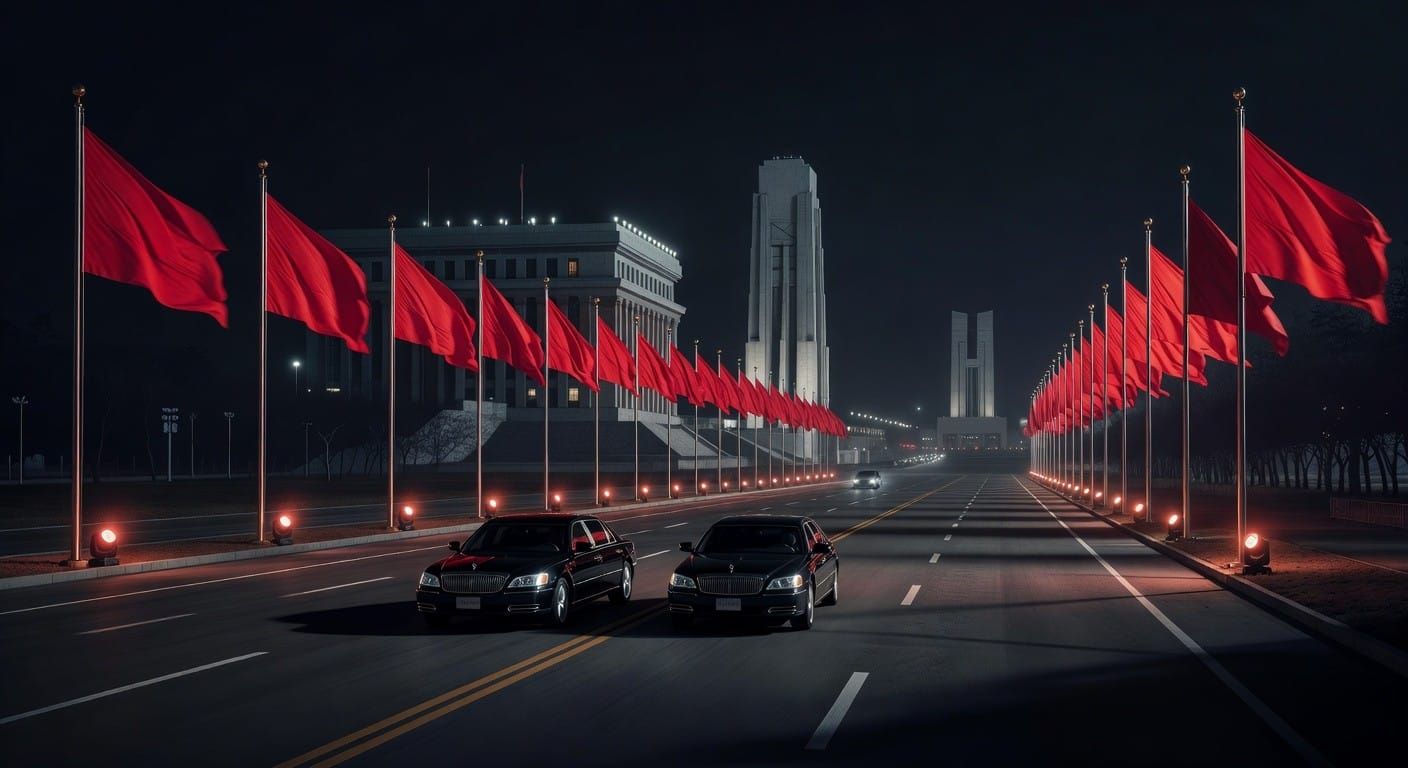
On June 8, Xi Jinping will land in Pyongyang for his first state visit to North Korea in nearly seven years. The optics will be heavy: red carpets, mass rallies, embraces. Western coverage will reach for the obvious frame — the China-Russia-North Korea "axis" is tightening, the autocrats are uniting, the West is losing.
That frame is wrong. Xi is not going to Pyongyang because the axis is tightening. He is going because it is fracturing — and the fracture is opening on his side.
Since Vladimir Putin's June 2024 mutual-defense treaty with Kim Jong Un, North Korea has effectively pivoted. It has supplied Russia with millions of artillery shells, more than a hundred ballistic missiles, and as many as 15,000 troops sent into combat in Kursk. In return, Moscow has shipped air defense systems, electronic-warfare gear, and, by most credible accounts, sensitive missile and satellite technology — the kind of transfers Beijing spent decades quietly refusing to make.
For the first time since the 1961 Sino-DPRK Treaty of Friendship, Beijing is no longer Pyongyang's most important patron. It is its second-most important. Xi is flying east to fix that.
The 65-year anniversary nobody is celebrating
This visit is officially timed to the 65th anniversary of the China-North Korea mutual defense treaty signed in 1961 — the only formal military alliance China has with any country in the world. That treaty is the architecture of Chinese influence on the peninsula. It is also, increasingly, a piece of paper.
For decades, the deal was simple. China gave Kim — first Il-sung, then Jong-il, then Jong-un — economic lifeline status. Roughly 90% of North Korean trade still flows through China. Pyongyang gave Beijing a strategic buffer against U.S. forces in South Korea and a useful proxy for complicating American power projection in Northeast Asia.
The Putin-Kim treaty broke that monopoly. Russia now offers Pyongyang what China would not: hard currency for shells, frontline combat experience for its troops, and the kind of weapons technology that meaningfully shifts the regional balance. The price is alignment with Moscow's strategic agenda — which is increasingly diverging from Beijing's.
Xi reads this clearly. So does Kim. The visit is, beneath the choreography, a negotiation.
What Xi wants
Three things.
First, intelligence on the technology pipeline. Russian missile, drone, and satellite tech reaching North Korea is a direct security problem for China. If Pyongyang acquires reliable submarine-launched ballistic missile capability, or genuine reentry vehicle technology, the U.S. response — more THAAD, more carrier rotations, possibly nuclear-armed South Korea or Japan — falls primarily on China's doorstep. Beijing wants to know exactly what is moving.
Second, a brake on Korean troop deployments. Kim has reportedly committed up to 30,000 additional troops to Russia through 2027. Every Korean soldier who comes home from Kursk having fought a NATO-equipped enemy is a soldier Beijing did not train, did not control, and cannot fully predict. China prefers a North Korean military that is dependent on it, not battle-hardened by Moscow.
Third, a seat at the table when Trump talks to Kim. The Trump administration has been signaling for months that a Kim summit is back on the agenda, possibly as early as November. China does not want to be the third party listening through the door. Xi's visit is, in part, a reminder to both Washington and Pyongyang that any deal on the peninsula goes through Beijing or it does not get implemented.
What Kim wants
Kim's leverage is now genuinely unprecedented. For the first time since 1991, he has two great-power patrons competing for his attention, and he can play them against each other.
Expect his asking price to be steep. Quiet relief on sanctions enforcement at the Sino-Korean border. Expanded crude oil shipments above the official UN cap (which Beijing has been winking at for years but could formalize). Re-opening of large-scale labor exports. Access to Chinese semiconductor and component flows that Pyongyang has struggled to obtain through Russian intermediaries.
He may also push for Chinese acknowledgment, even informal, of North Korea's nuclear status. Beijing will resist that publicly. Privately, the conversation has probably already moved past denuclearization as a credible objective.
Why investors should care
This is not abstract. Three things move on a visit like this.
Korean defense names re-rate higher. The structural arms-export boom in South Korean defense — Hanwha Aerospace, Korea Aerospace Industries, LIG Nex1 — has been driven by European rearmament and Middle East orders. A visible deepening of China-North Korea coordination accelerates the domestic procurement story too. Seoul's own defense budget trajectory is the real catalyst, and any signal from the summit that Beijing is committed to Pyongyang's security raises that trajectory.
Korean equity risk premium widens. The KOSPI dropped almost 5% on June 5, the day of the visit announcement. The narrative pinned it on the global semiconductor selloff, and most of it was. But the won also weakened to its lowest level against the dollar since 2009. Currency markets are not pricing semis — they are pricing geopolitical risk. The KOSPI has run from 4,000 to nearly 9,000 in twelve months on AI and export strength. It is priced for calm. Any concrete deliverable from the summit that shifts the security picture — a defense commitment language upgrade, a missile-tech reference, a joint statement on U.S. forces — and that calm gets repriced.
Chinese defense and SOE-linked logistics names catch a bid. A reaffirmed treaty alliance means renewed cross-border infrastructure spending — rail, energy, ports — and renewed quiet flows of dual-use goods through northeastern Chinese provinces. The trade is not headline-driven; it is structural. Watch the Liaoning-Jilin corridor names and the state-owned heavy industrials that have been listless for two years.
The Iran read-across. The most underpriced element of this visit is what it tells us about the wider authoritarian alignment. If Beijing is willing to spend Xi's first overseas trip of 2026 personally walking back Russian influence in Pyongyang, it tells you something about how Beijing actually views the "axis." It is transactional, not ideological. It is fragile, not coordinated. The Iran-Hormuz crisis has been priced partly on the assumption that China, Russia, and Iran are moving in lockstep. They are not. They are competing for influence over each other's clients. That is a different — and more tradable — story than the one most macro funds are running.
The bottom line
Xi Jinping does not waste his first overseas trip of the year. He does not visit Pyongyang because the alliance is healthy. He visits because it is slipping, and because the cost of letting it slip — a nuclear-armed neighbor increasingly aligned with a Russia that no longer needs Chinese mediation — is a strategic loss Beijing cannot accept.
The June 8-9 meeting will produce smiling photographs and a vague joint statement. The real outcomes will not be in the communiqué. They will be in the shipping data out of Dandong in July, the missile-test calendar in August, and the body language when Donald Trump and Kim Jong Un eventually share a stage.
For now, the trade is simple. Korean defense holds up. Korean equities get a risk-premium widening. And the lazy "axis of autocrats" narrative — the one that has dominated Western coverage since 2022 — gets quietly retired by the people who are supposed to be in it.
Get this level of intelligence every day. Subscribe to AlphaBriefing — free, member, and paid tiers available.
Sources & Further Reading
- Reuters — China's Xi to visit North Korea, Beijing seeks cosier ties with Pyongyang
- Yonhap News — Xi Jinping to make state visit to North Korea June 8-9
- FPRI — Russia, China, North Korea Relations: Obstacles to a Trilateral Axis
- Arms Control Association — North Korea, Russia Strengthen Military Ties
- Lowy Institute — Why Xi Jinping is going to Pyongyang
- Congressional Research Service — Russia-North Korea Military Cooperation
- East Asia Forum — China's silence over Russia-North Korea ties
- Atlantic Council — China, India and North Korea back Russia as global order shifts
Disclaimer
AlphaBriefing is an independent intelligence publication. The content in this article is produced for informational and educational purposes only. Nothing published by AlphaBriefing constitutes financial, investment, legal, tax, or regulatory advice, nor should it be construed as a solicitation or recommendation to buy, sell, or hold any security, asset, or financial instrument.
All views expressed are those of the author at the time of writing and are subject to change without notice. Markets are volatile and unpredictable; past performance is not indicative of future results. Any investment involves risk, including the possible loss of principal.
AlphaBriefing and its principals, employees, or contributors may hold positions in securities or assets mentioned in this article. This should be considered a potential conflict of interest. No material relationship with any company referenced exists unless explicitly disclosed. Readers should conduct their own due diligence and consult qualified financial, legal, and tax advisors before making any investment decisions.
Information in this article is drawn from public sources believed to be reliable at the time of publication. AlphaBriefing makes no warranty, express or implied, as to the accuracy, completeness, or timeliness of any information herein. AlphaBriefing accepts no liability for any loss or damage arising from reliance on this content.
© AlphaBriefing. All rights reserved. Unauthorised reproduction or distribution is prohibited.