Why the Pentagon Is Quietly Abandoning Its Defense Primes
Anduril just signed its biggest Pentagon contract yet. Boeing missed another KC-46 deadline. The $80 billion defense reshuffle isn't coming — it's already here.

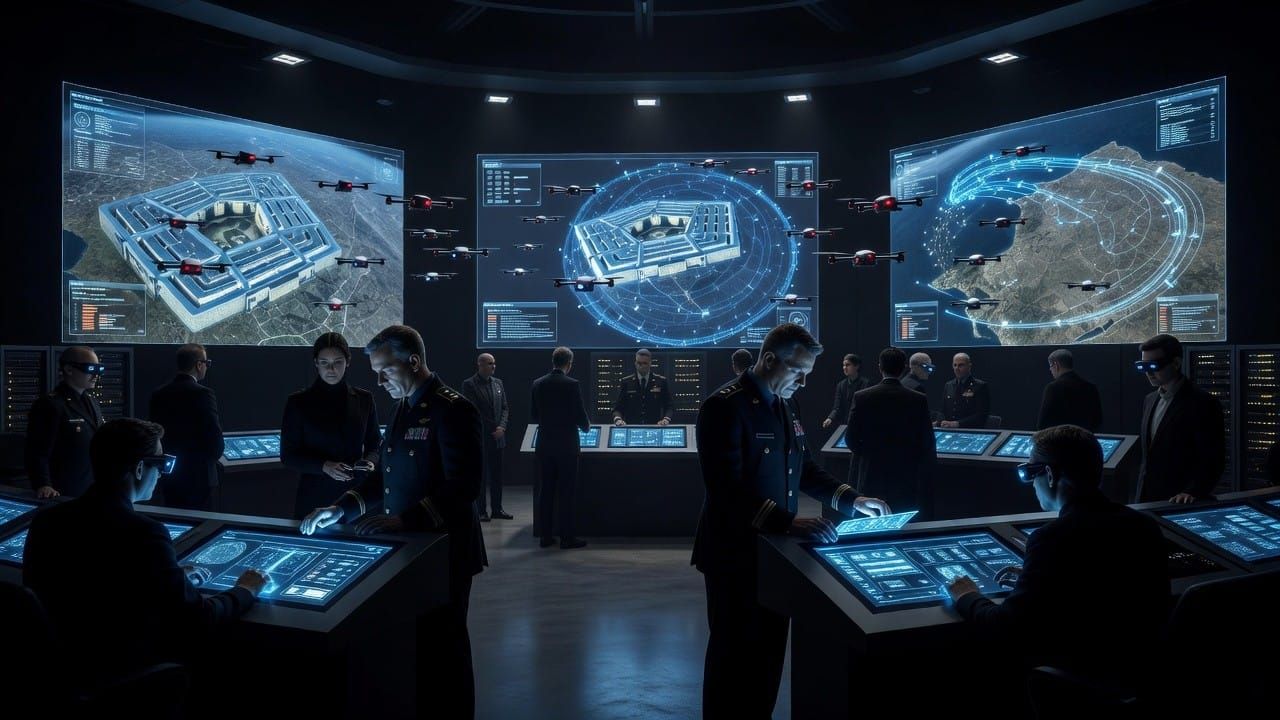
For seventy years, the Pentagon bought weapons from five companies. Lockheed Martin, RTX, Boeing, General Dynamics, Northrop Grumman. The "big five" primes built America's nuclear deterrent, its aircraft carriers, its stealth fighters, its missile defense shield. Together they collect roughly $200 billion in Pentagon contracts every year.
That model is ending.
In the last twelve months, the Department of Defense has shifted billions in contract dollars to a new tier of suppliers — software-first companies founded in the last decade, backed by venture capital, and led by founders who think more like Elon Musk than Robert McNamara. Anduril. Palantir. Shield AI. Skydio. Saronic Technologies. Hadrian. None of them existed in their current form when Joe Biden took office. By the end of 2027, several will be the Pentagon's largest single suppliers in their categories.
This isn't a story about scrappy startups taking on the establishment. It's a story about the establishment running out of road.
Why the Primes Are Failing
The legacy primes are not delivering, and the data is no longer ambiguous.
Boeing's KC-46 tanker is years late and has cost the company over $7 billion in losses. The Sentinel ICBM program — Northrop's flagship nuclear modernization effort — was breached under Nunn-McCurdy in 2024 with cost overruns approaching 81 percent. Lockheed's F-35 program continues to suffer the highest sustainment costs in Air Force history, with mission-capable rates hovering below 55 percent. The Virginia-class submarine line at General Dynamics is more than two years behind schedule. The Constellation-class frigate is paused.
The pattern is structural, not anecdotal. Legacy primes were built for a Cold War procurement system that prized requirement maturity, mechanical integration of huge platforms, and decades-long production cycles. They are exquisite engineering organizations optimized for $5 billion exquisite platforms. They are not optimized for software, autonomy, or attritable mass.
Ukraine made the mismatch impossible to ignore. That war is being fought by $400 drones, machine-learning targeting, software-defined radios, and electronic warfare suites that update every week. The primes cannot build at that tempo. Anduril and its peers can.
The New Stack
Walk through the Pentagon's 2026 procurement priorities and the names cycle quickly.
Replicator — Deputy Secretary Hicks's flagship effort to field thousands of low-cost autonomous systems — funneled contracts to Anduril (Roadrunner, Bolt-M, Lattice OS), AeroVironment (Switchblade), Saildrone, Saronic, and Performance Drone Works. Replicator 2.0 was announced in late 2024 with an additional $500 million focused on counter-drone systems.
CCA (Collaborative Combat Aircraft) — the Air Force's autonomous fighter program — picked Anduril (Fury) and General Atomics (XQ-67A Gambit) in April 2024, beating Lockheed and Boeing. Increment 2 contract decisions are expected by Q3 2026, with at least one new entrant likely.
Marine Corps Force Design 2030 has reorganized around long-range autonomous reconnaissance — Skydio drones, Anduril Altius loitering munitions, Shield AI's V-BAT. Procurement quantities have grown 4x year-over-year.
Project Linchpin — the Army's AI/ML operations platform — runs on Palantir's Foundry. Palantir is now the Army's de facto data layer for combat operations. Its TITAN ground station contract converted into a $618 million production award in March 2024.
The numbers tell the story. In FY2021, Pentagon contracts to the top five defense tech startups (Anduril, Palantir, Shield AI, Saronic, Hadrian) totaled under $400 million. In FY2025, that number is on track to exceed $4.2 billion. A 10x in four years. And the acceleration steepens from here.
This is where the analysis gets actionable. AlphaBriefing members get the full investment framework — scenarios, positioning, and the bottom line.
Subscribe to AlphaBriefing — Free, Member, and Paid tiers available.