Why the Chip Boom Has a Helium Problem
America just sold off the only strategic helium reserve it had — right as three major suppliers faltered. For a non-substitutable input to chips, MRIs, and rockets, that means structurally higher prices. Here's who controls the molecules now, and how to trade the squeeze.

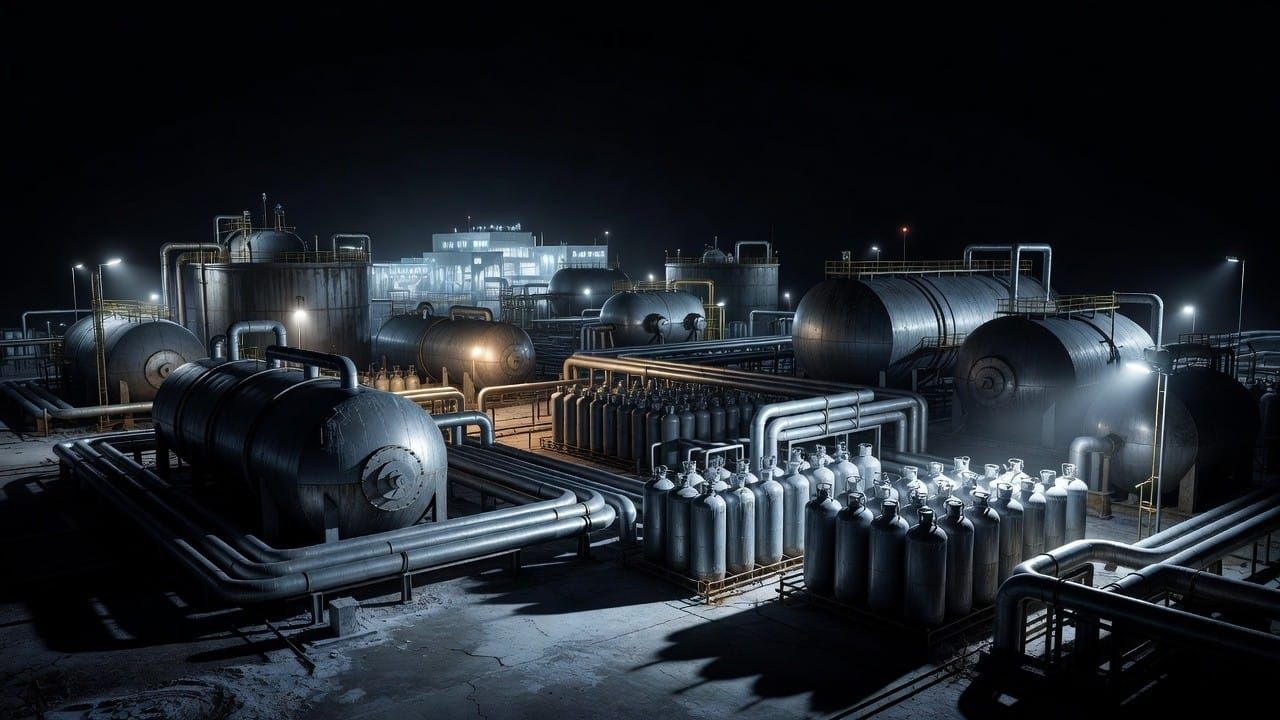
Helium is the second-most abundant element in the universe and one of the scarcest on Earth. It cannot be manufactured. It cannot be meaningfully recycled at scale. And once it escapes into the atmosphere, it is gone for good — light enough to drift past Earth's gravity and bleed into space.
For most people, helium means birthday balloons. For the global economy, it means something far more important: it is a non-substitutable input for the machines that define modern technology. Every advanced semiconductor fab, every MRI scanner, every rocket launch, and every mile of fiber-optic cable depends on it. There is no Plan B element waiting in the wings.
And in 2026, the world is short of it — at exactly the moment the United States walked away from the only strategic buffer that ever existed.
The buffer is gone
For nearly a century, Washington ran the world's helium shock absorber. The Federal Helium Reserve, carved into the Bush Dome formation beneath Amarillo, Texas, was established in 1925 to supply military airships. It outlived that mission by decades and quietly became the stabilizing force in a market most investors never think about.
In June 2024, the Bureau of Land Management completed the sale of the entire system — the Cliffside field, its wells, a 423-mile crude-helium pipeline, and the remaining gas in the ground — to Messer, the privately held German industrial-gas group, for roughly $460 million. For the first time since 1925, the United States no longer holds a strategic helium reserve.
That single transaction pulled a supply source representing roughly a quarter of US production and about 10% of global supply out of government-managed distribution and handed it to a private operator with no public mandate to stabilize prices. The shock absorber didn't break. It was sold.
Three failures at once
A privatized reserve would matter less if the rest of the supply chain were healthy. It isn't. Three of the world's largest helium sources are impaired simultaneously:
- Russia's Amur plant, designed to become one of the world's biggest helium producers, has been crippled by repeated fires and explosions and runs well below nameplate capacity. Western sanctions complicate any recovery.
- Qatar's Ras Laffan complex, the single largest seaborne helium source, sends its molecules out through the Strait of Hormuz — the same chokepoint that the Twelve-Day War just reminded the world is one missile salvo from closure. Maintenance shutdowns alone have driven price spikes north of 50%.
- The US system, even post-sale, faces the natural depletion of legacy fields and the slow ramp of new ones.
The result: spot helium prices have surged somewhere between 40% and 100% depending on grade and region, and large industrial buyers are once again rationing. This is the fourth major helium shortage in two decades — but the first one to arrive with no government backstop anywhere in the system.
Why there is no substitute
Helium's strategic value comes from a set of physical properties no other element shares. It has the lowest boiling point of any substance (-269°C), it is chemically inert, and its atoms are small enough to find leaks nothing else can. That makes it irreplaceable across the high-technology economy:
- Semiconductors: Helium cools the EUV lithography tools that print the most advanced chips, carries thin-film deposition gases, cools wafers during ion implantation, and detects microscopic vacuum leaks. Unlike photoresist or ultrapure water, it cannot be swapped out.
- Healthcare: Every superconducting MRI magnet is bathed in liquid helium. No helium, no scan.
- Space and defense: Helium purges and pressurizes rocket propellant systems. SpaceX and every other launch provider burn through it on each flight.
- Fiber optics and electronics: It controls the atmosphere in which optical fiber and many components are manufactured.
You can recycle silicon. You can re-engineer a chemical. You cannot invent more helium. That is what makes this a different kind of supply story — and why the molecule, not the company, holds the leverage.
This is where the analysis gets actionable. AlphaBriefing members get the full investment framework — scenarios, positioning, and the bottom line.
Subscribe to AlphaBriefing — Free, Member, and Paid tiers available.