Why the Best Weather Forecast Is No Longer the Government's
NOAA is buying private satellite data and leaning on Google's AI to track hurricanes — in the same year Washington cut its budget. Weather intelligence is becoming a market, and a short list of companies sits at the chokepoints.

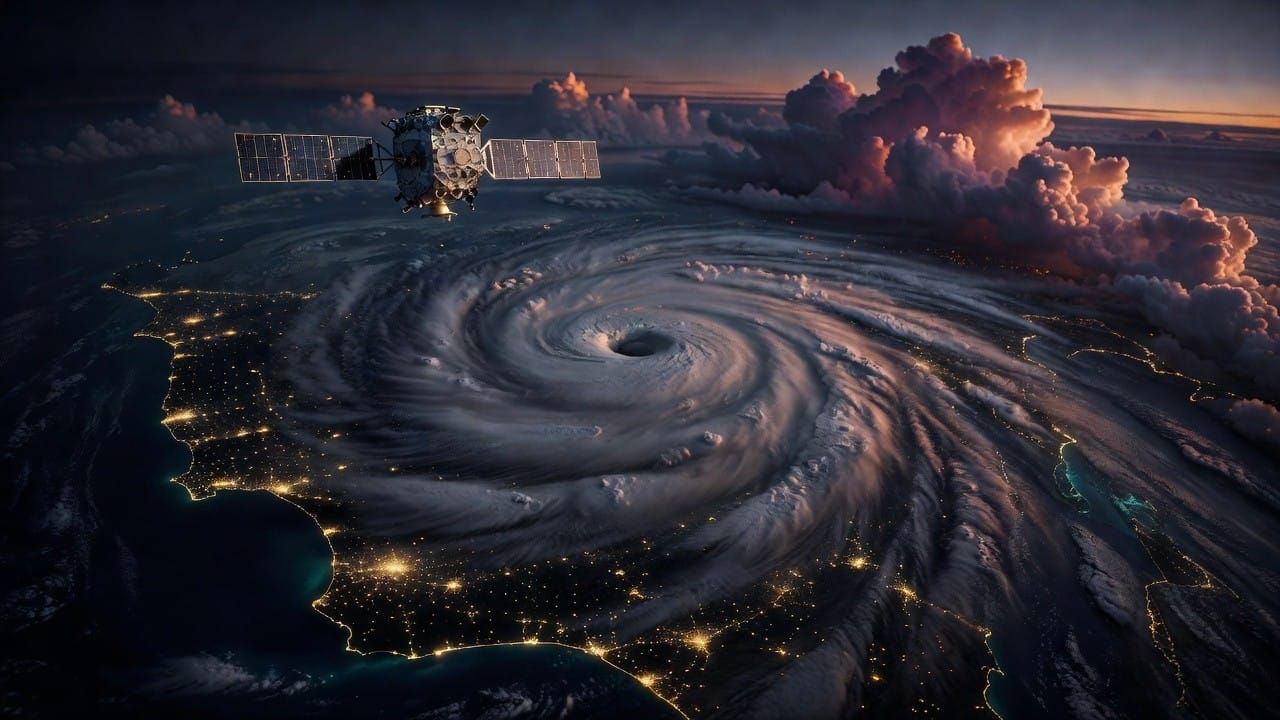
On July 1, a quiet contract took effect that says more about the future of American infrastructure than most defense deals ten times its size. NOAA began paying Tomorrow.io — a Boston-based private weather company — $7.3 million for passive microwave sounder data from its own satellite constellation, data the agency will feed into the models that produce every hurricane forecast you'll see this season.
Read that again. The federal agency that invented modern weather forecasting is now buying core observations from a startup — in the same fiscal year Congress cut its budget, after a round of staffing reductions that forced the National Weather Service to stop launching weather balloons at multiple stations across the country.
This is not a procurement footnote. It is the visible edge of a structural shift: the United States is quietly transitioning from a public weather-forecasting monopoly to a hybrid public-private system — in the middle of hurricane season, with record sums of weather-sensitive capital exposed. And as with every infrastructure transition this publication tracks, the interesting question is not whether it should happen. It's who gets paid as it does.
The Backbone Is Fraying
Start with what's breaking. In early 2025, NOAA lost hundreds of employees to layoffs, buyouts, and early retirements — one accounting puts National Weather Service departures alone at more than 600. By March 2025, the NWS began suspending or reducing twice-daily weather balloon launches at roughly a dozen sites: full suspensions in Omaha, Rapid City, and Kotzebue, Alaska; reductions to once daily in Aberdeen, Gaylord, Grand Junction, Green Bay, North Platte, and Riverton.
Radiosondes are not nostalgia. Those balloon-borne instrument packages provide the vertical profiles of temperature, humidity, and wind that numerical weather models are built on. Meteorologists reported working severe-weather outbreaks in the spring of 2025 with visible gaps in upper-air coverage over the middle of the country — precisely where tornado forecasting needs data most. NWS leadership maintains model performance hasn't suffered; a long list of independent meteorologists disputes that.
The budget fight made it structural. The administration's FY2026 request sought cuts to NOAA on the order of 25–30%, including the effective elimination of the Office of Oceanic and Atmospheric Research — the arm that develops the next generation of forecast models. Congress rejected the most severe version and enacted roughly $6.1 billion, a real-terms decline but not a demolition. The signal to the agency, though, was unambiguous: the era of assuming the public backbone gets rebuilt every cycle is over.
Here's why that matters to markets: NOAA itself has long estimated that roughly one-third of U.S. GDP is sensitive to weather and climate. Agriculture, energy, aviation, shipping, construction, insurance — the forecast is the invisible operating system under all of it. That operating system has been free, public, and continuously improving for seventy years. Two of those three properties are now in question.
Briefings like this land in members' inboxes before the market prices them in. Join free →
The Private Layer Is Outperforming
If the public system were degrading with no alternative, this would be a disaster story. What makes it an investment story is that the private alternative is arriving at exactly the same moment — and in places, it is already better.
The clearest evidence came out of the 2025 hurricane season. Google DeepMind's WeatherNext model was, in the words of National Hurricane Center forecasters, consistently among the best guidance available across basins — frequently beating the European model, the American GFS, and in many cases the NHC's own official track forecasts. When Hurricane Melissa spun up toward Jamaica last October, WeatherNext flagged the rapid intensification to Category 5 and the landfall zone earlier than most traditional physics-based models, and the NHC has publicly credited it as one of the best intensity tools it had. For the 2026 season now underway, the NHC is working with an expanded WeatherNext ensemble.
Microsoft's Aurora foundation model tells the same story from the research side: in published evaluations it beat seven major forecasting centers on global cyclone track forecasts — the first machine-learning model to outperform the NHC on five-day tropical cyclone tracks. These models run in minutes on GPUs instead of hours on government supercomputers, at a fraction of the cost.
The observation layer is privatizing in parallel. NOAA's Commercial Data Program — authorized by Congress in 2017, scaled up in earnest over the past three years — is now a real market. Spire Global holds an $11.1 million contract to deliver GPS radio-occultation soundings through September 2026, plus a $2.5 million pilot for satellite-derived ocean surface winds. Tomorrow.io's new $7.3 million microwave sounder award runs through March 2027 and will be evaluated specifically for tropical cyclone forecasting. WindBorne Systems, a Palo Alto startup flying long-duration smart balloons, has been selling upper-air data to fill the exact holes the NWS staffing cuts opened — including gaps in Alaska coverage.
Follow the logic to its destination. The government is becoming a customer of the observation layer it used to own, while Big Tech builds a model layer that outperforms the government's own. Neither trend reverses on any realistic budget path. The 2026 hurricane season — which NOAA projects as below-normal, 8–14 named storms, but which only takes one Tampa or Miami landfall to become historic — is the first full-scale live test of the hybrid system.
That leaves the question this entire transition turns on: when the best forecast in America is no longer the free one, who captures the spread between them? There is a surprisingly short list of companies positioned at the two chokepoints — and one of them is a small-cap trading at a fraction of the strategic value of its constellation.
The rest of this briefing is for paid members: the two chokepoints where forecast value concentrates, the debt-free pure-play with 40%+ core growth guidance and its risk profile, the private names to watch for IPO and M&A signals, the downstream industries already paying for private accuracy, and the three-scenario positioning framework for how the NOAA fight resolves.
AlphaBriefing Paid gets you every investment thesis, scenario framework, and catalyst brief we publish — the analysis private intel clients pay four figures for, at a fraction of that.