The Pentagon Now Buys Drones Like Bullets
The Pentagon has reclassified small drones as ammunition — and is deliberately crushing their price. That inverts the economics of the fastest-growing corner of defense. Here's where the margin survives, and who captures it.

On July 1, buried in the Department of War's daily contract announcements, the US Army handed AeroVironment a $500 million agreement for counter-drone systems. The stock jumped 11% that day, capping a run of roughly 35% in a week. Wall Street read it as a contract story.
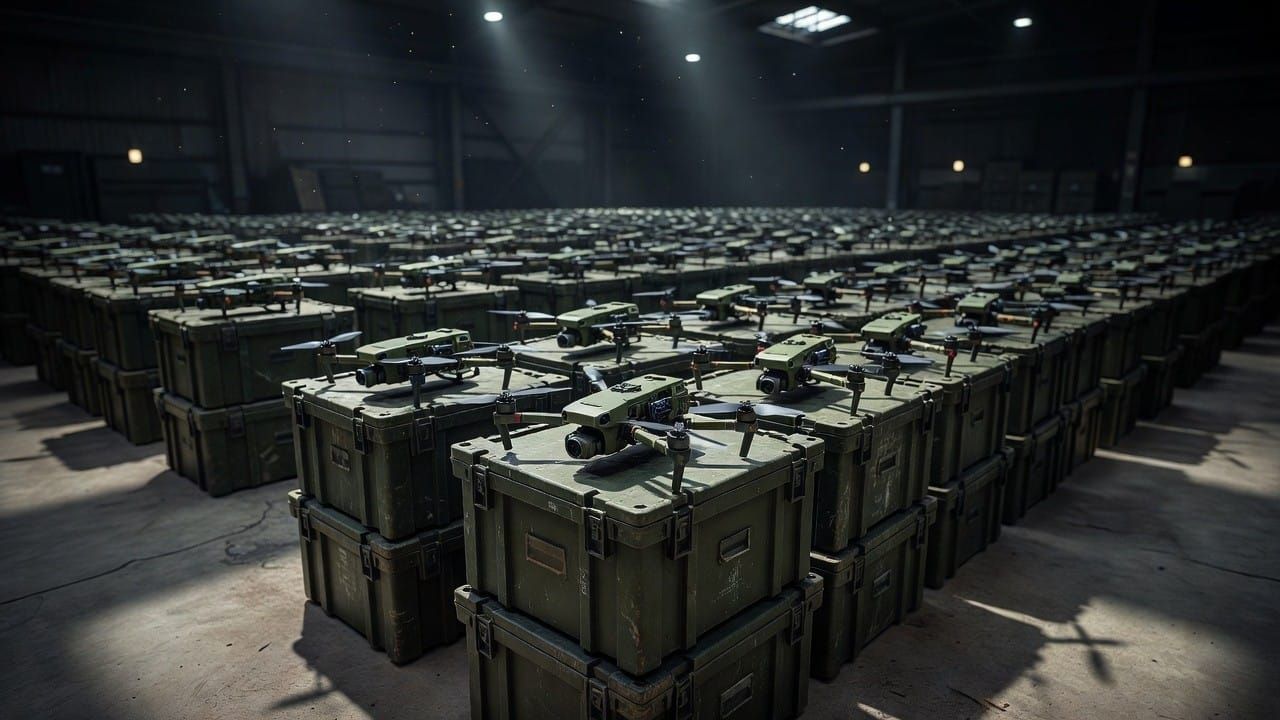
It's bigger than that. The award is the most visible receipt yet from the most consequential change in American defense procurement in a generation — one that has nothing to do with any single company, and everything to do with an accounting decision: the Pentagon no longer treats small drones as aircraft. It treats them as ammunition.
The memo that rewrote the category
The shift dates to July 10, 2025, when Secretary of War Pete Hegseth signed a memo titled "Unleashing U.S. Military Drone Dominance." Its most radical provision was also its most bureaucratic-sounding: small unmanned aerial systems — the Group 1 and 2 quadcopters and fixed-wing craft that now dominate battlefields — were reclassified as consumable commodities.
That single line dissolved decades of procurement architecture. An aircraft, in Pentagon accounting, is a durable asset: serialized, tracked, maintained, inspected, retired through formal channels. A consumable is a bullet. You issue it, you expend it, you reorder it. Under the new rules, small drones are issued like ammunition in unit basic loads, commanders at far lower levels can buy and field-modify them, and losing one in training or combat generates a resupply request instead of an investigation.
The doctrine followed the accounting. The goal, stated plainly by the department: every Army squad equipped with expendable drones by the end of fiscal year 2026 — this September.
What buying bullets looks like
The purchasing vehicle built on top of the memo is the Drone Dominance Program: roughly $1.1 billion across four phases, targeting 300,000 or more domestically produced, weaponizable small drones within about two years.
The numbers tell you exactly what kind of market this is:
- Phase 1 ("the Gauntlet," evaluated at Fort Benning starting in February 2026): about $150 million in prototype orders for ~30,000 drones — a target price near $5,000 per unit, split across roughly a dozen vendors.
- By June 2026, the department had ordered ~20,000 FPV-style drones from the top ten vendors, with deliveries already flowing to combat units.
- Later phases scale toward another ~150,000 units while pushing the target price down to $2,300–$3,000 — and cutting the number of vendors.
Read that sequence again. Volume goes up tenfold, unit price gets cut in half, and the supplier list gets shorter. For context, the broader fiscal 2026 request includes about $13.4 billion for autonomy and autonomous systems, roughly $9.4 billion of it for unmanned aerial vehicles.
This is the exact opposite of how every other defense market works. Fighter jets, ships, and missiles get more expensive every year, and their manufacturers are rewarded with decades of sustainment revenue. The Drone Dominance Program is a monopsony buyer deliberately engineering price deflation in its own supply base — because the customer's lesson from Ukraine is that the side that can expend drones like ammunition wins, and you can't expend $50,000 aircraft like ammunition.
Briefings like this land in members' inboxes before the market prices them in. Join free →
The trap in the obvious trade
Here is what the market is getting wrong. The reflexive trade — "the Pentagon is buying 300,000 drones, buy drone makers" — walks straight into the deflation engine. Do the arithmetic on Phase 1: $150 million divided among a dozen vendors is an average of $12.5 million each, for hardware the customer explicitly intends to buy cheaper next year, from fewer suppliers. That is not a defense franchise. That is a commodity contract with a single customer who publishes your future price cuts in advance.
When a product becomes ammunition, the ammunition itself is rarely where the money is. The durable economics migrate to the layers of the stack that don't commoditize — and the July 1 AeroVironment award is the first big signal of where those layers are.
The rest of this briefing is for paid members: the three layers of the drone stack where margin actually survives commoditization, the specific tickers positioned in each (and the numbers behind AeroVironment's 133% quarter), the cost-exchange asymmetry that makes counter-drone the compounding budget line, the July 8 catalyst date, and the names to avoid as the vendor list shrinks.
AlphaBriefing Paid gets you every investment thesis, scenario framework, and catalyst brief we publish — the analysis private intel clients pay four figures for, at a fraction of that.